Ever received good news from a Spanish-speaking friend and frozen for a second, unsure whether to say “felicidades” or “felicitaciones”? You’re not alone. Spanish offers several ways to say congratulations, and choosing the right one depends on context, region, and how formal the moment is. This guide walks you through the meaning, pronunciation, and real-world usage so you can respond naturally the next time someone shares exciting news.
Meaning and Translation
The most common way to say congratulations in Spanish is felicidades. It comes from the word felicidad, meaning “happiness,” so the phrase literally carries the sense of wishing someone joy. A close cousin, felicitaciones, comes from the verb felicitar, “to congratulate,” and is slightly more formal in tone. Both words translate directly to “congratulations” in English, and native speakers often use them interchangeably, though regional preferences do exist across Latin America and Spain.
Pronunciation
Spanish pronunciation is fairly consistent once you learn the vowel sounds, which makes this phrase easier to pick up than it might look. Here’s how to say congratulations in Spanish, broken into syllables:
- Felicidades: feh-lee-see-DAH-dess, with the stress on the second-to-last syllable
- Felicitaciones: feh-lee-see-tah-see-OH-ness, with the stress on the syllable “oh”
Every vowel in Spanish is pronounced clearly and consistently, unlike English, so “e” always sounds like “eh” and “i” always sounds like “ee.” Practicing the word slowly, syllable by syllable, before speeding up will help the rhythm feel natural.
Common Ways to Say It
While felicidades is the most universal choice, Spanish speakers have several other expressions depending on the situation:
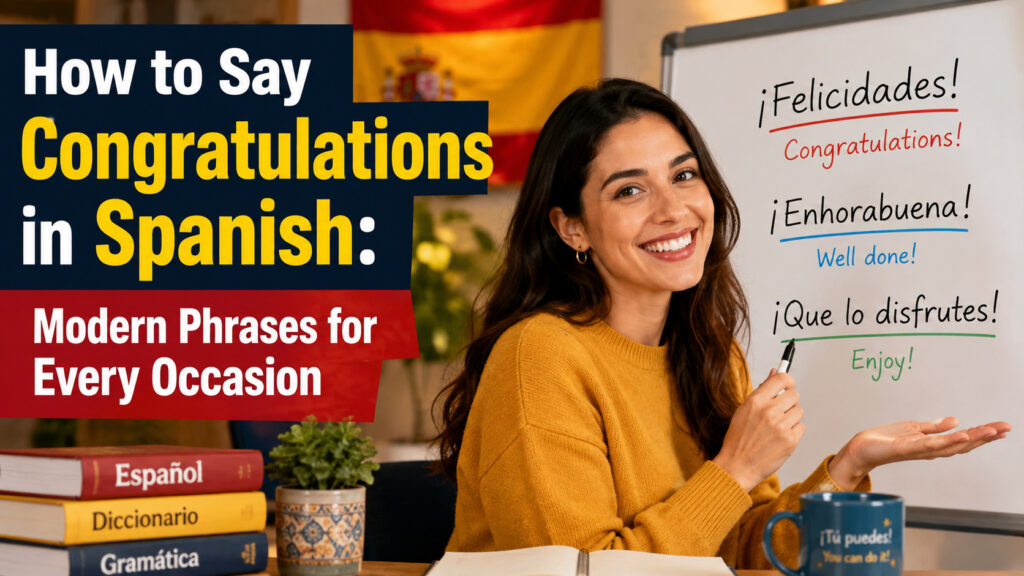
- Felicidades — the standard, all-purpose word for congratulations
- Felicitaciones — common in Latin America, slightly more formal or written
- Enhorabuena — widely used in Spain, especially for achievements or good news
- Bien hecho — meaning “well done,” used for accomplishments rather than events
- Qué bien — a more casual “how great,” often paired with felicidades in conversation
Knowing these alternatives helps you sound less like you’re reciting a textbook and more like a natural speaker.
Formal and Informal Usage
Felicidades works comfortably in almost any setting, from a quick text message to a formal card, which makes it a safe default for most learners. It’s appropriate for birthdays, graduations, weddings, and general good news alike.
Felicitaciones tends to appear more often in professional or written contexts, such as a formal email congratulating a colleague on a promotion. Enhorabuena, meanwhile, is common in Spain across both casual and formal settings, but rarely used in Latin America, where it can sound slightly old-fashioned or overly formal depending on the country. Casual expressions like qué bien or bien hecho are better suited to close friends and everyday conversation rather than formal correspondence.
Related Phrases
A few useful phrases build naturally on the core word:
- Felicidades por tu graduación — congratulations on your graduation
- Felicitaciones por el nuevo trabajo — congratulations on the new job
- Muchas felicidades — many congratulations, used to add emphasis
- Enhorabuena por el bebé — congratulations on the baby
- Te felicito — I congratulate you, a more personal, direct phrase
Learning these combinations helps you apply the word to specific life events rather than using it in isolation.
Real-Life Examples with English Translations
Here are a few natural sentences using these expressions in context:
- ¡Felicidades por tu boda! — “Congratulations on your wedding!”
- Te felicito por el examen, sacaste una nota excelente. — “I congratulate you on the exam, you got an excellent grade.”
- Enhorabuena por el nuevo puesto de trabajo. — “Congratulations on the new job position.”
- Muchas felicidades a los dos, ¡qué buena noticia! — “Many congratulations to you both, what great news!”
Practicing full sentences like these makes the vocabulary far more memorable than studying single words on their own.
Common Mistakes
- Confusing felicidades with felices, which means “happy” as an adjective, as in Felices Fiestas (“Happy Holidays”). The two words look similar but serve different grammatical roles.
- Using felicitaciones and felicidades as though they only apply in one specific country, when in reality both are understood almost everywhere, just with different regional frequency.
- Forgetting that enhorabuena is one single word in Spanish, not two separate words as it might appear when broken down phonetically.
- Overusing formal phrases like felicitaciones in casual texting with friends, where a simple felicidades or qué bien sounds more natural.
Paying attention to context, not just vocabulary, will help these phrases land the way native speakers intend.
Final Thoughts
Learning how to say congratulations in Spanish opens the door to genuinely celebrating milestones with Spanish-speaking friends, family, and colleagues. With felicidades as your reliable go-to and felicitaciones, enhorabuena, and a few casual expressions as backup, you’ll be ready for birthdays, promotions, weddings, and everyday good news alike. As with most conversational phrases, using them often in real context is what makes them feel truly natural.