Ever noticed how the word “chocolate” sounds almost identical in English and Spanish, yet still trips people up the moment they try to say it out loud? That small mismatch between spelling and sound is exactly why this word deserves a closer look. This guide covers how to say chocolate in Spanish, how to pronounce it correctly, and how the word shows up in everyday conversation across the Spanish-speaking world.
Meaning and Translation
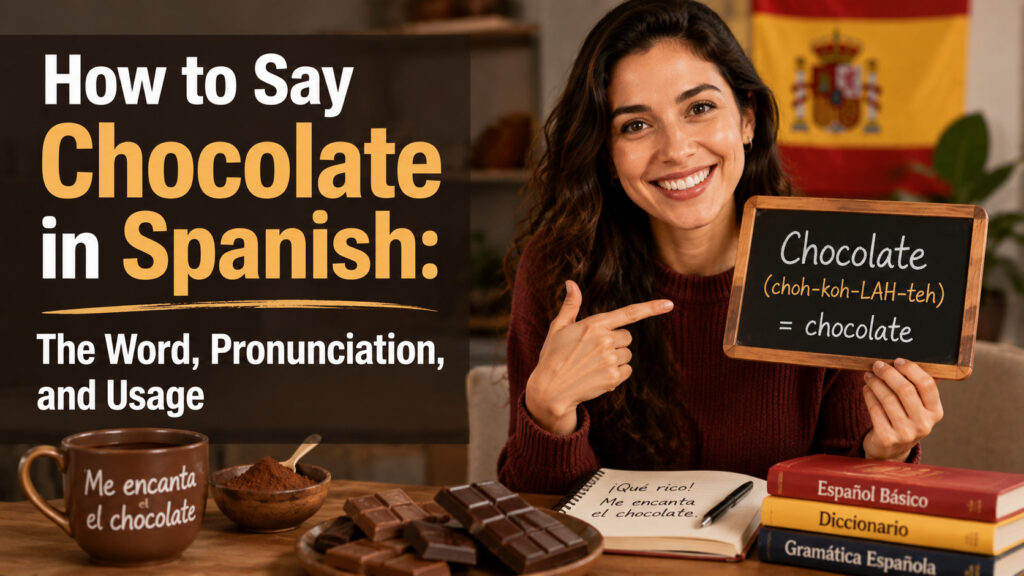
The word for chocolate in Spanish is chocolate, spelled exactly the same as in English. This isn’t a coincidence, since both languages borrowed the term from Nahuatl, the language of the Aztecs, who were among the first to cultivate and prepare cacao. Despite the identical spelling, the pronunciation differs noticeably between English and Spanish, which is where most learners run into trouble.
Pronunciation
Because the spelling looks so familiar, many learners default to English pronunciation, but that’s a mistake. Here’s how to say chocolate in Spanish, broken into syllables:
- Cho is pronounced “choh,” similar to the start of the English word “chore”
- Co is pronounced “koh,” with a clear, short “o” sound
- La is pronounced “lah”
- Te is pronounced “teh,” never like the English “tea”
Put together, it sounds like “choh-koh-LAH-teh,” with the stress falling on the third syllable. Every vowel is short and clean, without the diphthongs English speakers are used to, so resisting the urge to soften or drag out the vowels will make the word sound far more natural.
Common Ways to Say It
Chocolate itself covers most everyday uses, but a few related terms come up depending on context:
- Chocolate — the standard word for chocolate, both the food and the flavor
- Chocolate caliente — hot chocolate, a common drink especially in colder months
- Chocolatina — a small chocolate bar, common in Spain
- Bombón — a chocolate candy or truffle, often used for individually wrapped pieces
- Cacao — cacao or cocoa, referring to the raw bean or powder rather than the finished product
Knowing these related words helps you talk about chocolate in more specific, natural ways rather than relying on a single general term.
Formal and Informal Usage
Chocolate is a neutral, everyday word that works in any setting, from casual conversation to formal writing, since it simply names a food and carries no particular tone. You’ll see it used the same way on a restaurant menu as in a casual chat between friends.
Diminutive or regional variations, however, do carry more casual weight. Chocolatina, for instance, sounds friendly and informal, often used the way English speakers might say “candy bar” rather than the more generic “chocolate bar.” Bombón can also be used affectionately as a term of endearment for a person, similar to calling someone “sweetheart” in English, which shows how flexible food vocabulary can become in casual speech.
Related Phrases
A few useful phrases build naturally on the word:
- Una barra de chocolate — a chocolate bar
- Chocolate con leche — milk chocolate
- Chocolate negro — dark chocolate
- Un pastel de chocolate — a chocolate cake
- Me encanta el chocolate — I love chocolate
Learning these combinations helps you talk about chocolate in specific, real-world situations rather than using the word in isolation.
Real-Life Examples with English Translations
Here are a few natural sentences using the word in context:
- ¿Quieres chocolate caliente o café? — “Do you want hot chocolate or coffee?”
- Compré una chocolatina en la tienda. — “I bought a chocolate bar at the store.”
- Este pastel de chocolate está delicioso. — “This chocolate cake is delicious.”
- Prefiero el chocolate negro al chocolate con leche. — “I prefer dark chocolate to milk chocolate.”
Practicing full sentences like these helps the word feel far more natural than memorizing it on its own.
Common Mistakes
- Pronouncing chocolate with English vowel sounds out of habit, since the identical spelling makes it easy to default to the familiar English pronunciation.
- Stressing the wrong syllable, placing emphasis on the first syllable instead of the third, which sounds noticeably off to native speakers.
- Assuming chocolatina is used everywhere, when in reality it’s more common in Spain, while other regions may use different terms for a small chocolate bar.
- Overlooking gender agreement, since chocolate is a masculine noun and should be paired with el, as in el chocolate, not la chocolate.
Paying attention to pronunciation and grammar, not just the familiar spelling, helps this word sound genuinely native.
Final Thoughts
Learning how to say chocolate in Spanish is an easy win for beginners, since the spelling is already familiar, but getting the pronunciation and related vocabulary right is what makes it sound natural. With chocolate as your foundation, and terms like chocolate caliente, chocolatina, and bombón adding nuance, you’ll be ready to talk about one of the world’s favorite treats with real confidence. As always, practicing the word aloud in full sentences is the best way to make it stick.