Have you ever stood in a clothing store in Mexico or Spain, staring at a rack of shirts, and blanked on the one word you actually needed? It happens to nearly every language learner, and shirts is one of those everyday words that comes up constantly, whether you are shopping, packing for a trip, or just talking about your closet. If you have been searching for how to say shirts in Spanish, the good news is that it is one of the easier vocabulary words to pick up and remember. This guide covers the meaning, pronunciation, and natural usage so you can talk about shirts with confidence.
Meaning and Translation
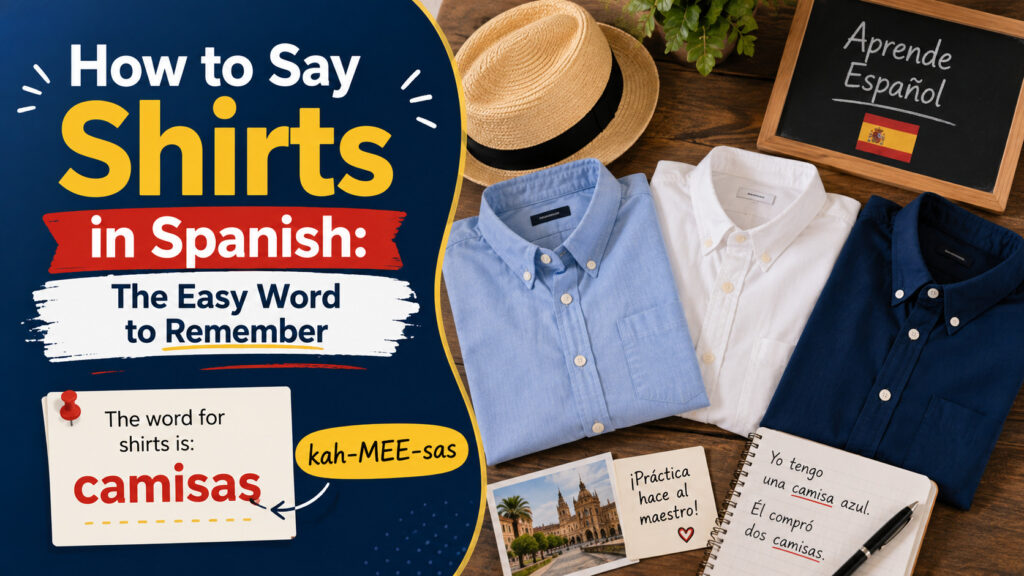
The most common word for shirts in Spanish is camisas, the plural form of camisa, meaning “shirt.” Camisas typically refers to button-up shirts, dress shirts, or collared shirts, similar to how the word is used in English. For casual t-shirts, Spanish speakers often use a different word, camisetas, which specifically refers to t-shirts or short-sleeved casual tops. Knowing this distinction is important, since using camisas when you mean a plain t-shirt can sound slightly off to a native speaker, even though both words are technically related.
Pronunciation
Pronouncing camisas correctly is straightforward once you understand basic Spanish vowel sounds. Camisas is pronounced kah-MEE-sahs, with the stress falling on the second syllable. The letter c before a is pronounced like the English k, and every vowel is short and clear, unlike the longer vowel sounds common in English. Camisetas, the word for t-shirts, is pronounced kah-mee-SEH-tahs, with the stress shifting to the third syllable. Practicing both words slowly at first will help you get comfortable with the rhythm before speaking at a natural pace.
Common Ways to Say It
Spanish offers a few practical variations depending on the type of shirt you are describing.
Camisas refers to collared, button-up shirts, the kind typically worn for work or formal occasions.
Camisetas refers to t-shirts or casual short-sleeved tops, the most commonly worn everyday shirt.
Camisas de manga larga means “long-sleeved shirts,” useful when shopping for cooler weather.
Camisas de manga corta means “short-sleeved shirts,” often used interchangeably with camisetas in casual conversation, though camisas de manga corta technically implies a collared style.
Camisas de vestir means “dress shirts,” specifically referring to formal shirts worn with suits or for professional settings.
Formal and Informal Usage
The word you choose can shift slightly depending on the setting and the type of shirt being discussed. In casual conversation, such as talking about laundry or packing for a trip, camisetas is used constantly and feels relaxed and everyday. In more formal or retail settings, such as shopping for work attire or discussing a dress code, camisas or camisas de vestir sound more appropriate and precise. If you are unsure which word fits, camisas works as a safe, general term in most contexts, since it is widely understood even when the exact style is not specified.
Related Phrases
Beyond the core words for shirts, several related expressions come up often when shopping or talking about clothing in Spanish.
Ropa means “clothes” or “clothing,” a general term useful in almost any shopping conversation.
Pantalones means “pants,” a common companion word when discussing an outfit.
¿Tienes camisas en talla mediana? means “Do you have shirts in medium size?” a practical phrase for shopping.
Me gusta esta camisa means “I like this shirt,” useful when picking something out in a store.
¿Cuánto cuesta esta camiseta? means “How much does this t-shirt cost?” a handy question for any shopping trip.
Real-Life Examples with English Translations
Seeing these words used in real sentences helps make them easier to remember and apply naturally.
“Necesito comprar camisas nuevas para el trabajo.” translates to “I need to buy new shirts for work.”
“Esta camiseta es mi favorita.” translates to “This t-shirt is my favorite.”
“¿Dónde están las camisas de manga larga?” translates to “Where are the long-sleeved shirts?”
“Empaqué solo tres camisetas para el viaje.” translates to “I only packed three t-shirts for the trip.”
“Compré una camisa de vestir para la entrevista.” translates to “I bought a dress shirt for the interview.”
Common Mistakes
One common mistake English speakers make is using camisas and camisetas interchangeably, when native speakers typically reserve camisas for collared or button-up shirts and camisetas for casual t-shirts. Another mistake is forgetting to pluralize correctly, saying camisa when referring to more than one shirt instead of the correct plural form camisas. Learners also sometimes confuse camisa with camiseta due to their similar spelling, leading to mismatched descriptions when shopping or describing an outfit. Additionally, mispronouncing the soft s sound at the end of camisas, either dropping it or overemphasizing it, can make plural and singular forms harder to distinguish in conversation.
Final Thoughts
Learning how to say shirts in Spanish is a simple but genuinely useful step for everyday conversations, shopping trips, and travel. Camisas and camisetas cover nearly every situation you will encounter, and understanding the small difference between them will help you sound more precise and natural. With a little practice on pronunciation and context, talking about shirts in Spanish will quickly become second nature.