
Picture this: you are sitting in a small trattoria in Rome, halfway through a plate of cacio e pepe, when nature calls. Do you know how to politely ask where the bathroom is without fumbling through your phrasebook? Knowing how to say bathroom in Italian is one of the most practical phrases any traveler or language learner can master, and it is far more nuanced than a single word. Italian has several ways to refer to this everyday space, each shaped by context, formality, and region. This guide breaks it all down so you can speak with confidence.
Meaning and Translation
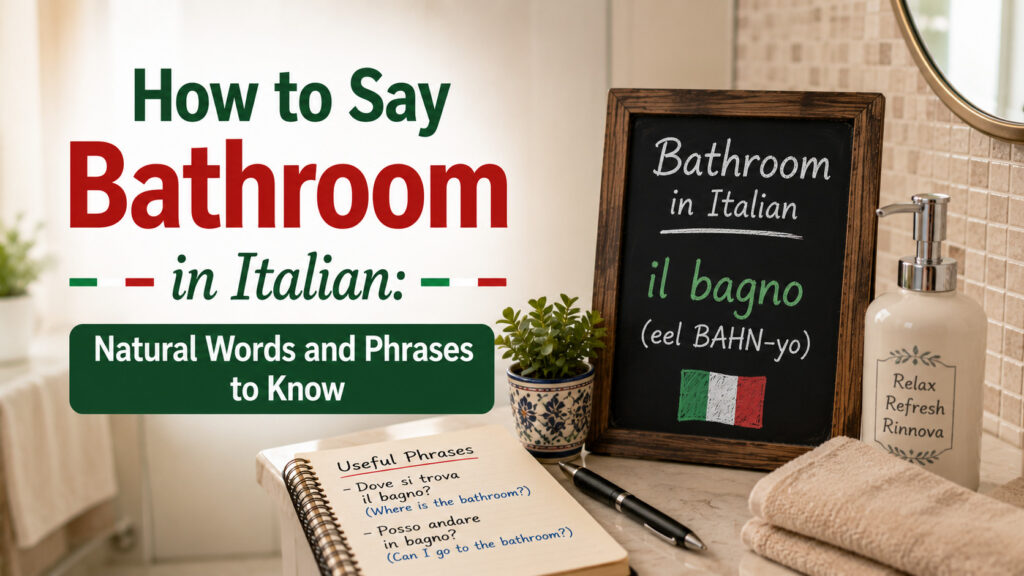
The most direct answer to how to say bathroom in Italian is “il bagno.” This word covers both the bathroom in a private home and the restroom in a public place like a restaurant, airport, or museum. Italian does not always separate the idea of a bathing room from a toilet room the way English sometimes does. In most everyday conversations, “bagno” is the catch-all term Italians reach for, similar to how English speakers use “bathroom” as a general, polite word regardless of whether a bathtub is involved.
Pronunciation
Getting the pronunciation right makes a real difference when you are asking for directions in a hurry. “Bagno” is pronounced “BAH-nyoh.” The tricky part for English speakers is the “gn” combination, which does not exist in English. It creates a soft, nasal sound similar to the “ny” in the English word “canyon.” Say it slowly at first: BAH, then NYOH, blending them together smoothly. Practicing this sound out loud a few times will help it become natural.
Common Ways to Say It
While “il bagno” is the standard term, Italian offers a few alternatives depending on the setting.
“La toilette” is borrowed from French and often appears on signs in more upscale restaurants, hotels, or on airplanes. It sounds a bit more refined and is widely understood across Italy.
“I servizi” literally translates to “the services” and is a polite, slightly formal way to refer to restroom facilities, commonly seen on signage in public buildings, train stations, and rest stops.
“Il gabinetto” is an older, more clinical term for the toilet itself rather than the room. It is less commonly used in casual speech today but still appears in some contexts, particularly among older generations.
Knowing these variations helps you recognize signage and understand locals no matter which term they choose.
Formal and Informal Usage
Just like in English, the way you ask about the bathroom changes depending on who you are speaking to. In informal settings, such as with friends or family, you might simply say “Dov’è il bagno?” which means “Where is the bathroom?”
In more formal situations, such as speaking with a waiter, hotel staff, or someone you do not know well, Italians often add polite phrasing. A common formal request is “Scusi, dov’è il bagno?” meaning “Excuse me, where is the bathroom?” The word “scusi” is the formal version of “excuse me,” while “scusa” is used informally with people you are on a first-name basis with.
Choosing the right level of formality shows respect and helps you blend in naturally as a considerate guest.
Related Phrases
Beyond the basic question, a few related phrases are worth learning for smoother conversations.
“Posso usare il bagno?” means “Can I use the bathroom?” and works well when you are a guest in someone’s home.
“C’è un bagno qui vicino?” translates to “Is there a bathroom nearby?” which is useful when you are out and about in an unfamiliar area.
“Il bagno è occupato” means “The bathroom is occupied,” something you might hear or need to say while waiting in line at a public restroom.
“Carta igienica” means toilet paper, a small but genuinely useful word to know in case you ever need to ask for more.
Real-Life Examples with English Translations
Seeing these phrases in context makes them easier to remember.
“Scusi, dov’è il bagno per favore?” translates to “Excuse me, where is the bathroom please?” This is ideal for asking a waiter or shopkeeper.
“Il bagno è in fondo a destra.” means “The bathroom is at the end on the right,” a typical response you might receive.
“Posso usare il vostro bagno?” means “Can I use your bathroom?” and is appropriate when addressing a group or a business formally.
“Mi scusi, i servizi sono a questo piano?” translates to “Excuse me, are the restrooms on this floor?” which works well in hotels, train stations, or shopping centers.
Common Mistakes
One frequent error English speakers make is confusing “bagno” with “bagnino,” which actually means lifeguard. The similarity in spelling can easily trip up beginners, so it helps to say each word aloud separately until the difference feels automatic.
Another mistake is overusing “toilette” in casual settings where “bagno” would sound more natural. While “toilette” is understood everywhere, relying on it too often can sound slightly stiff in everyday conversation among friends or family.
Learners also sometimes forget the gender and article rules, saying “la bagno” instead of the correct “il bagno,” since “bagno” is a masculine noun. Small grammar details like this matter for sounding fluent and confident.
Finally, many beginners forget to soften their tone with “scusi” or “per favore” when asking strangers for directions, which can come across as abrupt even if the vocabulary itself is correct.
Final Thoughts
Learning how to say bathroom in Italian is a small piece of vocabulary that carries real everyday value, whether you are traveling, studying the language, or simply curious about Italian culture. From the standard “il bagno” to more formal alternatives like “i servizi,” understanding these variations, their pronunciation, and the right level of formality will help you navigate real conversations with ease. With a little practice, asking for the bathroom will become second nature, letting you focus on enjoying the rest of your Italian experience.