Ever noticed how saying no politely can sometimes feel trickier than saying yes? In Spanish, there are several natural ways to decline, disagree, or simply say no, each with its own tone and level of politeness. If you are learning how to say no in Spanish, this guide covers the meaning, pronunciation, and everyday usage so you can express yourself clearly and respectfully in any situation.
Meaning and Translation
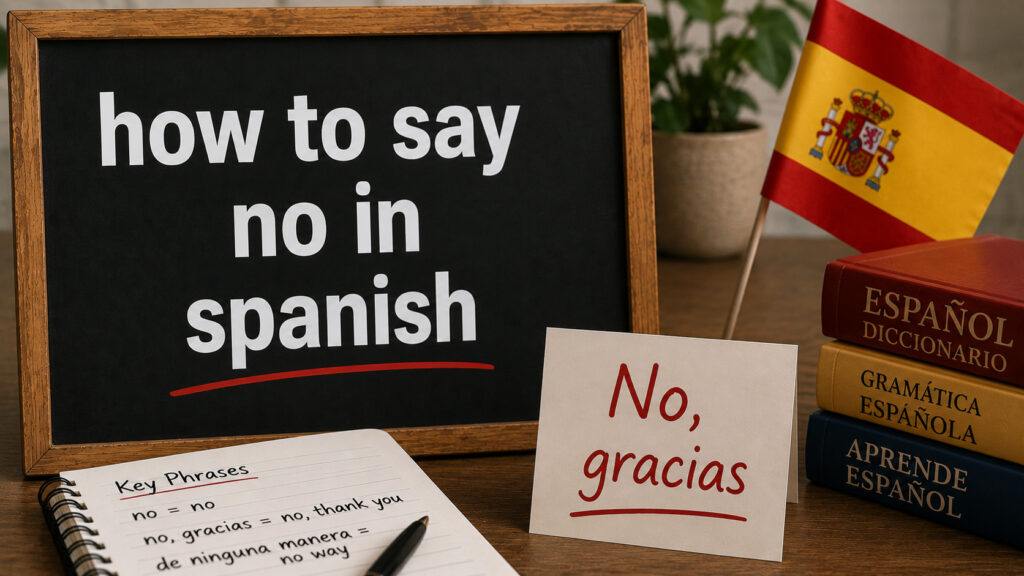
The direct translation of “no” in Spanish is simply “No” (noh), which is identical in spelling to English but pronounced slightly differently. This straightforward word works in most everyday situations, just as it does in English. For a softer or more polite refusal, Spanish speakers often add phrases like “No, gracias” (noh GRAH-see-ahs), meaning “No, thank you,” which softens the response and is commonly used when declining an offer.
Pronunciation
Pronouncing “No” in Spanish is simple, since it is a single syllable pronounced noh, with a pure, short “o” sound rather than the diphthong often heard in the English “no.” “No, gracias” is pronounced noh GRAH-see-ahs, with the stress falling on the first syllable of “gracias.” Practicing the clean, short Spanish “o” sound will help you avoid an accent that sounds too influenced by English pronunciation patterns.
Common Ways to Say It
While “No” is the most basic way to say no, Spanish speakers use various expressions depending on the situation. “No, gracias” is used to politely decline an offer. “Claro que no” means “Of course not,” used to emphasize a firm no. “Para nada” means “not at all,” often used to strongly deny something. “Ni hablar” translates to “no way” or “don’t even mention it,” a more expressive way to reject an idea or suggestion. Each of these phrases carries a slightly different tone and level of emphasis.
Formal and Informal Usage
The word “No” itself does not change based on formality, since it functions the same way in both casual and professional settings. However, the phrases that accompany it often do shift in tone. “No, gracias” is polite and works well in both formal and informal contexts, making it a safe and respectful choice. “Ni hablar” is more informal and expressive, best used with friends or in casual conversation rather than professional settings. In formal situations, softer phrases like “Lo siento, pero no puedo” meaning “I’m sorry, but I can’t,” are often preferred over a blunt “No” alone, since they demonstrate politeness and consideration.
Related Phrases
A few related expressions can help you decline or disagree more naturally in conversation. “No puedo” means “I can’t,” a common way to decline an invitation. “No quiero” means “I don’t want to,” used to express personal preference. “Lo siento, pero no” means “I’m sorry, but no,” a polite way to soften a refusal. “De ninguna manera” translates to “no way” or “under no circumstances,” a stronger and more formal way to express firm disagreement. These phrases give you more flexibility depending on the tone you want to convey.
Real-Life Examples with English Translations
Seeing these phrases in context can help you understand how they are used naturally. Here are a few examples:
“¿Quieres más café?” “No, gracias, ya tomé suficiente.” translates to “Do you want more coffee?” “No, thank you, I already had enough,” a polite exchange in a casual setting.
“¿Puedes ayudarme mañana?” “Lo siento, pero no puedo.” means “Can you help me tomorrow?” “I’m sorry, but I can’t,” a respectful way to decline a request.
“¿Estás de acuerdo con eso?” “Para nada.” translates to “Do you agree with that?” “Not at all,” a firm and clear way to express disagreement.
Common Mistakes
One common mistake learners make is relying only on a blunt “No” in situations where a softer phrase like “No, gracias” or “Lo siento, pero no” would sound more polite and natural. Another frequent error is overusing strong expressions like “Ni hablar” in formal settings, where they can come across as too casual or dismissive. Learners also sometimes forget that tone and body language matter just as much as the words themselves, since a flat “No” without context can sound abrupt even when that is not the intention. Choosing the right phrase for the situation will help you communicate more effectively and respectfully.
Final Thoughts
Learning how to say no in Spanish involves more than memorizing a single word, since tone and politeness play a major role in how your response is received. Whether you use a simple “No,” a polite “No, gracias,” or a firmer phrase like “Para nada,” understanding the context behind each option will help you communicate clearly and respectfully. With a little practice, expressing refusal or disagreement in Spanish will start to feel natural and appropriate for any situation.