Ever wondered why a simple thank you can mean so much more depending on how it is said? In Spanish-speaking cultures, expressing gratitude is an important part of everyday politeness, and there are several natural ways to do it beyond the basic phrase most learners already know. If you are learning how to say thank you in Spanish, this guide covers the meaning, pronunciation, and everyday usage so you can express appreciation naturally and appropriately in any situation.
Meaning and Translation
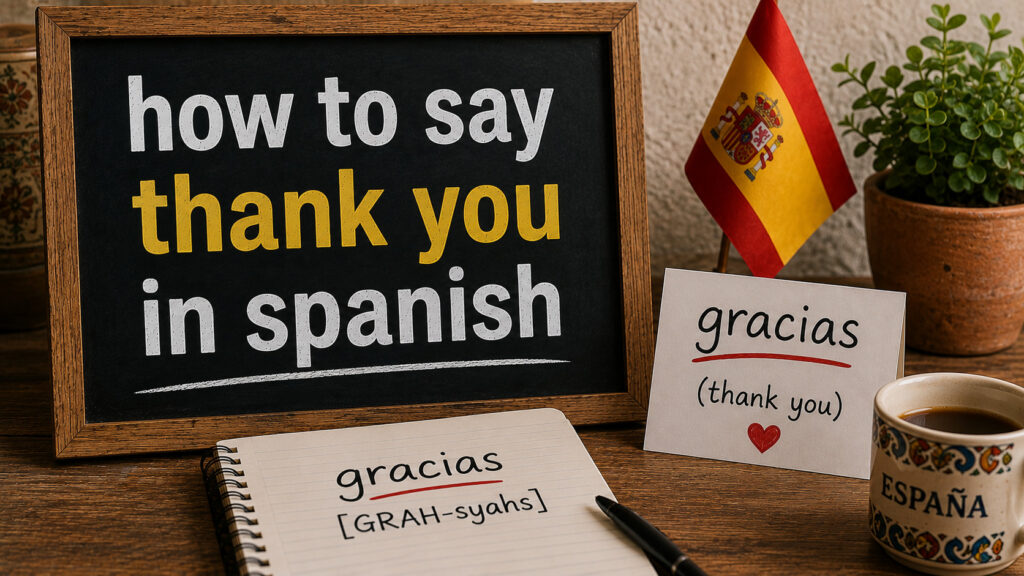
The most common way to say thank you in Spanish is “Gracias” (GRAH-see-ahs). This single word is universally understood across every Spanish-speaking country and works in nearly any situation. For added emphasis, speakers often say “Muchas gracias” (MOO-chahs GRAH-see-ahs), meaning “thank you very much,” which strengthens the expression of gratitude without changing its basic meaning.
Pronunciation
Pronouncing “Gracias” correctly involves three syllables: GRAH-see-ahs, with the stress falling on the first syllable. The “ci” combination creates a soft “see” sound, and the ending “as” is pronounced clearly rather than rushed. “Muchas gracias” adds an extra word before it, pronounced MOO-chahs, with the stress on the first syllable as well. Practicing the smooth flow between “Muchas” and “gracias” will help the phrase sound more natural when spoken at a normal conversational pace.
Common Ways to Say It
Beyond “Gracias” and “Muchas gracias,” Spanish speakers use a few other expressions depending on the level of gratitude they want to convey. “Mil gracias” literally means “a thousand thanks” and is used to express even greater appreciation than “Muchas gracias.” “Te lo agradezco” translates to “I appreciate it,” a slightly more heartfelt and personal way to say thank you. “Gracias por todo” means “thank you for everything,” often used when someone has helped with multiple things or gone out of their way.
Formal and Informal Usage
“Gracias” itself works well in both formal and informal settings, making it one of the most versatile expressions in Spanish. However, the surrounding language can shift depending on the context. In formal situations, speakers might add “Muchas gracias por su ayuda,” meaning “Thank you very much for your help,” using the formal “su” to show respect. In casual settings, simply saying “Gracias” or “Mil gracias” among friends feels natural without needing additional formal phrasing. The word itself rarely changes, but pairing it with respectful language elevates its tone when necessary.
Related Phrases
A few related phrases can help you respond to or expand on a simple thank you. “De nada” means “you’re welcome,” the standard response to “Gracias.” “No hay de qué” is another way to say “you’re welcome,” roughly translating to “there’s nothing to thank me for.” “Con gusto” means “with pleasure,” a warm way to respond when someone thanks you for a favor. “Te agradezco de corazón” translates to “I thank you from the heart,” a deeply sincere expression used in more emotional or meaningful situations.
Real-Life Examples with English Translations
Seeing these phrases in context can help you understand how they are used naturally. Here are a few examples:
“Gracias por tu ayuda con la mudanza.” translates to “Thank you for your help with the move,” a casual and genuine expression of gratitude among friends.
“Muchas gracias por su tiempo, doctor.” means “Thank you very much for your time, doctor,” a respectful and formal way to thank a professional.
“Mil gracias, no sé qué habría hecho sin ti.” translates to “A thousand thanks, I don’t know what I would have done without you,” a heartfelt expression used for someone who went above and beyond.
Common Mistakes
One common mistake learners make is overusing “Muchas gracias” for every situation, when a simple “Gracias” is often sufficient for smaller favors or everyday interactions. Another frequent error is forgetting the appropriate response, since simply nodding after being thanked can feel incomplete in Spanish-speaking cultures where responding with “De nada” or “Con gusto” is customary. Learners also sometimes mispronounce the soft “ci” sound in “Gracias,” pronouncing it more like a hard “k” or “s” sound instead of the correct soft blend. Paying attention to these small details will help your Spanish sound more natural and polished.
Final Thoughts
Learning how to say thank you in Spanish is a simple yet meaningful way to show genuine appreciation and build rapport with Spanish speakers. Whether you use the everyday “Gracias,” the stronger “Muchas gracias,” or a heartfelt phrase like “Te lo agradezco,” understanding the context behind each expression will help you communicate warmly and respectfully. With a little practice, expressing gratitude in Spanish will soon feel like second nature in your everyday conversations.