
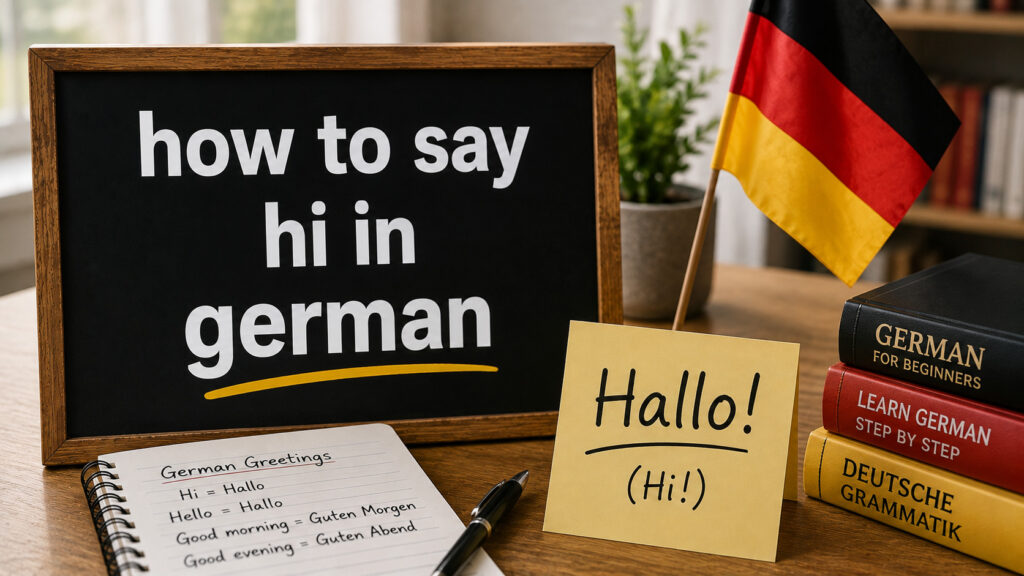
Ever noticed how the way people greet each other can instantly reveal a little about the local culture? In Germany, greetings tend to be straightforward and practical, much like the language itself, but they still vary depending on region and formality. If you are learning how to say hi in German, this guide covers the meaning, pronunciation, and everyday usage of the most common greetings so you can speak with confidence wherever you go.
Meaning and Translation
The most common way to say hi in German is “Hallo” (hah-LOH), a simple and widely understood greeting used across German-speaking countries. Another common informal greeting is “Hi,” borrowed directly from English and used casually among younger speakers. In southern Germany, Austria, and parts of Switzerland, “Servus” (SEHR-voos) is a popular regional greeting that can mean both hello and goodbye, depending on context.
Pronunciation
Pronouncing “Hallo” correctly involves two clear syllables: hah-LOH, with the stress falling on the second syllable, unlike the English “hello,” which stresses the first. “Servus” is pronounced SEHR-voos, with the stress on the first syllable. German pronunciation tends to be very consistent with spelling, so once you learn the basic sound patterns, greetings become easier to pronounce accurately compared to some other European languages.
Common Ways to Say It
Beyond “Hallo,” German speakers use several other common greetings depending on the time of day and region. “Guten Morgen” means “good morning” and is used until around late morning. “Guten Tag” means “good day” and is one of the most versatile and widely used greetings throughout the daytime hours. “Guten Abend” means “good evening,” used once the day transitions into evening. In casual settings, especially in northern Germany, “Moin” is a popular short greeting that can be used at almost any time of day, despite its origins as a morning greeting.
Formal and Informal Usage
German places clear importance on formality, and greetings reflect this distinction. “Hallo” is considered fairly neutral and works well in both casual and semi-formal situations, making it a safe choice for beginners. “Guten Tag” is more formal and often preferred in professional settings, when meeting someone for the first time, or when addressing someone older. “Servus” and “Moin” are informal and regional, best used with friends, peers, or in relaxed local settings rather than formal business environments. Choosing the appropriate greeting shows respect and awareness of German social norms.
Related Phrases
A few related phrases can help you continue a conversation naturally after your initial greeting. “Wie geht’s?” means “How’s it going?” a casual follow-up question. “Wie geht es Ihnen?” is the formal version of the same question, using the respectful “Ihnen” pronoun. “Auf Wiedersehen” means “goodbye” in a formal sense, while “Tschüss” is a common and friendly way to say goodbye informally. These phrases help round out a basic but functional greeting exchange in German.
Real-Life Examples with English Translations
Seeing these phrases in context can help you understand how they are used naturally. Here are a few examples:
“Hallo, wie geht’s?” translates to “Hi, how’s it going?” a common and friendly way to greet someone you know casually.
“Guten Tag, mein Name ist Anna.” means “Good day, my name is Anna,” a polite and formal way to introduce yourself.
“Servus! Lange nicht gesehen.” translates to “Hey! Long time no see,” a warm and casual greeting often used in southern Germany or Austria among friends.
Common Mistakes
One common mistake learners make is using “Servus” outside of southern Germany, Austria, or Switzerland, where it may sound unfamiliar or out of place to speakers from other regions. Another frequent error is using “Hallo” in very formal business settings where “Guten Tag” would be more appropriate and expected. Learners also sometimes forget that “Guten Morgen,” “Guten Tag,” and “Guten Abend” are time-specific, so using the wrong one for the time of day can sound slightly off to native speakers. Paying attention to regional and contextual differences will help your German greetings sound more natural.
Final Thoughts
Learning how to say hi in German is a simple but useful step toward navigating everyday conversations with confidence. Whether you use the versatile “Hallo,” the more formal “Guten Tag,” or a regional favorite like “Servus” or “Moin,” understanding the context behind each greeting will help you sound natural and culturally aware. With a little practice, these everyday phrases can help you connect more easily with German speakers wherever your travels take you.