Have you ever tried to answer a simple question like “do you speak Spanish” and wanted a way to say “just a little” instead of a full yes or no? This small phrase comes up constantly in everyday conversation, whether you are describing your language skills, an amount of food, or how much time you have. If you are learning how to say a little in Spanish, this guide will walk you through the meaning, pronunciation, common variations, and real conversational examples so you can use it naturally and accurately.
Meaning and Translation
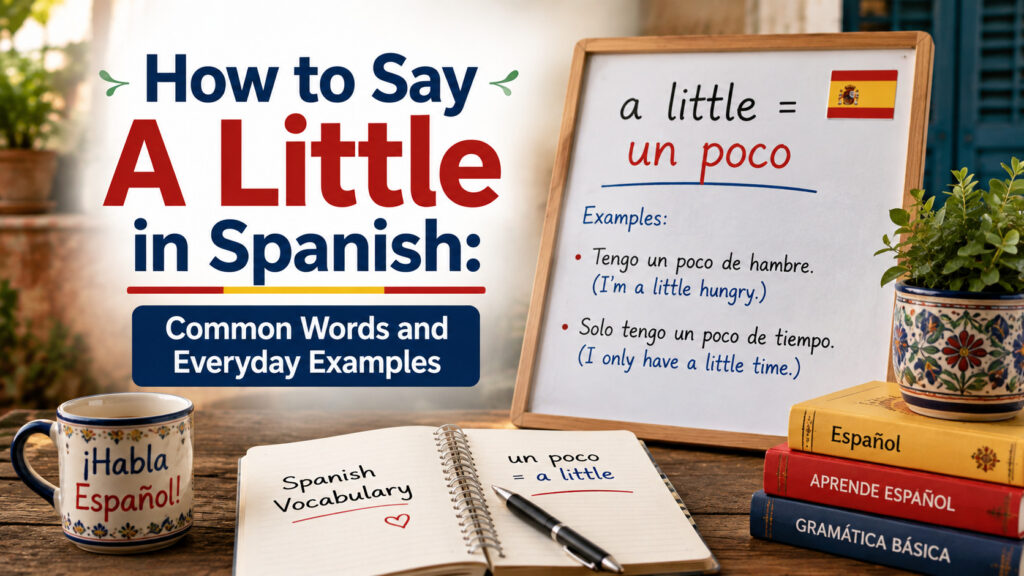
The most common way to say a little in Spanish is un poco. This phrase is used broadly to describe a small amount of something, whether it refers to quantity, time, or ability. For example, un poco de agua means “a little water,” while hablo un poco de español means “I speak a little Spanish.” When describing a small amount of a specific noun, Spanish speakers often use un poco de, adding de before the noun being described, which functions similarly to “a little of” in English.
Pronunciation
Un poco is pronounced “oon POH-koh,” with the stress falling on the first syllable of poco. The u in un is short and quick, similar to the oo in “book,” while poco has a clear, rounded o sound. Practicing the smooth connection between un and poco as one flowing phrase, rather than pausing between the two words, will help you sound more natural when speaking.
Common Ways to Say It
While un poco is the most common phrase, Spanish offers a few related expressions depending on context and emphasis:
Un poquito is a diminutive form of un poco, meaning “a tiny bit,” often used to sound softer, more affectionate, or more casual.
Algo de means “some” or “a bit of,” used similarly to un poco de but with a slightly more neutral tone.
Un poco más means “a little more,” commonly used when asking for or offering an additional small amount.
Muy poco means “very little,” used to emphasize that the amount is smaller than expected or smaller than average.
These variations allow speakers to adjust the tone and emphasis of the phrase depending on the situation, from a neutral description to a warmer, more affectionate expression.
Formal and Informal Usage
Un poco is used consistently in both formal and informal Spanish, since it functions as a standard, neutral phrase rather than one tied to strict politeness levels. In formal settings, such as professional conversations, interviews, or academic contexts, un poco or algo de are commonly used to describe small amounts clearly and appropriately.
In informal, everyday conversation, especially among friends or family, un poquito is frequently used to add warmth or softness to a request or description. For example, a parent might say come un poquito más, meaning “eat a little more,” using the diminutive form to sound gentle and encouraging rather than direct. This flexibility makes un poco and its variations useful across nearly every type of conversation.
Related Phrases
Learning a few related expressions makes it easier to talk about small amounts naturally in everyday Spanish:
Un poco de tiempo meaning “a little time,” often used when asking for patience or a short delay.
Un poco de paciencia meaning “a little patience,” commonly used in both casual and polite requests.
Solo un poco meaning “just a little,” used to clarify that the amount is limited or modest.
Nada más que un poco meaning “nothing more than a little,” used to emphasize a small quantity.
These phrases frequently pair with un poco and help create more complete, natural-sounding sentences in everyday conversation.
Real-Life Examples with English Translations
Seeing these phrases used in real conversation helps reinforce how they naturally fit together. Here are a few examples:
A: ¿Hablas español? (Do you speak Spanish?) B: Sí, hablo un poco. (Yes, I speak a little.)
A: ¿Quieres más café? (Do you want more coffee?) B: Solo un poquito, gracias. (Just a little bit, thank you.)
A: ¿Tienes tiempo ahora? (Do you have time now?) B: Tengo un poco de tiempo. (I have a little time.)
A: ¿Cuánta sal le pongo? (How much salt should I add?) B: Solo un poco, no mucha. (Just a little, not much.)
Common Mistakes
Learners often make a few predictable mistakes when using this phrase. One common error is forgetting to add de before a noun, saying un poco agua instead of the correct un poco de agua. Another mistake is confusing un poco, meaning “a little,” with poco alone, which can mean “little” in a more negative or limited sense, such as tengo poco tiempo, meaning “I have little time” in a way that suggests not enough time. Some learners also overuse un poquito in formal situations, when the more neutral un poco would sound more appropriate. Paying attention to these small grammar and tone differences helps this phrase come out sounding accurate and natural.
Final Thoughts
Learning how to say a little in Spanish involves more than memorizing a single phrase. It requires understanding when to add de before a noun, recognizing the softer tone of un poquito, and knowing how context shapes which variation fits best. By practicing the phrases and examples covered in this guide, you will be able to describe small amounts naturally and accurately, whether you are talking about time, quantity, or your own language ability.