Ever tried to describe a big house, a big problem, or a big dog in Spanish and hesitated because more than one word came to mind? That hesitation makes sense, since Spanish actually has several common words for “big,” each with its own shade of meaning. This guide breaks down how to say big in Spanish, how to pronounce it correctly, and how native speakers naturally choose between the different options.
Meaning and Translation
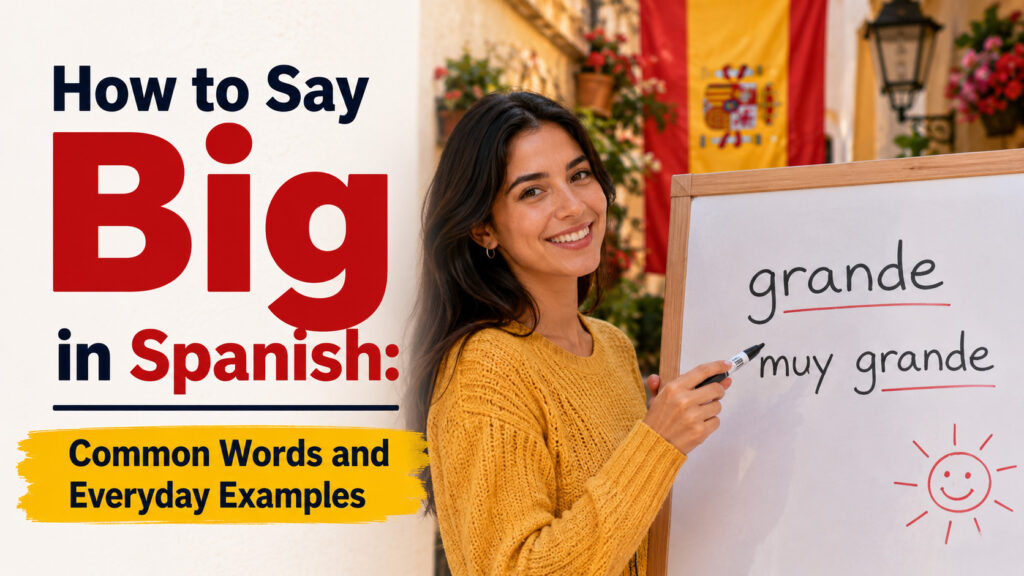
The most common and direct translation of “big” in Spanish is grande. It’s a versatile adjective used to describe size, but also importance, since grande can mean both “big” in a literal sense and “great” in a figurative one, similar to how English uses “great” for both size and quality. Depending on context, other words like enorme (“enormous”) or gran (a shortened form of grande) also come into play, each carrying a slightly different weight or emphasis.
Pronunciation
Spanish pronunciation is generally straightforward once you learn the vowel sounds, and grande is no exception. Here’s how to say big in Spanish, broken into syllables:
- Grande is pronounced “GRAHN-deh,” with the stress on the first syllable
- Gran is pronounced “grahn,” a shorter, single-syllable version
- Enorme is pronounced “eh-NOR-meh,” with the stress on the second syllable
Every vowel in Spanish keeps a consistent sound, so the “a” in grande always sounds like “ah,” never like the “a” in the English word “cake.” Practicing each word slowly before speeding up helps the rhythm feel natural.
Common Ways to Say It
While grande is the most universal choice, Spanish speakers use a few different words depending on the size or intensity being described:
- Grande — the standard, all-purpose word for big
- Gran — a shortened form used before singular nouns, often for emphasis or importance
- Enorme — used for something enormous or very large
- Gigante — meaning “giant,” used for something extremely large
- Amplio — meaning “spacious” or “wide,” often used for rooms or spaces rather than objects
Knowing these alternatives helps you sound more precise and natural, rather than relying on a single word for every situation.
Formal and Informal Usage
Grande works comfortably in almost any setting, from casual conversation to formal writing, which makes it a safe default for most learners. It’s appropriate whether you’re describing a big city, a big decision, or a big meal.
Gran, the shortened form, is used specifically before a singular noun and often signals importance rather than just physical size, as in un gran hombre (“a great man”). This distinction matters, since grande hombre would sound unnatural to a native speaker. Enorme and gigante tend to appear in both casual and descriptive contexts, especially when emphasizing scale, while amplio is more common in formal or descriptive writing, such as real estate listings or architectural descriptions.
Related Phrases
A few useful phrases build naturally on these words:
- Una casa grande — a big house
- Un gran día — a great day
- Una ciudad enorme — an enormous city
- Un problema gigante — a giant problem
- Un espacio amplio — a spacious area
Learning these combinations helps you apply the vocabulary to everyday situations rather than memorizing isolated words.
Real-Life Examples with English Translations
Here are a few natural sentences using these words in context:
- Vivimos en una casa grande. — “We live in a big house.”
- Fue un gran esfuerzo de todo el equipo. — “It was a great effort by the whole team.”
- El parque es enorme, se puede caminar horas. — “The park is enormous, you can walk for hours.”
- Tenemos un problema gigante que resolver. — “We have a giant problem to solve.”
Practicing full sentences like these makes the vocabulary far more memorable than studying single words in isolation.
Common Mistakes
- Placing gran after the noun instead of before it, since gran must come before a singular noun, while grande can come before or after depending on the meaning intended.
- Using grande when gran is required, which changes the meaning from physical size to importance or greatness.
- Confusing enorme with the English word “enormous” in spelling, leading to an extra or misplaced letter.
- Overusing grande when a more specific word like gigante or amplio would better capture the intended meaning, especially in descriptive writing.
Paying attention to placement and context, not just vocabulary, helps these words sound the way native speakers naturally use them.
Final Thoughts
Learning how to say big in Spanish opens up more precise, natural-sounding descriptions in everyday conversation and writing. With grande as your reliable go-to, and gran, enorme, gigante, and amplio as useful alternatives, you’ll be equipped to describe size and scale with real nuance. As with most vocabulary, using these words often in real sentences is what makes them feel truly natural over time.