Ever poured yourself a bowl of cereal in a Spanish-speaking country and realized you had no idea what to call it on the box? Breakfast vocabulary is often one of the first things language learners overlook, yet it comes up almost every single day. Knowing how to say cereal in Spanish is a simple but genuinely useful piece of vocabulary, whether you are ordering breakfast abroad, chatting with Spanish-speaking friends, or reading a recipe. This guide walks through the exact word, how to pronounce it, and how to use it naturally in conversation.
Meaning and Translation
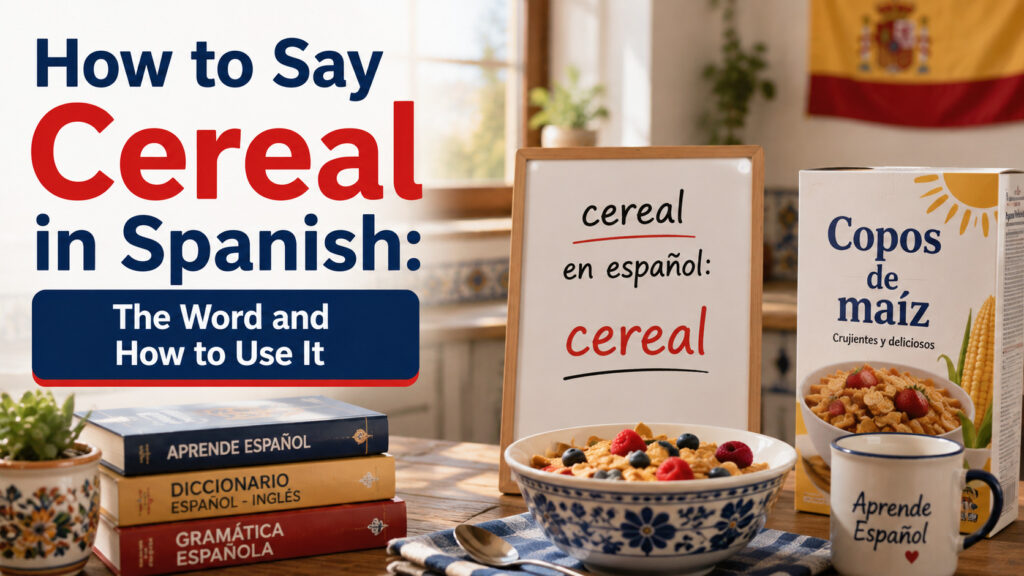
The Spanish word for cereal is simply “cereal.” It is what linguists call a cognate, meaning it looks and sounds almost identical to its English counterpart because both words trace back to the same Latin root, “Ceres,” the Roman goddess of agriculture and grain. This makes it one of the easier food words for English speakers to pick up. Just like in English, “cereal” in Spanish can refer to breakfast cereal in a bowl or, more broadly, to cereal grains like wheat, corn, and oats used in farming and food production.
Pronunciation
Although the spelling matches English almost exactly, the pronunciation is different. In Spanish, “cereal” is pronounced “seh-reh-AHL.” The stress falls on the final syllable, unlike the English version, which stresses the first syllable. Each vowel is pronounced clearly and separately, since Spanish vowels do not blend together the way English vowels often do. Practicing it slowly as four distinct sounds, seh, reh, AHL, will help you avoid accidentally saying the word with an English accent.
Common Ways to Say It
“Cereal” is used as both a singular and general term in Spanish, much like in English. When talking about a bowl of breakfast cereal, Spanish speakers typically say “un tazón de cereal” or “un plato de cereal,” meaning “a bowl of cereal.”
If you want to refer to cereal grains in general, such as in farming or nutrition contexts, the plural form “cereales” is used. For example, “los cereales integrales” means “whole grain cereals,” a phrase you might see on packaging or health articles.
It is worth noting that brand names for cereal, like corn flakes or granola, are often used directly in Spanish as loanwords, so you may hear “cornflakes” or “granola” spoken exactly as they are in English, even within a Spanish sentence.
Formal and Informal Usage
Cereal is a neutral, everyday word, so there is very little difference between formal and informal usage. You would use the same word “cereal” whether you are speaking casually with family at breakfast or writing a formal nutrition report.
That said, formality shows up more in the surrounding sentence structure. Informally, you might hear “Quiero cereal” meaning “I want cereal,” used casually among friends or family. In a more formal or polite context, such as at a hotel breakfast buffet or restaurant, you would more likely hear “Me gustaría un poco de cereal, por favor,” meaning “I would like some cereal, please.” The vocabulary word itself does not change, but the politeness comes from the phrasing around it.
Related Phrases
A few related phrases can help round out your breakfast vocabulary in Spanish.
“Cereal con leche” means “cereal with milk,” the standard way to describe a typical bowl of breakfast cereal.
“Desayuno” means “breakfast,” the meal during which cereal is most commonly eaten.
“Avena” specifically means “oatmeal,” a close relative of cereal that is extremely common in Spanish-speaking households.
“Leche descremada” means “skim milk,” useful if you want to specify how you take your cereal.
“Azúcar” means “sugar,” handy if you are asking whether a cereal is sweetened or discussing ingredients.
Real-Life Examples with English Translations
Seeing the word in full sentences makes it easier to remember and use correctly.
“Todas las mañanas como cereal con leche.” translates to “Every morning I eat cereal with milk.”
“¿Tienen cereal sin azúcar?” means “Do you have sugar-free cereal?” which is useful when shopping or asking about options at a hotel breakfast.
“Mi hijo solo quiere cereal para el desayuno.” translates to “My son only wants cereal for breakfast,” a common phrase among parents.
“Los cereales integrales son buenos para la salud.” means “Whole grain cereals are good for your health,” a sentence you might encounter in a nutrition article or conversation about healthy eating.
Common Mistakes
One common mistake is mispronouncing the word with an English accent, stressing the first syllable instead of the last. Since the spelling looks so familiar, it is easy to default to English pronunciation without realizing it.
Another mistake is forgetting to pluralize correctly when talking about grains in general. Learners sometimes say “cereal” when they should use “cereales,” particularly in agricultural or nutritional contexts where the plural form is standard.
Some learners also assume “cereal” always refers to a boxed breakfast product, but in Spanish it commonly refers to grains more broadly, so context matters when translating.
Finally, confusing “cereal” with “cerebro,” which means brain, is a mistake that occasionally happens due to the similar starting sounds. Practicing both words separately can help avoid this mix-up.
Final Thoughts
Learning how to say cereal in Spanish is a small but practical step toward feeling more comfortable with everyday vocabulary, especially around meals and daily routines. Because the word is a near-perfect cognate, it is one of the easier terms to remember, but pronunciation and context still matter for sounding natural. With a little practice on stress patterns and the phrases surrounding it, you will be able to talk about breakfast, groceries, and nutrition in Spanish with confidence.