Imagine you are traveling in a Spanish-speaking country and suddenly need medical help. Would you know how to ask for a doctor, or explain that you need to see one? Medical vocabulary is some of the most important language to learn before you travel, yet it is often overlooked in favor of greetings and small talk. Knowing how to say doctor in Spanish, along with a few related terms, can make a real difference in an emergency or even in a routine conversation about health. This guide walks through the meaning, pronunciation, common usage, and real examples so you can use this word confidently and correctly.
Meaning and Translation
The word for doctor in Spanish is médico or médica, depending on gender. Médico refers to a male doctor, while médica refers to a female doctor. Both words come from the same root as the English word “medical,” which makes them fairly intuitive to remember.
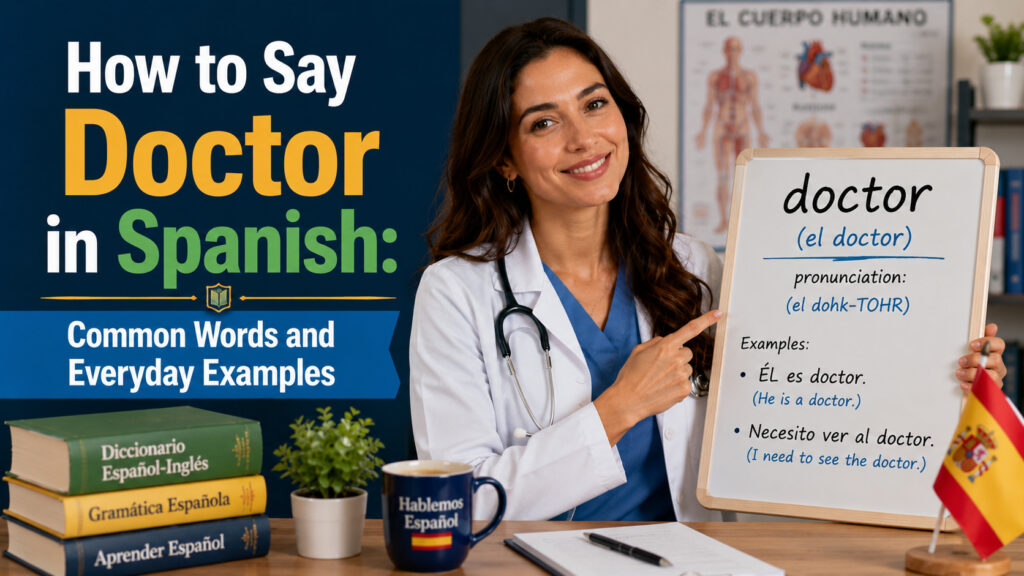
Another very common word is doctor or doctora, which is essentially the same word as in English with a Spanish pronunciation. In everyday conversation, doctor and médico are often used interchangeably, though médico is technically the more precise term for a licensed physician, while doctor can also refer to someone holding a doctoral degree in any field.
Pronunciation
Pronouncing these words correctly will help you be understood clearly, especially in a medical setting where clarity matters.
- Médico: pronounced “MEH-dee-koh,” with the stress on the first syllable.
- Médica: pronounced “MEH-dee-kah,” following the same stress pattern.
- Doctor: pronounced “dohk-TOR,” with the stress on the second syllable, unlike the English pronunciation which stresses the first.
- Doctora: pronounced “dohk-TOH-rah,” with the stress on the second syllable as well.
A helpful tip is to remember that Spanish stress patterns often differ from English, so doctor sounds noticeably different when spoken by a native Spanish speaker compared to an English speaker.
Common Ways to Say It
There are several natural ways to refer to a doctor in Spanish, depending on the situation and the type of care needed.
- Médico or médica: the general term for a physician.
- Doctor or doctora: commonly used both as a noun and as a respectful title before a name.
- El médico de cabecera: refers to a primary care doctor or family physician.
- El especialista: refers to a specialist, such as a cardiologist or dermatologist.
- El pediatra: refers specifically to a children’s doctor, or pediatrician.
Choosing the right term depends on context, but médico and doctor are the two words you will hear and use most often.
Formal and Informal Usage
In both formal and informal settings, médico and doctor are considered polite and appropriate, since they refer to a respected profession. However, there are some differences worth knowing.
Doctor or doctora is frequently used as a direct title, similar to how English speakers say “Doctor Smith.” For example, you might greet someone by saying “Buenos días, doctor” instead of using their last name. This is common in both formal medical settings and everyday conversation.
Médico tends to appear more often in descriptive or formal contexts, such as filling out a form that asks for your médico de cabecera, or describing someone’s profession by saying “Ella es médica.” In casual conversation among friends or family, people often simplify and just say doctor when referring to someone’s occupation, even though médico remains equally correct.
Related Phrases
Beyond the word for doctor itself, there are several related phrases that are useful in medical situations or everyday conversation about health.
- Necesito ver a un médico: means “I need to see a doctor.”
- ¿Dónde está el hospital más cercano?: means “Where is the nearest hospital?”
- Tengo una cita con el doctor: means “I have an appointment with the doctor.”
- La enfermera: means “the nurse,” a related profession often mentioned alongside médico.
- La clínica: means “the clinic,” a common place to see a médico for non-emergency care.
Learning these related phrases alongside the word for doctor helps you communicate more completely in real situations.
Real-Life Examples with English Translations
Seeing these words used in full sentences makes them easier to remember and apply naturally.
- Necesito ver a un médico, por favor. — “I need to see a doctor, please.”
- Mi médico de cabecera es muy amable. — “My family doctor is very kind.”
- ¿Es usted doctor? — “Are you a doctor?”
- Ella es una médica excelente. — “She is an excellent doctor.”
- Tengo una cita con la doctora a las tres. — “I have an appointment with the doctor at three o’clock.”
These examples show how médico, médica, doctor, and doctora fit naturally into everyday Spanish sentences, whether describing someone’s profession or asking for help.
Common Mistakes
One common mistake English speakers make is mispronouncing doctor by stressing the first syllable, as in English, instead of the second syllable as Spanish requires. This can make the word harder for native speakers to recognize right away.
Another mistake is forgetting to match gender correctly. Saying “el médica” or “la médico” mixes masculine and feminine forms incorrectly, so it is important to remember médico pairs with el and médica pairs with la, and the same rule applies to doctor and doctora.
Learners sometimes also assume médico and doctor are always interchangeable in every context, but médico is the more accurate term when referring specifically to a licensed physician, while doctor can apply more broadly. Being aware of this small distinction can help you sound more precise.
Final Thoughts
Knowing how to say doctor in Spanish is a small but valuable piece of vocabulary that can help in real, sometimes urgent situations. Whether you use médico, médica, doctor, or doctora, understanding the pronunciation, gender agreement, and context will help you communicate clearly and respectfully. With a few related phrases added to your vocabulary, you will be well prepared to talk about health and medical care confidently in Spanish.