
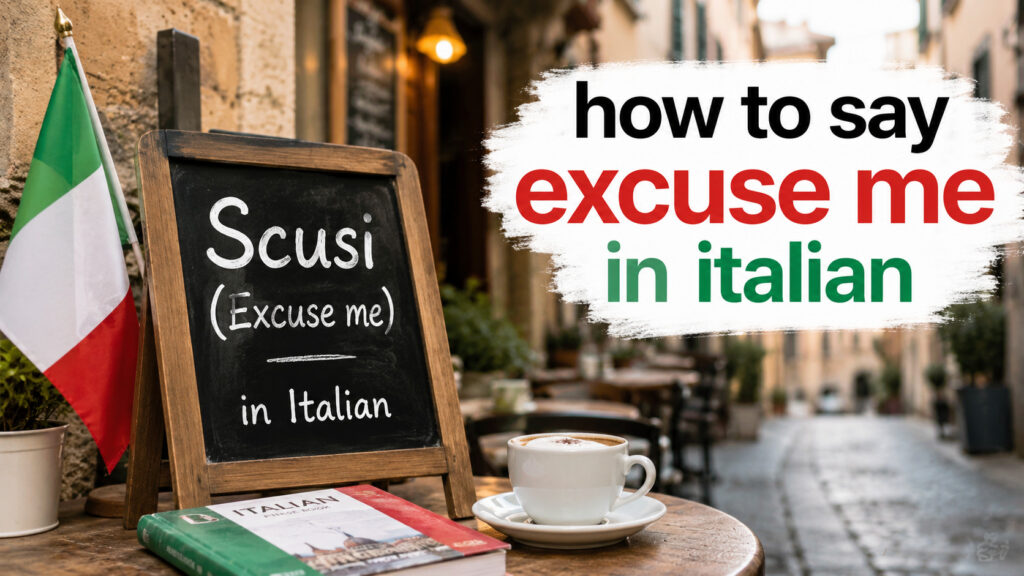
Ever squeezed through a crowded Italian market or accidentally bumped into someone on a narrow street in Rome and had no idea what to say? Politeness matters in Italian culture, and knowing how to say excuse me in Italian can help you navigate everyday situations with grace. This guide breaks down the meaning, pronunciation, and proper usage of this essential phrase so you can speak with confidence wherever you go.
Meaning and Translation
The most common way to say excuse me in Italian is “Scusa” (SKOO-zah) in informal settings or “Scusi” (SKOO-zee) in formal ones. Both words come from the verb “scusare,” meaning “to excuse.” Italians also use “Permesso” (pehr-MEH-soh), which literally translates to “permission” and is used specifically when trying to pass through a crowd or enter a space. Understanding the difference between these expressions will help you choose the right one depending on the situation.
Pronunciation
Getting the pronunciation right will help these phrases roll off your tongue naturally. “Scusa” is pronounced SKOO-zah, with the stress on the first syllable. “Scusi” follows a similar pattern, pronounced SKOO-zee, also stressed on the first syllable. “Permesso” is broken into three syllables, pehr-MEH-soh, with the stress falling on the middle syllable. Italian pronunciation is fairly phonetic, meaning words are generally pronounced the way they are spelled, which makes these phrases easier to pick up with a little practice.
Common Ways to Say It
Italians rely on a few key variations depending on the context. “Scusa” is used casually, such as when getting a friend’s attention or apologizing for a minor inconvenience. “Scusi” is the polite version, appropriate for strangers, older individuals, or professional settings. “Permesso” is specifically used when moving through a crowded space, like getting off a bus or walking through a packed café. Learning when to use each one will make your Italian sound more natural and appropriate to the moment.
Formal and Informal Usage
Italian places a strong emphasis on formality, and choosing the wrong version of “excuse me” can come across as impolite. “Scusa” should be reserved for friends, family, peers, or children, since it uses the informal “tu” form. “Scusi,” on the other hand, uses the formal “Lei” form and is the safer choice when speaking with someone you do not know, an elder, or in a professional environment such as a shop or office. When in doubt, especially as a beginner or visitor, defaulting to “Scusi” is generally the more respectful option.
Related Phrases
A few related expressions pair well with “excuse me” in everyday Italian conversation. “Mi dispiace” means “I am sorry” and is used for more sincere apologies rather than a quick excuse me. “Con permesso” is a slightly more polite variation of “Permesso,” often used when leaving a room or table. “Scusami” is another informal variation of “Scusa,” adding a direct object pronoun that translates roughly to “excuse me” but with a bit more personal emphasis. These phrases help round out your ability to navigate polite conversation in Italian.
Real-Life Examples with English Translations
Seeing these phrases in real situations can help you remember when to use them. Here are a few practical examples:
“Scusi, dov’è la stazione?” translates to “Excuse me, where is the station?” a polite way to ask a stranger for directions.
“Permesso, devo scendere qui.” means “Excuse me, I need to get off here,” useful when navigating public transportation.
“Scusa, puoi ripetere?” translates to “Excuse me, can you repeat that?” a casual phrase used with friends during conversation.
Common Mistakes
One frequent mistake learners make is using “Scusa” with strangers or in formal settings, which can come across as too casual or even disrespectful. Another common error is confusing “Permesso” with “Scusi,” using “Permesso” to apologize rather than to ask to pass through a space. Some learners also forget to adjust their tone and body language to match the phrase, since Italian communication often pairs polite words with clear, respectful gestures. Practicing the correct context for each phrase will help you sound more natural and culturally aware.
Final Thoughts
Learning how to say excuse me in Italian is a small but meaningful step toward navigating everyday interactions with confidence and respect. Whether you use the casual “Scusa” with friends, the formal “Scusi” with strangers, or “Permesso” to move through a crowd, understanding the context behind each phrase will help you communicate more naturally. With a bit of practice, these polite expressions will soon feel like second nature during your travels or conversations in Italian.