Have you ever noticed how family words often carry more warmth in other languages than they do in English? Italian is known for its close family culture, and the words used for grandparents reflect that closeness in a way that goes beyond simple translation. If you are learning how to say grandpa in Italian, this guide will walk you through the meaning, pronunciation, common variations, and real conversational examples so you can talk about family naturally and with the right tone.
Meaning and Translation
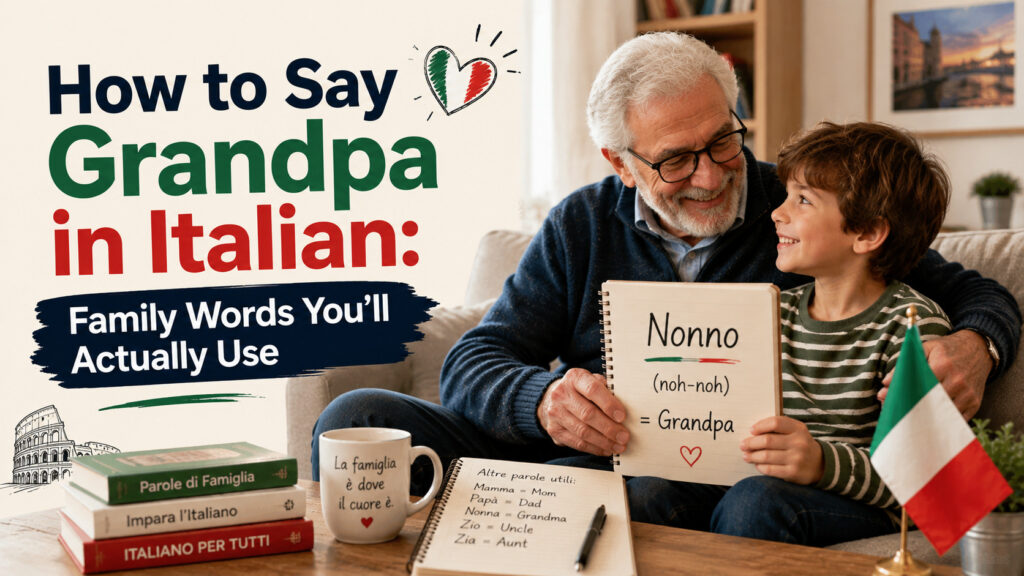
The standard Italian word for grandpa is nonno. This is the direct and most commonly used translation, referring to a paternal or maternal grandfather without distinction. Italian does not separate grandfather terms by side of the family the way some languages do, so nonno applies equally whether you are talking about your mother’s father or your father’s father. The word is masculine and follows regular Italian noun patterns, making it straightforward for beginners to learn and use.
Pronunciation
Nonno is pronounced “NOHN-noh.” The stress falls on the first syllable, and the double “n” in the middle should be pronounced with a slightly longer, more emphasized sound than a single n, which is a common feature in Italian. The final “o” is short and clear, similar to the o in “note” but without lengthening it. Practicing the double consonant sound is important, since Italian relies heavily on these subtle differences to distinguish between similar-looking words.
Common Ways to Say It
While nonno is the standard word, Italian has a few affectionate variations depending on the region and relationship:
Nonnino is a diminutive, affectionate form often used by young children or to express extra warmth toward a beloved grandfather.
Il mio nonno means “my grandfather,” commonly used when specifying whose grandfather is being discussed.
Nonno paterno specifically means “paternal grandfather,” used when clarity about which side of the family is needed.
Nonno materno specifically means “maternal grandfather,” used in the same clarifying context.
These variations allow speakers to be more specific or more affectionate depending on the situation, while nonno remains the standard term in everyday use.
Formal and Informal Usage
In formal settings, such as filling out official documents, discussing family history, or speaking in a professional context, nonno paterno or nonno materno are used to clearly identify which grandfather is being referenced. This level of specificity is common in written or official Italian.
In informal, everyday conversation, Italians almost always simply say nonno without specifying which side of the family, since the context usually makes it clear. Children in particular often use nonnino as a sweet, informal nickname, similar to how English speakers might say “grandpa” or “papa” instead of the more neutral “grandfather.” The warmth built into these informal terms reflects how central grandparents often are in Italian family life.
Related Phrases
Learning related family vocabulary makes it easier to talk about grandparents naturally in conversation:
Nonna meaning “grandmother,” the female counterpart to nonno.
I miei nonni meaning “my grandparents,” used to refer to both grandparents together.
Nonno e nonna meaning “grandpa and grandma,” commonly used when referring to both by name or role.
Vado dai nonni meaning “I am going to my grandparents’ house,” a common everyday phrase in Italian family life.
These phrases are especially useful for beginners who want to describe family visits, relationships, or holiday traditions involving grandparents.
Real-Life Examples with English Translations
Seeing these words in real conversation helps reinforce how they are naturally used. Here are a few examples:
A: Come si chiama tuo nonno? (What is your grandpa’s name?) B: Si chiama Giuseppe. (His name is Giuseppe.)
A: Vai spesso dai tuoi nonni? (Do you visit your grandparents often?) B: Sì, vado ogni domenica. (Yes, I go every Sunday.)
A: Il mio nonno paterno vive in Sicilia. (My paternal grandfather lives in Sicily.) B: Che bello, ci vai spesso? (That is nice, do you visit often?)
A: Nonno, mi racconti una storia? (Grandpa, will you tell me a story?) B: Certo, vieni qui. (Of course, come here.)
Common Mistakes
Learners often make a few common mistakes when using this word. One frequent error is confusing nonno with nonna, since the words look and sound similar but refer to grandfather and grandmother respectively. Another mistake is forgetting the double consonant sound in nonno, which can make the pronunciation sound closer to an unrelated or incorrect word. Some learners also overuse nonno paterno or nonno materno in casual conversation, when simply saying nonno is more natural unless clarification is specifically needed. Paying attention to these small details helps make family conversations sound more fluent and accurate.
Final Thoughts
Learning how to say grandpa in Italian involves more than memorizing a single word. It includes understanding pronunciation, common affectionate variations, and how Italian family vocabulary reflects close relationships. By practicing the phrases and examples covered in this guide, you will be able to talk about grandparents naturally, whether you are sharing family stories, describing relationships, or simply greeting a loved one in Italian.