Have you ever wanted to surprise a Russian friend, coworker, or online language partner with a birthday message that actually sounds natural instead of a stiff textbook line? Russian birthday culture is warm, expressive, and full of heartfelt phrases that go beyond a simple greeting. If you are learning how to say happy birthday in Russian, this guide will walk you through the meaning, pronunciation, common expressions, and real examples so you can wish someone well with confidence.
Meaning and Translation
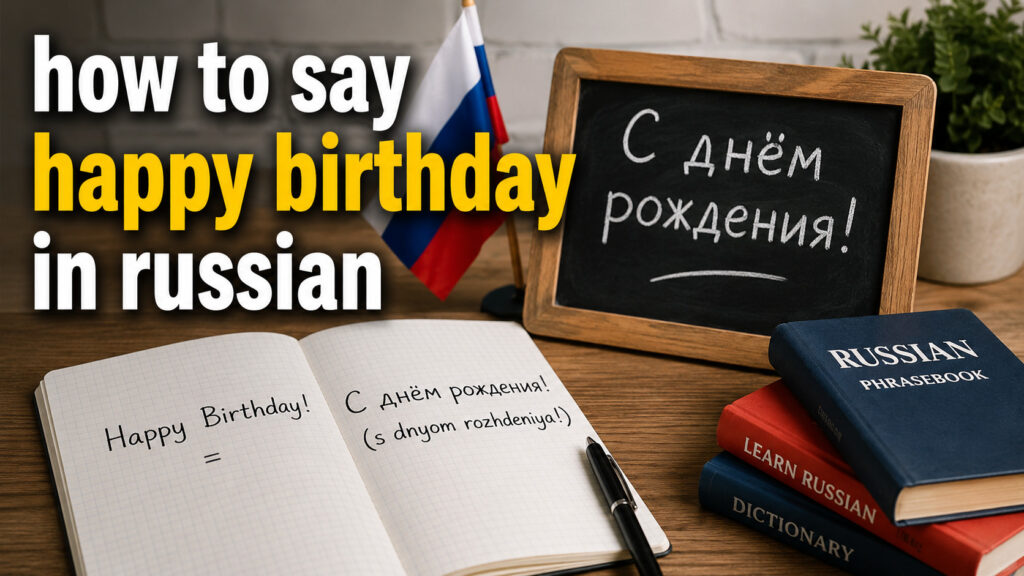
The most common way to say happy birthday in Russian is “С днём рождения” (S dnyom rozhdeniya). This phrase literally translates to “with day of birth,” which is the standard Russian way of expressing birthday wishes. Unlike English, Russian does not use a direct word-for-word version of “happy,” so the phrase leans on the preposition “с” (with) to convey celebration, similar to how Russians say “with the holiday” for other occasions.
Pronunciation
Getting the pronunciation right makes a big difference in how natural your greeting sounds. Break it down like this: “S” sounds like the English letter S, “dnyom” rhymes with “gnome” but starts with a soft “d” sound, and “rozhdeniya” is pronounced roh-ZHDYEH-nee-yah, with the stress falling on the second syllable. Practicing it slowly first and then speeding it up naturally will help you sound more fluent when speaking to native speakers.
Common Ways to Say It
While “С днём рождения” is the standard phrase, Russians use several variations depending on the mood and relationship. “Поздравляю с днём рождения” (Pozdravlyayu s dnyom rozhdeniya) means “I congratulate you on your birthday” and is slightly more formal. A shorter and more casual version simply says “С днюхой” (S dnyukhoy), which is slang for birthday and is common among close friends and younger speakers. Choosing the right version depends on who you are speaking to and how casual the setting is.
Formal and Informal Usage
Russian, like many languages, distinguishes between formal and informal speech. When speaking to an elder, a boss, or someone you do not know well, it is best to use the full phrase “Поздравляю вас с днём рождения” (Pozdravlyayu vas s dnyom rozhdeniya), which uses the formal “you” (вас). For friends, classmates, or family members, you can drop the formal pronoun and simply say “С днём рождения” or add a warm personal touch like “Поздравляю тебя с днём рождения” using the informal “you” (тебя). Understanding this distinction shows respect and cultural awareness.
Related Phrases
Beyond the basic greeting, Russians often add extra wishes to make the message more heartfelt. Common additions include “Желаю тебе счастья” (I wish you happiness), “Желаю здоровья” (I wish you health), and “Всего наилучшего” (All the best). Another popular phrase is “Пусть все мечты сбудутся” (May all your dreams come true), which is often used in more heartfelt or written messages such as cards and social media posts.
Real-Life Examples with English Translations
Seeing the phrases in context helps them stick. Here are a few natural examples:
“С днём рождения, Аня! Желаю тебе счастья и успехов.” This translates to “Happy birthday, Anya! I wish you happiness and success.” This is a warm, friendly message suitable for a close friend.
“Поздравляю вас с днём рождения, Иван Петрович. Желаю крепкого здоровья.” This means “Happy birthday, Ivan Petrovich. I wish you strong health.” This formal version is appropriate for an older colleague or respected figure.
“С днём рождения! Пусть этот год принесёт много радости.” This translates to “Happy birthday! May this year bring lots of joy.” This phrase works well for casual greetings among peers or acquaintances.
Common Mistakes
Many learners make small errors that can change the tone of the message. One frequent mistake is forgetting the preposition “с” and simply saying “Днём рождения,” which sounds incomplete. Another common error is mixing up formal and informal pronouns, such as using “тебя” with someone who expects the respectful “вас.” Learners also sometimes translate “happy” too literally, trying to say “счастливого дня рождения,” which is grammatically understandable but far less natural than the standard expression. Paying attention to these details will help your Russian sound more authentic.
Final Thoughts
Learning how to say happy birthday in Russian is a simple yet meaningful way to connect with Russian speakers and show cultural appreciation. Whether you choose the standard “С днём рождения,” a formal version for someone you respect, or a warm phrase paired with extra wishes, the key is to speak with sincerity. With a little practice, this small phrase can open the door to more genuine connections and a deeper appreciation of the Russian language.