
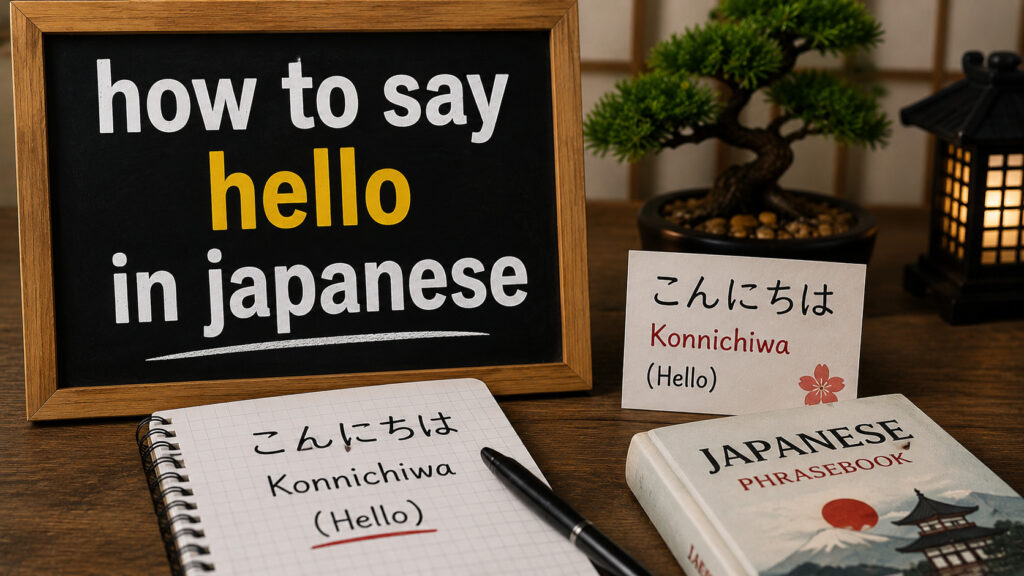
Did you know that Japanese has separate greetings for morning, afternoon, and evening, with no single word that works at every hour like “hello” does in English? This time based approach to greetings reflects the importance Japanese culture places on context and consideration for others. If you are starting to learn the language or preparing for a trip to Japan, understanding how to say hello in Japanese properly, including which greeting fits which moment, will help you communicate with genuine confidence.
This guide walks through the meaning, pronunciation, and correct usage of Japanese hello phrases so you always choose the right words at the right time.
Meaning and Translation
The standard word most people associate with hello in Japanese is こんにちは (Konnichiwa). Breaking the word down, konnichi refers to “this day” or “today,” and wa functions as a topic marking particle. Together, the phrase carries a meaning closer to “regarding today,” which evolved into a general daytime greeting equivalent to “hello” or “good afternoon” in English.
Japanese also uses separate words depending on the time of day. おはようございます (Ohayo Gozaimasu) means “good morning,” and こんばんは (Konbanwa) means “good evening.” Unlike English, where “hello” can be used at any hour, Japanese greetings are tied more closely to when the conversation is taking place.
Pronunciation
Konnichiwa is pronounced “kohn-nee-chee-wah,” with each syllable given clear, even pronunciation. The double “n” sound should be held slightly longer than usual, and there is no strong stress on any particular syllable, since Japanese pronunciation tends to be flatter and more even than English.
Ohayo Gozaimasu is pronounced “oh-hah-yoh goh-zai-mahs.” In casual speech, the final “u” sound at the end of masu is often softened or nearly silent, a common feature in natural spoken Japanese.
Konbanwa is pronounced “kohn-bahn-wah,” following a similar rhythm to Konnichiwa, with clear, evenly spaced syllables.
Because Japanese does not rely on stress accents the way English does, focusing on pronouncing each syllable clearly and at a steady pace will help your greetings sound more natural than trying to emphasize specific parts of the word.
Common Ways to Say It
こんにちは (Konnichiwa) remains the most recognizable and widely used greeting, appropriate for daytime hours, roughly from late morning through early evening.
おはようございます (Ohayo Gozaimasu) is used specifically in the morning and is one of the most frequently spoken greetings in Japan, especially in workplaces, schools, and among neighbors.
こんばんは (Konbanwa) is reserved for the evening hours, used as the sun goes down and the day transitions into nighttime.
もしもし (Moshi Moshi) is a unique greeting used specifically when answering the telephone, functioning as a spoken “hello” exclusively in that context and not used in face to face greetings.
Formal and Informal Usage
こんにちは (Konnichiwa) works comfortably in both semi formal and everyday casual situations, making it a dependable choice when greeting acquaintances, classmates, neighbors, or people you do not know especially well.
おはようございます (Ohayo Gozaimasu) is the polite, formal version of the morning greeting and is standard in professional and academic settings. Among close friends, this is often shortened to simply おはよう (Ohayo), dropping the polite ending for a more casual tone.
こんばんは (Konbanwa) similarly works well in both formal and informal evening settings without needing much adjustment based on who you are speaking to.
For business settings specifically, greetings are often paired with a slight bow and a clear, polite tone, regardless of which time based greeting is used, reflecting the broader emphasis on respect within Japanese communication.
Related Phrases
お元気ですか (Ogenki Desu Ka) means “how are you,” a natural phrase to follow any of the greetings above.
はじめまして (Hajimemashite) means “nice to meet you,” used specifically the first time you meet someone.
失礼します (Shitsurei Shimasu) literally means “excuse my rudeness” and is often used as a polite phrase when entering a room or ending a conversation, particularly in formal settings.
よろしくお願いします (Yoroshiku Onegaishimasu) is a versatile phrase often used after an introduction, roughly meaning “please treat me well” or “I look forward to working with you.”
さようなら (Sayonara) means “goodbye,” though it tends to imply a longer or more definitive farewell rather than a casual parting.
Real-Life Examples with English Translations
こんにちは、今日はいい天気ですね。 (Konnichiwa, kyou wa ii tenki desu ne.) Hello, the weather is nice today, isn’t it?
おはようございます、よく眠れましたか。 (Ohayo gozaimasu, yoku nemuremashita ka.) Good morning, did you sleep well?
こんばんは、お疲れ様でした。 (Konbanwa, otsukaresama deshita.) Good evening, thank you for your hard work today.
もしもし、田中ですが。 (Moshi moshi, Tanaka desu ga.) Hello, this is Tanaka speaking. (used when answering the phone)
こんにちは、はじめまして、よろしくお願いします。 (Konnichiwa, hajimemashite, yoroshiku onegaishimasu.) Hello, nice to meet you, I look forward to working with you.
Common Mistakes
One common mistake is using こんにちは (Konnichiwa) at any hour of the day, including early morning or late at night, when a time specific greeting like Ohayo Gozaimasu or Konbanwa would be more appropriate and natural.
Another mistake is using もしもし (Moshi Moshi) in face to face conversation, since this greeting is reserved exclusively for phone calls and can sound confusing or out of place if used elsewhere.
Some learners also drop the polite ending gozaimasu from Ohayo in formal settings where politeness is expected, which can come across as too casual, particularly in professional or unfamiliar situations.
Finally, applying English style stress patterns to Japanese greetings, rather than pronouncing each syllable evenly, is a frequent mistake that can make otherwise correct words sound slightly unnatural to native speakers.
Final Thoughts
Understanding how to say hello in Japanese means learning more than a single word, since the language ties its greetings closely to the time of day and the level of formality involved. With こんにちは (Konnichiwa) for daytime, おはようございます (Ohayo Gozaimasu) for mornings, and こんばんは (Konbanwa) for evenings, you now have a solid foundation for greeting people appropriately in nearly any setting. Paying attention to timing and tone will help your Japanese greetings feel natural, respectful, and genuinely well suited to the moment.


