
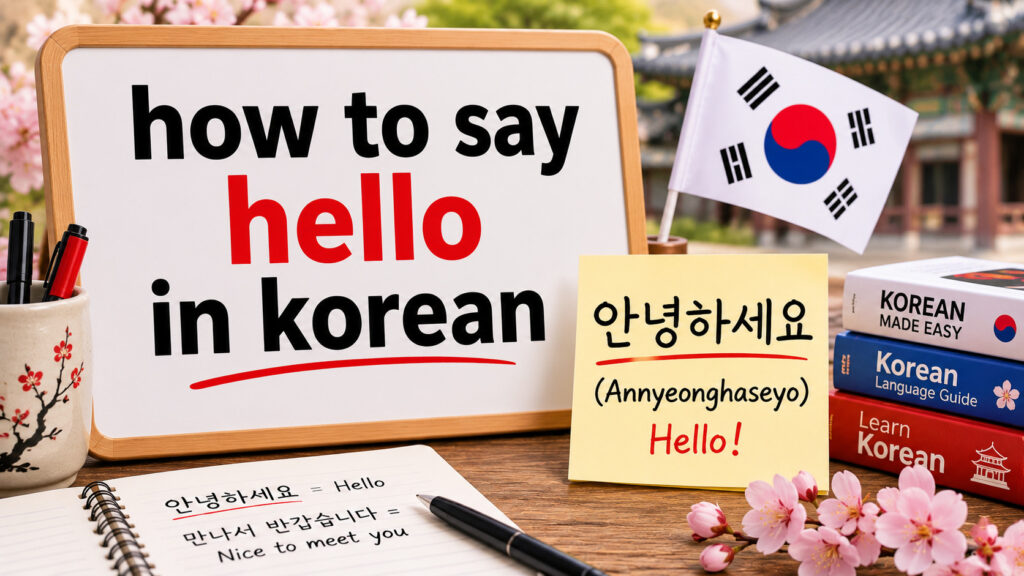
Ever noticed how K-dramas and K-pop have made Korean one of the most searched languages to learn in recent years? With that growing interest comes a simple but important first step: learning how to greet someone properly. If you are learning how to say hello in Korean, this guide covers the meaning, pronunciation, and everyday usage of the most common greetings so you can speak with confidence and respect.
Meaning and Translation
The most common way to say hello in Korean is “안녕하세요” (annyeonghaseyo). This polite, standard greeting is used in most everyday situations and translates loosely to “Are you at peace?” reflecting the caring nature often embedded in Korean expressions. A shorter, more casual version, “안녕” (annyeong), is used among close friends or people younger than you. Korean greetings shift depending on formality, which is an essential part of the language and culture.
Pronunciation
Pronouncing “안녕하세요” correctly involves breaking it into syllables: ahn-nyeong-ha-se-yo. The stress is fairly even across the phrase, without one syllable standing out strongly, which is typical in Korean. The casual version, “안녕,” is pronounced ahn-nyeong, with a soft nasal ending on the final syllable. Korean pronunciation relies heavily on its own writing system, called Hangul, so learning to read the characters alongside the romanized pronunciation will help you build accuracy faster.
Common Ways to Say It
Beyond the standard “안녕하세요,” Korean speakers use different greetings depending on the time of day and setting, though Korean does not have separate words for “good morning” or “good evening” the way English does. Instead, “안녕하세요” works at any time of day. In very formal or respectful situations, such as addressing an elder or someone significantly higher in social status, Koreans use “안녕하십니까” (annyeonghasimnikka), an even more formal version often heard in news broadcasts, speeches, or military contexts.
Formal and Informal Usage
Korean is well known for its complex system of speech levels, and greetings are a clear example of this in action. “안녕” is strictly informal and should only be used with close friends, younger people, or family members of a similar age. “안녕하세요” is the standard polite form, appropriate for most everyday interactions, including with strangers, coworkers, or people you have just met. “안녕하십니까” is the most formal option, typically reserved for very respectful or official settings. Choosing the right level of formality shows respect and cultural understanding, which is highly valued in Korean society.
Related Phrases
A few related phrases can help you continue a conversation after your initial greeting. “반갑습니다” (bangapseumnida) means “nice to meet you,” often used right after an introduction. “감사합니다” (gamsahamnida) means “thank you” in a polite form. “잘 지내세요?” (jal jinaeseyo) means “How have you been?” a common follow-up question. “안녕히 가세요” (annyeonghi gaseyo) means “goodbye,” specifically said to someone who is leaving, while “안녕히 계세요” (annyeonghi gyeseyo) is used when you are the one leaving and the other person is staying.
Real-Life Examples with English Translations
Seeing these phrases in context can help you understand how they are used naturally. Here are a few examples:
“안녕하세요, 반갑습니다.” translates to “Hello, nice to meet you,” a common phrase used when meeting someone for the first time.
“안녕! 잘 지냈어?” means “Hi! Have you been well?” a casual greeting used between close friends.
“안녕하십니까, 여러분.” translates to “Hello, everyone,” a formal greeting often heard at the start of a speech or presentation.
Common Mistakes
One common mistake learners make is using the casual “안녕” with someone older or in a professional setting, which can come across as disrespectful. Another frequent error is skipping the effort to learn Hangul altogether and relying only on romanization, which can lead to pronunciation mistakes since Korean sounds do not always match English letter patterns exactly. Learners also sometimes assume Korean greetings change based on the time of day like in English, when in reality “안녕하세요” works consistently throughout the day regardless of morning, afternoon, or evening.
Final Thoughts
Learning how to say hello in Korean is a meaningful first step into a language deeply connected to respect, relationships, and social awareness. Whether you use the casual “안녕” with friends or the polite “안녕하세요” in everyday interactions, understanding the right level of formality will help you communicate naturally and respectfully. With consistent practice, these greetings can become a comfortable and genuine part of your growing Korean vocabulary.


