Have you ever walked into a Spanish speaking country and realized that “hola” is only the beginning of a much richer greeting culture? With over twenty countries speaking Spanish across the globe, greetings can shift slightly depending on the time of day, the region, and who you are talking to. If you are just starting your Spanish learning journey or brushing up before a trip, knowing how to say hello in Spanish properly will help you make a great first impression wherever you go.
This guide covers the meaning, pronunciation, and everyday usage of Spanish greetings so you can speak with natural confidence.
Meaning and Translation
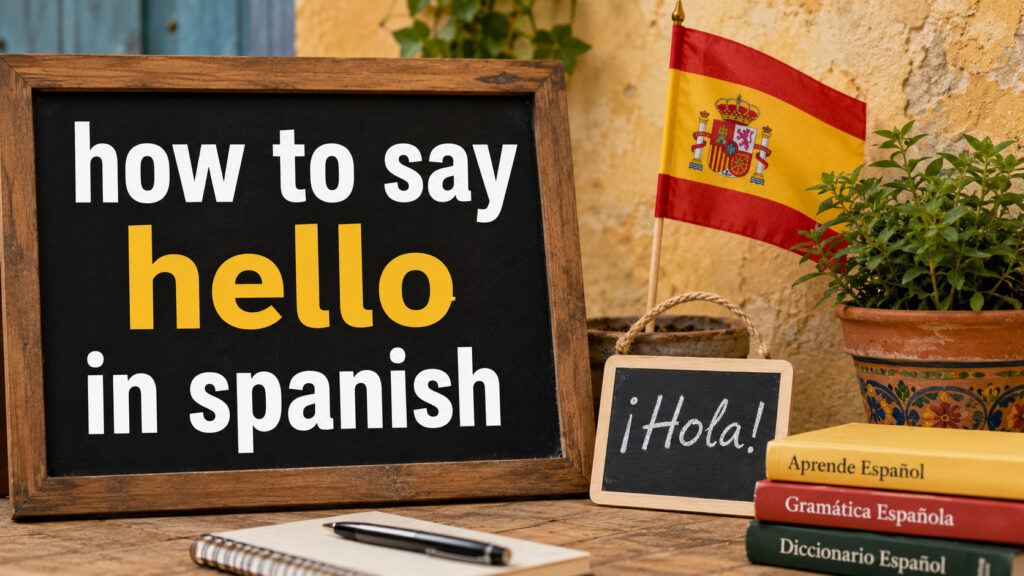
The most universal way to say hello in Spanish is Hola. This short, simple word works at any time of day and in nearly any setting, making it the first greeting most learners pick up. Hola does not carry any deeper literal meaning beyond “hello,” functioning much like its English counterpart.
Spanish also offers time specific greetings, similar to English. Buenos días means “good morning,” combining buenos, meaning “good,” and días, meaning “days.” Buenas tardes means “good afternoon,” and buenas noches means “good evening” or “good night,” depending on the context.
Understanding both the universal and time based greetings gives you flexibility to match your hello to the situation naturally.
Pronunciation
Hola is pronounced “OH-lah.” The “h” is completely silent in Spanish, a common feature that trips up many English speakers at first. The stress falls on the first syllable, and both vowels are pronounced clearly and fully.
Buenos días is pronounced “BWEH-nohs DEE-ahs.” The “ue” combination creates a quick “weh” sound, and días is pronounced with stress on the first syllable, “DEE-ahs.”
Buenas tardes is pronounced “BWEH-nahs TAR-dehs,” and buenas noches is pronounced “BWEH-nahs NOH-chehs.” In each phrase, buenas shifts to its feminine form to match días, tardes, and noches, which are all grammatically feminine or masculine nouns requiring gender agreement.
Spanish pronunciation is largely phonetic, meaning words are generally pronounced exactly as they are spelled, which makes these greetings especially approachable for beginners.
Common Ways to Say It
Hola is the most versatile and commonly used greeting, appropriate at any hour and in almost any social setting, from casual chats to first introductions.
Buenos días is used specifically in the morning, generally until around noon, and is a polite, widely used greeting throughout the Spanish speaking world.
Buenas tardes covers the afternoon hours, typically from noon until early evening, while buenas noches applies to both greeting someone in the evening and saying goodnight, since the same phrase serves both purposes in Spanish.
¿Qué tal? is a common, casual way to say hello that also means “how’s it going,” often used interchangeably as a greeting among friends and peers.
Formal and Informal Usage
Hola works comfortably in both casual and semi formal situations, making it a safe, flexible choice for beginners in nearly every context, from greeting a friend to addressing a store clerk.
Buenos días, buenas tardes, and buenas noches tend to carry a slightly more polite or formal tone, often used when greeting strangers, elders, or in professional settings such as offices, hotels, or restaurants. These time based greetings are also commonly used when entering a room or store, even among people who do not know each other.
¿Qué tal? and its cousin ¿Qué onda?, popular in Mexico, are strictly casual, best reserved for friends, peers, or people close to your own age. Using these with someone significantly older or in a formal setting may come across as overly familiar.
When in doubt, especially with someone you do not know well, starting with a time appropriate greeting like Buenos días shows politeness and cultural awareness.
Related Phrases
¿Cómo estás? means “how are you,” a natural follow up question after any greeting.
Mucho gusto means “nice to meet you,” commonly used during introductions.
¿Cómo te llamas? means “what is your name,” useful right after saying hello to someone new.
Adiós means “goodbye,” a standard way to end a conversation.
Hasta luego means “see you later,” a common, friendly way to part ways.
Real-Life Examples with English Translations
Hola, ¿cómo estás? Hello, how are you?
Buenos días, ¿tiene una mesa disponible? Good morning, do you have an available table?
Buenas tardes, mucho gusto en conocerlo. Good afternoon, nice to meet you.
¿Qué tal? Hace mucho que no te veo. How’s it going? I have not seen you in a while.
Buenas noches a todos, que descansen. Good evening everyone, rest well.
Common Mistakes
One common mistake is pronouncing the silent “h” in Hola, adding an audible “h” sound at the beginning of the word when it should be completely silent in Spanish.
Another mistake is using Buenas noches only to mean “goodnight,” forgetting that it also functions as a proper evening greeting when arriving somewhere or meeting someone after dark.
Some learners also forget gender agreement, mistakenly saying buenos tardes or buenas días instead of the correct buenas tardes and buenos días, since días is masculine while tardes and noches are feminine.
Finally, using casual expressions like ¿Qué tal? in formal situations, such as a job interview or when speaking with an elder for the first time, can come across as too relaxed. Sticking with a time appropriate greeting in unfamiliar or professional settings is the safer choice.
Final Thoughts
Learning how to say hello in Spanish gives you a flexible set of tools to greet anyone, anywhere, at any time of day. With Hola as your reliable everyday greeting and Buenos días, Buenas tardes, and Buenas noches for more time specific or polite situations, you are well equipped to navigate greetings naturally across the Spanish speaking world. Practice the pronunciation, pay attention to context, and you will find that a simple hello opens the door to countless meaningful conversations.