
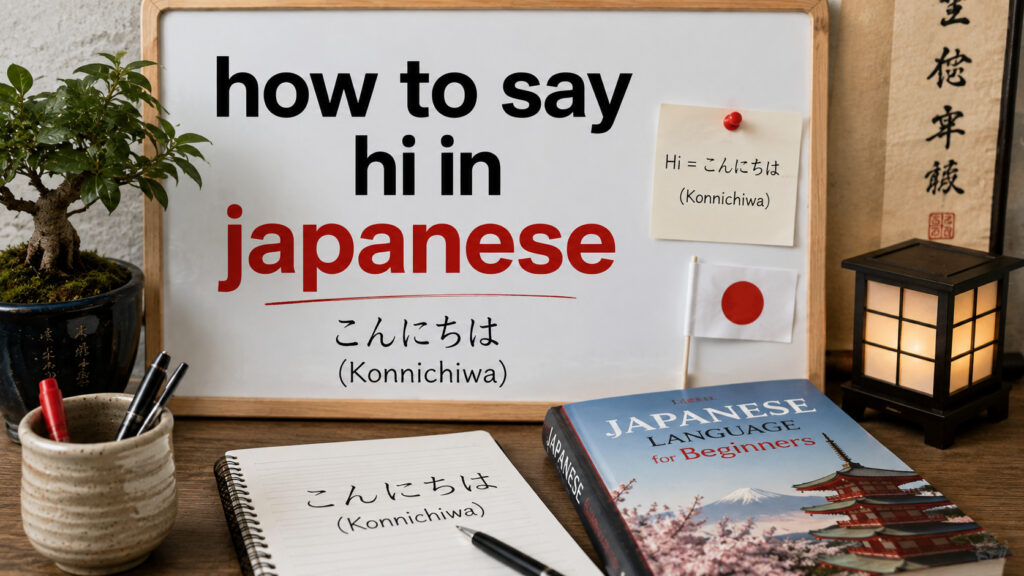
Have you ever noticed how the greeting you choose in Japanese can depend heavily on the time of day, rather than just the situation? Unlike English, where “hi” works around the clock, Japanese greetings shift depending on when you are speaking. If you are planning a trip to Japan, studying the language, or simply want to greet Japanese speaking friends correctly, learning how to say hi in Japanese is a great first step into the language.
This guide covers the meaning, pronunciation, and natural usage of Japanese greetings so you can say hello confidently in any situation.
Meaning and Translation
The most well known way to say hi in Japanese is こんにちは (Konnichiwa). This word is often translated simply as “hello,” but it literally combines konnichi, meaning “this day,” with wa, a topic marker, giving it a deeper meaning closer to “as for today.” In practice, it functions as a general daytime greeting, similar to “hello” or “good afternoon” in English.
For a more casual and versatile option, many Japanese speakers simply say どうも (Domo), which can mean “hi,” “thanks,” or “hey there,” depending on context. It is short, flexible, and widely used in everyday interactions.
Another common casual greeting, especially among younger speakers, is おっす (Ossu), a very informal way to say “hi” or “yo,” typically used between close friends.
Pronunciation
Konnichiwa is pronounced “kohn-nee-chee-wah.” Japanese pronunciation is generally consistent, with each syllable pronounced clearly and evenly, without the strong stress patterns found in English. The double “n” sound in the middle is held slightly longer than a single “n.”
Domo is pronounced “DOH-moh,” with both syllables given roughly equal weight, though a light emphasis is often placed on the first syllable in casual speech.
Ossu is pronounced “OHS-soo,” a short, punchy word with the double “s” sound held briefly, giving it a slightly clipped, energetic feel that matches its casual tone.
Since Japanese does not use stress accents the way English does, focusing on even, clear pronunciation of each syllable will help you sound more natural than trying to emphasize particular syllables.
Common Ways to Say It
こんにちは (Konnichiwa) is the standard, most recognized greeting used during the daytime, roughly from late morning until early evening, and works well in most everyday situations.
おはよう (Ohayo), or the more polite おはようございます (Ohayo Gozaimasu), means “good morning” and is used specifically in the morning hours, often extending informally throughout the day among coworkers as a way to say hi at the start of an interaction.
どうも (Domo) offers a flexible, casual way to greet someone at any time of day, often used among coworkers, acquaintances, or in quick, informal exchanges.
やあ (Yaa) is another casual greeting, similar to a relaxed “hey,” commonly used among friends or in informal settings.
Formal and Informal Usage
こんにちは (Konnichiwa) works well in both semi formal and casual daytime settings, making it a dependable, all purpose greeting for beginners, appropriate for greeting acquaintances, coworkers, or people you do not know very well.
For more formal situations, such as business settings or greeting someone with higher social status, おはようございます (Ohayo Gozaimasu) in the morning is standard and expected in Japanese workplaces, often said upon arriving regardless of how late in the morning it actually is.
Casual greetings like どうも (Domo), やあ (Yaa), and especially おっす (Ossu) are best reserved for friends, peers, or people you know well. Using these in a formal setting, such as with a boss or an elder you have just met, can come across as inappropriately casual.
When uncertain, defaulting to こんにちは (Konnichiwa) during the day is almost always a safe, polite choice across a wide range of social situations.
Related Phrases
こんばんは (Konbanwa) means “good evening,” used as the day transitions into nighttime hours.
お元気ですか (Ogenki Desu Ka) means “how are you,” a common follow up question after an initial greeting.
さようなら (Sayonara) means “goodbye,” though in casual daily life, shorter alternatives are often used instead.
じゃあね (Jaa Ne) means “see you later,” a casual way to part ways with friends.
はじめまして (Hajimemashite) means “nice to meet you,” used specifically during first introductions.
Real-Life Examples with English Translations
こんにちは、お元気ですか。 (Konnichiwa, ogenki desu ka.) Hello, how are you?
どうも、久しぶり! (Domo, hisashiburi!) Hey, long time no see!
おはようございます、今日もよろしくお願いします。 (Ohayo gozaimasu, kyou mo yoroshiku onegaishimasu.) Good morning, thank you for your help today. (a common formal workplace greeting)
やあ、元気にしてた? (Yaa, genki ni shiteta?) Hey, how have you been?
こんにちは、はじめまして。 (Konnichiwa, hajimemashite.) Hello, nice to meet you.
Common Mistakes
One common mistake is using こんにちは (Konnichiwa) too early in the morning or too late at night, since it is specifically a daytime greeting. Switching to おはよう (Ohayo) in the morning or こんばんは (Konbanwa) in the evening keeps your greeting time appropriate.
Another mistake is using very casual greetings like おっす (Ossu) with someone significantly older or in a professional context, which can unintentionally sound disrespectful. Sticking with こんにちは (Konnichiwa) or a proper morning greeting in unfamiliar situations avoids this issue.
Some learners also assume Japanese greetings function exactly like the English “hi,” usable at any time without adjustment. Understanding that Japanese greetings are often time sensitive is an important cultural and linguistic distinction to keep in mind.
Finally, forgetting that pronunciation should remain even and clear, rather than adding English style stress patterns, can make words like Konnichiwa sound slightly unnatural, even if all the syllables are technically correct.
Final Thoughts
Learning how to say hi in Japanese opens the door to more natural, culturally aware conversations, whether you are traveling, studying the language, or connecting with Japanese speaking friends and colleagues. With こんにちは (Konnichiwa) as your reliable daytime greeting and a few casual alternatives like どうも (Domo) for relaxed settings, you now have the tools to greet people appropriately in almost any situation. Pay attention to timing and formality, and your greetings will feel genuine and well suited to the moment.


