Imagine you are traveling in a Spanish speaking country and suddenly need to find medical help quickly. Would you know the right word to ask for directions or explain the situation clearly? Knowing how to say hospital in Spanish is one of those essential, practical phrases that can genuinely make a difference in an emergency, and thankfully, it is also one of the easiest Spanish words for English speakers to learn.
This guide covers the meaning, pronunciation, and everyday usage of the word so you can communicate confidently in medical situations.
Meaning and Translation
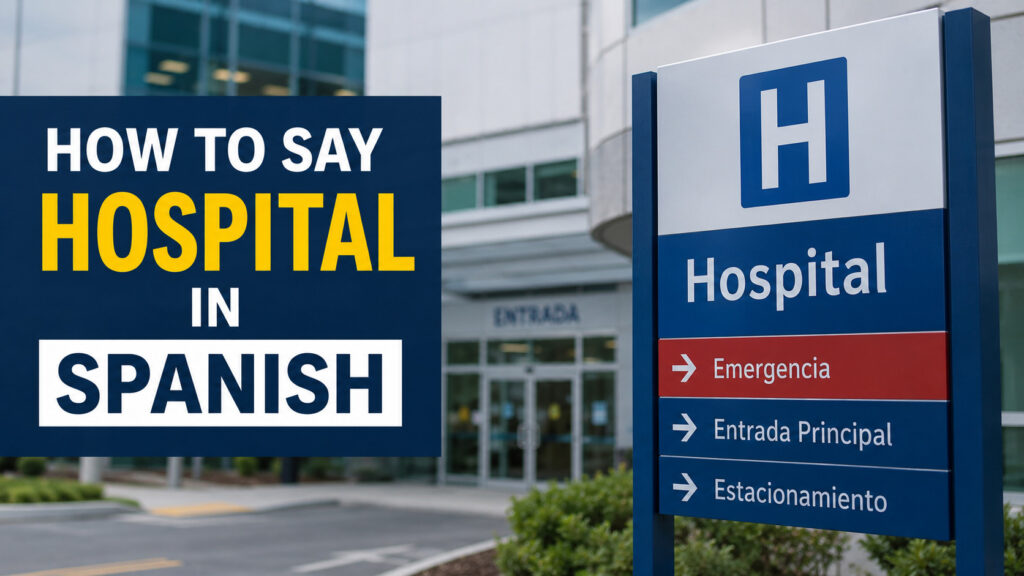
The word for hospital in Spanish is hospital, spelled exactly the same as in English. This is what linguists call a cognate, a word that looks and means the same thing in both languages because both English and Spanish borrowed it from the same Latin root, hospitalis, meaning “relating to a guest or host.”
Because the spelling is identical, hospital is one of the most immediately recognizable Spanish words for English speakers, even before any formal study of the language.
Pronunciation
Although hospital is spelled the same in both languages, the pronunciation is noticeably different. In Spanish, hospital is pronounced “ohs-pee-TAHL,” with the stress falling on the final syllable, unlike the English pronunciation, which stresses the first syllable.
The “h” at the beginning of the word is silent in Spanish, which is a key difference from English. The “o” sounds like the “o” in “hope,” and the final “al” is pronounced clearly, rhyming with the English word “doll” but with a slightly more open vowel sound.
Getting the stress on the correct syllable is the most important part of pronouncing this word naturally, since placing stress on the first syllable, as in English, can make the word harder for native Spanish speakers to immediately recognize.
Common Ways to Say It
Hospital is the standard, universally understood word across Spain and Latin America, and no significant regional variations exist for this term.
El hospital is used with the definite article “el” when referring to a specific hospital or hospitals in general, such as when giving directions or talking about a particular building.
Sala de emergencias means “emergency room,” a related and important phrase for urgent medical situations, often used alongside the word hospital when specifying the part of the building being referenced.
Clínica is a related but distinct word meaning “clinic,” typically referring to a smaller medical facility that may not offer the same full range of services as a hospital, such as emergency care or overnight stays.
Formal and Informal Usage
The word hospital itself does not change between formal and informal contexts, since it is a straightforward noun used the same way regardless of the situation. This consistency makes it especially easy for beginners, as there is no need to memorize multiple versions depending on tone or setting.
In casual conversation, someone might simply say voy al hospital, meaning “I am going to the hospital,” a direct and simple statement appropriate in nearly any context.
In more formal or urgent situations, such as speaking with emergency responders or hospital staff, complete sentences using polite phrasing are helpful, such as ¿Podría decirme dónde está el hospital más cercano?, meaning “Could you tell me where the nearest hospital is?” This adds a layer of politeness appropriate for addressing strangers or professionals during a stressful situation.
Related Phrases
El médico or la médica means “the doctor,” essential vocabulary when discussing hospital visits.
La ambulancia means “the ambulance,” a related term that often comes up in emergency contexts alongside hospital.
La sala de espera means “the waiting room,” a common area referenced when describing the hospital experience.
Tengo una emergencia means “I have an emergency,” a critical phrase to know if you ever need urgent medical help while in a Spanish speaking country.
El seguro médico means “health insurance,” relevant vocabulary when discussing hospital visits or medical costs.
Real-Life Examples with English Translations
Necesito ir al hospital, me duele mucho el estómago. I need to go to the hospital, my stomach hurts a lot.
¿Dónde está el hospital más cercano? Where is the nearest hospital?
Mi hermano trabaja como enfermero en el hospital central. My brother works as a nurse at the central hospital.
Llamen a una ambulancia, hay que llevarlo al hospital. Call an ambulance, we need to take him to the hospital.
El hospital abre las veinticuatro horas para emergencias. The hospital is open twenty four hours for emergencies.
Common Mistakes
One common mistake English speakers make is stressing the first syllable, saying “HOS-pi-tal” instead of the correct “ohs-pee-TAHL.” Since the spelling looks so familiar, it is easy to default to English pronunciation habits without realizing the stress pattern is different.
Another mistake is pronouncing the silent “h” at the beginning of the word. In Spanish, the “h” is not voiced at all, so the word should begin with the open “o” sound rather than an audible “h” sound.
Some learners also confuse hospital with clínica, using them interchangeably when they can refer to different types of medical facilities. While the distinction is not always strict in casual conversation, understanding the difference can help you communicate more precisely, especially in urgent situations.
Finally, forgetting to use el before hospital when referring to a specific location can make sentences sound slightly incomplete, since Spanish typically requires an article before singular nouns in most contexts, unlike some usages in English.
Final Thoughts
Knowing how to say hospital in Spanish, along with a few related emergency phrases, is practical, essential vocabulary that can genuinely help in real life situations, whether you are traveling, living abroad, or communicating with Spanish speaking patients or colleagues. With the correct pronunciation and a handful of useful related phrases, you will be prepared to ask for help clearly and confidently whenever it matters most.