Have you ever sat down at a restaurant in Mexico City or Madrid and realized you had no idea how to tell your server you were starving? Spanish has its own quirky way of expressing hunger, and it is nothing like the direct “I am hungry” you are used to in English. Learning how to say hungry in Spanish the right way will help you sound natural instead of like a textbook. This guide breaks down the meaning, pronunciation, and everyday usage so you can talk about hunger with confidence in any Spanish-speaking country.
Meaning and Translation
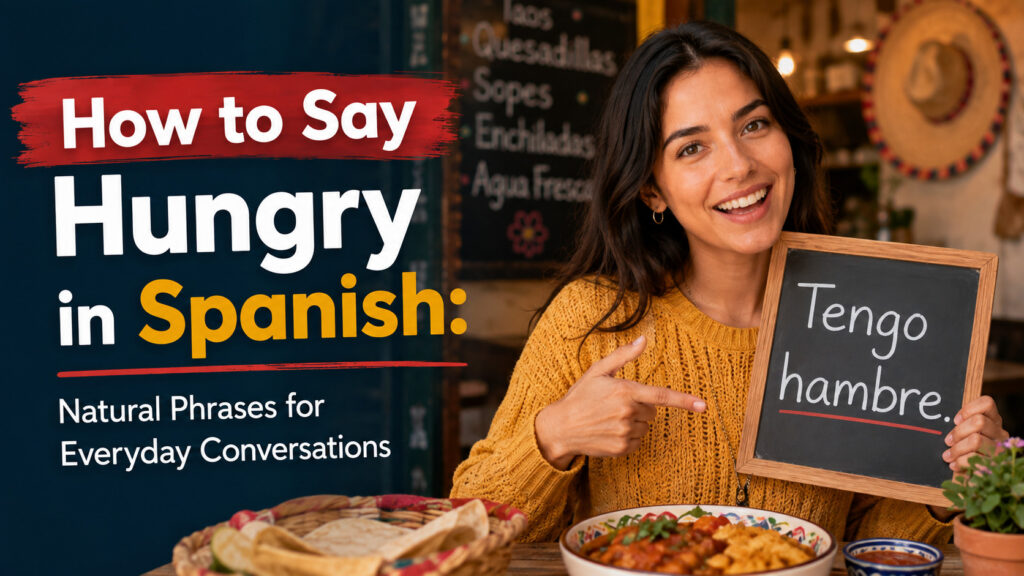
In English, hunger is described using the verb “to be,” as in “I am hungry.” Spanish works differently. Instead of using the verb ser or estar, Spanish uses the verb tener, which means “to have.” So the phrase for hungry in Spanish is tener hambre, which literally translates to “to have hunger.” This is one of the first grammar quirks learners notice, since Spanish treats hunger as something you possess rather than a state you are in. Once you understand this pattern, saying hungry in Spanish becomes much easier to remember.
Pronunciation
Getting the pronunciation right matters just as much as knowing the words. Hambre is pronounced AHM-breh, with a silent h at the beginning, since h is always silent in Spanish. The word tengo, meaning “I have,” is pronounced TEN-goh. Put together, tengo hambre sounds like TEN-goh AHM-breh. Practicing this phrase out loud a few times will help the rhythm feel natural, especially since Spanish vowels are short and crisp compared to English.
Common Ways to Say It
There are several everyday expressions built around tener hambre that native speakers use depending on the situation.
Tengo hambre means “I am hungry” and is the most basic and widely used version.
Tengo mucha hambre means “I am very hungry” and adds emphasis when you are especially famished.
Me muero de hambre translates to “I am dying of hunger” and is a common exaggeration used casually among friends, similar to how English speakers say “I’m starving.”
Tengo un hambre feroz means “I have a fierce hunger” and is used when someone wants to sound dramatic or humorous about their appetite.
These variations show that Spanish speakers, much like English speakers, enjoy adding personality to simple statements rather than always sticking to the plain version.
Formal and Informal Usage
Spanish distinguishes between formal and informal speech more clearly than English does, and this applies to talking about hunger as well. In casual settings, such as with friends or family, tengo hambre or me muero de hambre work perfectly well. In more formal situations, such as speaking with an elder, a boss, or someone you just met, it is common to soften the statement slightly, for example by saying creo que tengo hambre, meaning “I think I am hungry,” or disculpa, tengo un poco de hambre, meaning “excuse me, I am a little hungry.” Adding polite phrases before or after the core expression shows respect without changing the core grammar.
Related Phrases
Beyond the basic expression, there are related phrases that often come up in conversations about food and appetite.
Tengo sed means “I am thirsty” and follows the same tener structure.
¿Tienes hambre? means “Are you hungry?” and is a common question asked before meals.
No tengo hambre means “I am not hungry,” useful when declining food politely.
Se me antoja algo translates loosely to “I am craving something” and is used when you want a specific food rather than general hunger.
Estoy satisfecho or estoy lleno means “I am full,” the natural response after finishing a meal.
Learning these related expressions rounds out your ability to discuss food and appetite in a well-rounded, natural way.
Real-Life Examples with English Translations
Seeing these phrases in context makes them easier to remember and use correctly.
“Tengo hambre, ¿vamos a comer?” translates to “I am hungry, shall we go eat?”
“Mi hijo siempre tiene hambre después de la escuela.” translates to “My son is always hungry after school.”
“No comí nada hoy, me muero de hambre.” translates to “I did not eat anything today, I am starving.”
“¿Tienes hambre o solo quieres un café?” translates to “Are you hungry or do you just want coffee?”
“Después de la caminata, todos teníamos mucha hambre.” translates to “After the hike, we were all very hungry.”
Practicing with real sentences like these helps you internalize the tener hambre structure so it becomes automatic rather than something you have to translate word by word.
Common Mistakes
One of the most frequent errors English speakers make is trying to translate “I am hungry” directly, resulting in the incorrect phrase soy hambre or estoy hambre. Since hunger is expressed with tener rather than ser or estar, these direct translations sound confusing to native speakers. Another common mistake is forgetting to conjugate tener correctly for different subjects. For example, “you are hungry” is tienes hambre, not tener hambre or tengo hambre. Learners also sometimes drop the article incorrectly or add “un” before hambre, saying tengo un hambre instead of tengo hambre, when no article is needed in the basic form. Being aware of these small grammar traps will help you sound more fluent and avoid confusion in everyday conversations.
Final Thoughts
Mastering how to say hungry in Spanish opens the door to more natural, confident conversations, whether you are ordering food, chatting with friends, or traveling through a Spanish-speaking country. Remember that Spanish uses tener hambre instead of a direct translation of “to be hungry,” and once that structure feels familiar, the related phrases and expressions will come easily. With a bit of practice, expressing hunger in Spanish will feel just as natural as it does in your first language.