
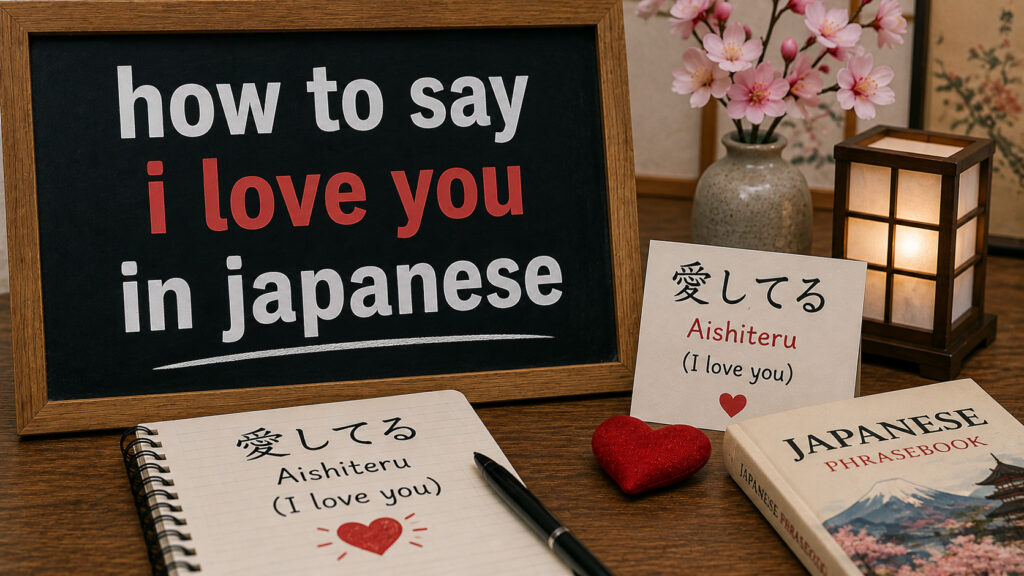
Did you know that in Japan, saying “I love you” out loud is often considered such a big deal that many couples go years into a relationship without ever saying it directly? Japanese culture tends to express love through actions and subtler words rather than frequent verbal declarations, which makes learning how to say I love you in Japanese a fascinating look into both language and culture. Whether you are studying Japanese for a relationship or simply curious about its romantic expressions, understanding these phrases will help you use them appropriately and meaningfully.
This guide covers the meaning, pronunciation, and cultural context behind Japanese expressions of love so you can speak with genuine understanding.
Meaning and Translation
The most direct and serious way to say I love you in Japanese is 愛してる (Aishiteru). This phrase comes from the verb 愛する (aisuru), meaning “to love” in a deep, often romantic or even lifelong sense. Because of its intensity, Aishiteru is used sparingly in real life, often reserved for very serious relationships, marriage proposals, or emotionally significant moments.
A more commonly used phrase in everyday relationships is 好き (Suki), meaning “like,” or its stronger version 大好き (Daisuki), meaning “really like” or “love.” While suki technically translates to “like” rather than “love,” it functions as the standard way Japanese couples express romantic feelings, especially in the early stages of dating or when confessing feelings for the first time.
This distinction matters greatly in Japanese, where the intensity of your words carries real cultural weight.
Pronunciation
Aishiteru is pronounced “ai-shee-teh-roo.” The word breaks into four syllables, with each one pronounced clearly and evenly, following the typical flat rhythm of Japanese speech rather than English style stress patterns.
Suki is pronounced “SKEE,” often said quickly with the “u” sound nearly silent, a common feature in casual spoken Japanese. Daisuki is pronounced “dai-SKEE,” adding the prefix dai, meaning “big” or “very,” to intensify the feeling.
Both phrases are short and relatively easy to pronounce, making them accessible even for absolute beginners just starting to learn Japanese vocabulary.
Common Ways to Say It
好き (Suki) is the most commonly used phrase for expressing romantic interest or love in everyday Japanese relationships, often used when confessing feelings for the first time in a practice known as kokuhaku, or a formal confession of love.
大好き (Daisuki) intensifies the feeling beyond simple liking, often used to express strong affection, though it still falls short of the seriousness carried by Aishiteru.
愛してる (Aishiteru) is reserved for deep, often long term romantic love, and its use is far less frequent in daily conversation compared to English speaking cultures, where “I love you” is said more casually and often.
愛してるよ (Aishiteru yo), adding the particle yo for emphasis, softens the phrase slightly while still conveying deep affection, sometimes used between long term partners in intimate moments.
Formal and Informal Usage
Both 好き (Suki) and 大好き (Daisuki) are inherently casual and personal, appropriate for use with romantic partners, close friends, or even to express strong liking for hobbies, food, or interests in non romantic contexts. Context usually makes the romantic meaning clear when directed at a person.
愛してる (Aishiteru) is almost exclusively used in serious romantic contexts and rarely appears in casual daily conversation, even among couples. Many Japanese partners express love through actions, thoughtful gestures, or the word suki rather than frequently repeating Aishiteru, which is culturally understood to carry significant emotional weight.
There is no formal, professional version of these phrases, since expressing romantic love does not typically arise in formal or business settings within Japanese culture.
Related Phrases
付き合ってください (Tsukiatte Kudasai) means “please go out with me,” a common phrase used when formally asking someone to become your girlfriend or boyfriend.
大切な人 (Taisetsu na Hito) means “important person” or “someone precious,” a tender phrase often used to describe someone you deeply care about.
一緒にいたい (Issho ni Itai) means “I want to be with you,” a heartfelt phrase expressing a desire for closeness.
会いたい (Aitai) means “I want to see you,” commonly used between partners who are apart.
幸せ (Shiawase) means “happiness,” often used in romantic contexts such as “being with you makes me happy.”
Real-Life Examples with English Translations
好きです、付き合ってください。 (Suki desu, tsukiatte kudasai.) I like you, please go out with me. (a traditional confession of love)
大好きだよ、いつもありがとう。 (Daisuki da yo, itsumo arigatou.) I really love you, thank you always.
愛してる、これからもずっと一緒にいよう。 (Aishiteru, korekara mo zutto issho ni iyou.) I love you, let us stay together forever from now on.
会いたいよ、早く週末にならないかな。 (Aitai yo, hayaku shuumatsu ni naranai kana.) I want to see you, I wish the weekend would come sooner.
あなたと一緒にいると幸せです。 (Anata to issho ni iru to shiawase desu.) Being with you makes me happy.
Common Mistakes
One common mistake is using 愛してる (Aishiteru) too casually or too frequently, similar to how English speakers might say “I love you” often. In Japanese, this can feel overly intense or even insincere if used too soon or too regularly, since the phrase carries significant emotional weight.
Another mistake is assuming 好き (Suki) is a weaker or less meaningful expression simply because it translates to “like.” In practice, Suki is the standard, culturally appropriate way to express romantic love in Japan, especially early in a relationship, and should not be underestimated.
Some learners also forget that context matters greatly, since suki and daisuki can refer to liking objects, hobbies, or people, so tone and situation are important for understanding whether the meaning is romantic or general.
Finally, expecting frequent verbal expressions of love, as is common in some English speaking cultures, can lead to misunderstandings, since Japanese partners often show love through actions, thoughtfulness, and consistent presence rather than repeated verbal affirmations.
Final Thoughts
Learning how to say I love you in Japanese reveals as much about the culture as it does about the language itself. With 好き (Suki) and 大好き (Daisuki) as your everyday expressions of romantic affection, and 愛してる (Aishiteru) reserved for deeply meaningful moments, you now understand not just the words, but the emotional context behind them. Using these phrases thoughtfully, with an appreciation for their cultural weight, will help your words feel genuine and well understood.


