Have you ever noticed that Spanish actually has two different ways to express love, each carrying its own emotional weight? Unlike English, where “I love you” works for nearly every relationship, Spanish distinguishes between deep romantic love and warm affection. If you are learning the language for a relationship, planning to impress someone special, or simply curious about romantic expressions, knowing how to say I love you in Spanish properly will help you express exactly what you mean.
This guide breaks down the meaning, pronunciation, and appropriate usage of these phrases so you can speak from the heart with confidence.
Meaning and Translation
The most common and deeply romantic way to say I love you in Spanish is Te amo. This phrase is built from te, meaning “you,” and amo, from the verb amar, meaning “to love” in a profound, romantic sense. Te amo is typically reserved for serious romantic relationships, such as between spouses, long term partners, or family members expressing deep love.
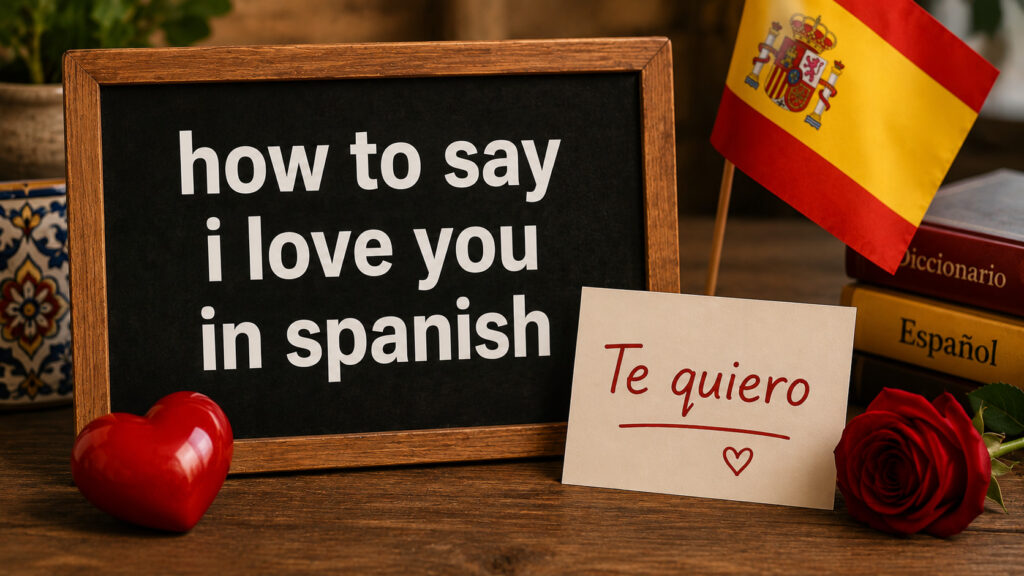
Another very common phrase is Te quiero, which literally translates to “I want you” but functions culturally as “I love you” in a warmer, slightly less intense way. Te quiero comes from querer, meaning “to want” or “to love,” and is widely used among romantic partners, close friends, and family members alike.
Understanding this distinction is key, since Spanish speakers choose between these two phrases based on the depth and nature of the relationship.
Pronunciation
Te amo is pronounced “teh AH-moh.” The stress falls on the first syllable of amo, and both vowels are pronounced clearly and fully, following the consistent, phonetic nature of Spanish.
Te quiero is pronounced “teh kee-EH-roh.” The “qu” in Spanish makes a hard “k” sound, so quiero begins with “kee” rather than the softer “kw” sound some English speakers might expect. The stress falls on the second syllable, “EH.”
Both phrases are short and beginner friendly, making them some of the easiest romantic expressions to pronounce correctly with just a little practice.
Common Ways to Say It
Te amo is the go to phrase for expressing deep, romantic love, most commonly used between committed partners, spouses, or in emotionally significant moments.
Te quiero is used more broadly and comfortably across different types of relationships, including romantic partners, close friends, and family members, making it a versatile phrase for various levels of affection.
Te quiero mucho, meaning “I love you very much” or “I care about you a lot,” adds emphasis and is commonly used with family members, close friends, or in the early stages of a romantic relationship.
Estoy enamorado de ti, used by a man, or estoy enamorada de ti, used by a woman, means “I am in love with you,” a more descriptive and poetic way to express romantic feelings, often used when first confessing love.
Formal and Informal Usage
Both Te amo and Te quiero are inherently personal and informal phrases, since expressing love naturally occurs in close, intimate relationships rather than formal settings. There is no equivalent formal version of these phrases, as the concept of romantic love itself does not typically arise in professional or formal contexts.
Within personal relationships, however, choosing between the two phrases carries its own kind of social nuance. Te amo tends to feel more serious and weighty, often saved for significant moments or long established romantic relationships. Using it too early in a new relationship can feel intense to some Spanish speakers.
Te quiero feels warmer and more flexible, comfortably used with romantic partners, close friends, and family members without implying the same depth of commitment as Te amo. Many couples use Te quiero regularly and reserve Te amo for particularly meaningful moments.
Related Phrases
Mi amor means “my love,” a common term of endearment used when addressing a romantic partner directly.
Eres mi vida means “you are my life,” a poetic expression of deep affection.
Me haces muy feliz means “you make me very happy,” a heartfelt phrase often paired with expressions of love.
Cariño means “sweetheart” or “darling,” a gentle term of endearment used affectionately between partners or close family members.
No puedo vivir sin ti means “I cannot live without you,” a dramatic, romantic phrase often used in passionate declarations of love.
Real-Life Examples with English Translations
Te amo con todo mi corazón. I love you with all my heart.
Te quiero mucho, eres muy importante para mí. I love you very much, you are very important to me.
Desde el día que te conocí, supe que te amaba. Since the day I met you, I knew I loved you.
Mi amor, te quiero y siempre te voy a apoyar. My love, I care about you and I will always support you.
Estoy enamorada de ti desde hace mucho tiempo. I have been in love with you for a long time.
Common Mistakes
One common mistake is using Te amo too casually or too early in a new relationship, since its emotional weight in Spanish is generally stronger than a casual “I love you” might be in English. Using Te quiero first often feels more natural in developing relationships.
Another mistake is assuming Te quiero literally means “I want you” in a possessive or physical sense. While the verb querer does mean “to want,” in the context of relationships it culturally translates to a warm expression of love or care, not desire in a literal sense.
Some learners also forget to match adjectives correctly based on gender, such as saying enamorado instead of enamorada when a woman is speaking about her own feelings. Paying attention to these small grammatical details helps the phrase sound accurate and natural.
Finally, overusing dramatic phrases like No puedo vivir sin ti in everyday conversation can come across as overly intense. These expressions are best saved for genuinely significant, heartfelt moments rather than casual daily exchanges.
Final Thoughts
Learning how to say I love you in Spanish, with the meaningful distinction between Te amo and Te quiero, allows you to express your feelings with the right depth and tone for any relationship. Whether you are speaking to a longtime partner, a close friend, or someone you are just beginning to fall for, understanding these phrases and their cultural nuance will help your words feel genuine and heartfelt every time you use them.