Have you ever tried to order a drink with lemon while traveling, only to end up with lime instead? This mix-up happens more often than you might think, since the words for lemon and lime can vary depending on the Spanish-speaking country you are in. If you are learning how to say lemon in Spanish, this guide will walk you through the meaning, pronunciation, common variations, and real conversational examples so you can use the word correctly no matter where you are.
Meaning and Translation
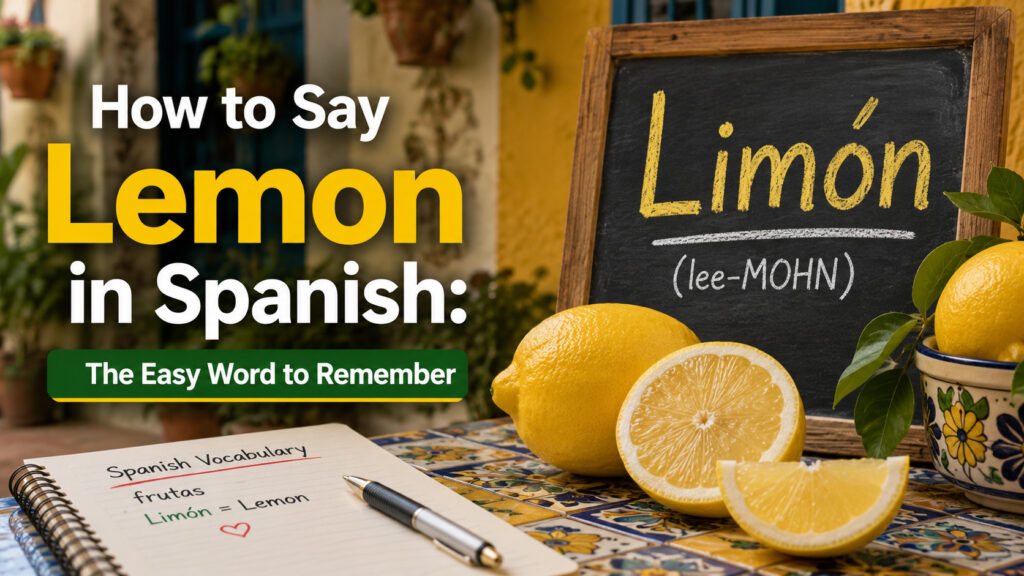
The standard word for lemon in Spanish is limón. This word is used widely across Spain and most Latin American countries to describe the yellow citrus fruit known in English as lemon. However, there is an important regional detail worth knowing. In many Latin American countries, limón is also commonly used to refer to lime, since limes are more widely available and used in everyday cooking than true lemons. In Spain, limón consistently refers to lemon, while lima is the word used for lime. This regional difference is one of the most useful things to understand when learning this vocabulary.
Pronunciation
Limón is pronounced “lee-MOHN.” The stress falls on the second syllable, which carries an accent mark to indicate this emphasis. The “i” sounds like the ee in “see,” and the final “n” is pronounced clearly, unlike in some languages where nasal sounds are softened. Practicing the accented stress on the second syllable is especially important, since shifting the stress to the first syllable can make the word sound unnatural to native Spanish speakers.
Common Ways to Say It
While limón is the standard word, a few related terms and phrases help clarify meaning depending on region and context:
Limón amarillo means “yellow lemon,” sometimes used in Latin America to specifically clarify that the true lemon, rather than lime, is being referred to.
Jugo de limón means “lemon juice,” a common phrase used in cooking and beverages.
Cáscara de limón means “lemon peel” or “lemon zest,” often used in recipes.
Agua con limón means “water with lemon,” a popular and simple drink phrase.
These related terms help specify exactly what type of citrus is being discussed, which is especially useful given the regional overlap between lemon and lime vocabulary.
Formal and Informal Usage
Limón is used consistently in both formal and informal settings, since it is a straightforward, neutral noun rather than a phrase with varying levels of politeness. In formal contexts, such as restaurant menus, recipes, or professional food writing, limón appears exactly as it does in casual conversation.
In informal, everyday conversation, especially in Latin American countries where limón commonly refers to lime, speakers may add amarillo or clarify with additional context if they specifically mean lemon rather than lime. This clarification is more about regional accuracy than formality, but it becomes especially useful in informal settings like markets or kitchens where the distinction matters for cooking or flavor purposes.
Related Phrases
Learning a few related expressions makes it easier to use limón naturally in everyday conversation:
Un limón, por favor meaning “a lemon, please,” useful when shopping or ordering.
Con limón meaning “with lemon,” often added when ordering food or drinks.
Sabe a limón meaning “it tastes like lemon,” useful for describing flavors.
Huele a limón meaning “it smells like lemon,” useful for describing scents or cleaning products.
These simple phrases are practical for travel, cooking, and everyday situations where lemon or its flavor comes up in conversation.
Real-Life Examples with English Translations
Seeing this word used in real conversation helps make it easier to remember and apply correctly. Here are a few examples:
A: ¿Quieres agua con limón? (Do you want water with lemon?) B: Sí, por favor. (Yes, please.)
A: Necesito jugo de limón para la receta. (I need lemon juice for the recipe.) B: Hay limones en la cocina. (There are lemons in the kitchen.)
A: ¿Este es limón o lima? (Is this lemon or lime?) B: Es limón amarillo. (It is yellow lemon.)
A: El té sabe a limón. (The tea tastes like lemon.) B: Sí, le puse cáscara de limón. (Yes, I added lemon peel.)
Common Mistakes
Learners often make a few predictable mistakes with this word. One common error is assuming limón always means lemon, without realizing that in many Latin American countries it commonly refers to lime instead. Another mistake is confusing limón with lima, especially since English speakers expect a direct one to one translation that does not always apply across Spanish-speaking regions. Some learners also mispronounce the word by placing stress on the first syllable instead of the second, which can make the word sound unclear. Paying attention to regional context is the most important step in avoiding confusion with this particular word.
Final Thoughts
Learning how to say lemon in Spanish involves more than memorizing a single word. It requires understanding regional differences, correct pronunciation, and how to clarify meaning when lemon and lime overlap in everyday vocabulary. By practicing the phrases and examples covered in this guide, you will be able to talk about lemons accurately and confidently, whether you are cooking, ordering food, or traveling through different Spanish-speaking countries.