
Have you ever noticed that in Korean dramas, characters seem to thank each other differently depending on who they are speaking to, sometimes with a quick word and other times with a much longer phrase? Korean, like many aspects of its language, layers politeness levels into everyday expressions of gratitude. If you are diving into Korean for the first time or preparing for a trip to Seoul, learning how to say thank you in Korean the right way for each situation will help you sound genuinely respectful and natural.
This guide covers the meaning, pronunciation, and appropriate usage of Korean thank you phrases so you always express gratitude correctly.
Meaning and Translation
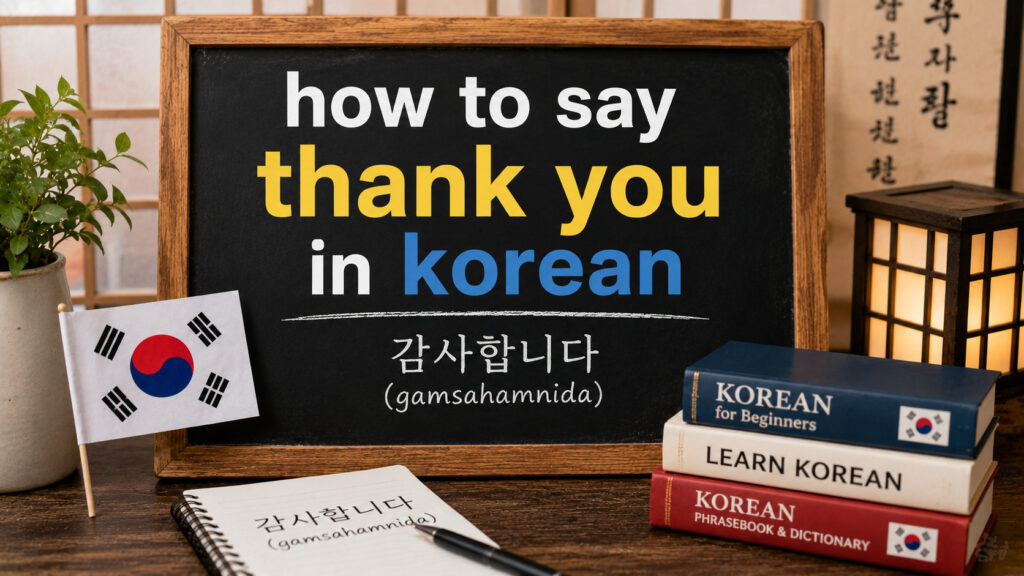
The most common and widely used way to say thank you in Korean is 감사합니다 (Gamsahamnida). This phrase comes from 감사 (gamsa), meaning “gratitude” or “thanks,” combined with a polite verb ending. It functions as a respectful, all purpose way to express thanks in most everyday situations.
For casual situations, Koreans often say 고마워 (Gomawo), a warmer, more familiar way to say thanks, typically used with friends, close peers, or people younger than or equal to you in age or social status.
An even more formal version, 감사드립니다 (Gamsadeurimnida), adds an extra layer of humility and respect, often used in very formal speeches, customer service, or when addressing someone of significantly higher status.
Pronunciation
Gamsahamnida is pronounced “gahm-sah-hahm-nee-dah.” The word breaks into five syllables with an even, steady rhythm typical of Korean speech. The “eu” and “a” sounds should be pronounced clearly, without the stress patterns common in English words.
Gomawo is pronounced “goh-mah-wo,” a shorter, softer phrase compared to its formal counterpart. The final “wo” sound is pronounced quickly, similar to the “wo” in the English word “won.”
Gamsadeurimnida is pronounced “gahm-sah-deu-rim-nee-dah,” slightly longer than the standard formal version, with the added deuri syllables giving it a more humble, deferential tone.
Since Korean pronunciation relies on clear, evenly paced syllables rather than English style stress accents, practicing each syllable individually before combining them will help these phrases come out naturally.
Common Ways to Say It
감사합니다 (Gamsahamnida) is the standard, most commonly used expression of thanks, appropriate in the vast majority of everyday interactions, including with strangers, coworkers, teachers, and service staff.
고마워 (Gomawo) is the casual version, used specifically among close friends, siblings, or people younger than you, making it one of the first casual phrases learners pick up from Korean media and music.
고맙습니다 (Gomapseumnida) is another polite version, similar in formality to Gamsahamnida but derived from a different root word, gomap, and is equally common and interchangeable in most polite contexts.
정말 감사합니다 (Jeongmal Gamsahamnida) adds jeongmal, meaning “really” or “truly,” to intensify the expression, translating to “thank you so much” or “I really appreciate it.”
Formal and Informal Usage
감사합니다 (Gamsahamnida) and 고맙습니다 (Gomapseumnida) are both safe, polite defaults appropriate for nearly any situation, including with strangers, elders, coworkers, or anyone you are not especially close with. Beginners should rely on these until they are confident about the social context of a relationship.
고마워 (Gomawo) is strictly informal and should be reserved for close friends, younger siblings, or peers you know well. Given the importance Korean culture places on age and social hierarchy, using this casual phrase with someone older or unfamiliar can come across as disrespectful.
For particularly formal occasions, such as public speeches, customer service interactions, or addressing someone with considerably higher status, 감사드립니다 (Gamsadeurimnida) conveys an extra degree of humility and respect, though Gamsahamnida remains perfectly polite and sufficient for the overwhelming majority of everyday situations.
Related Phrases
천만에요 (Cheonmaneyo) means “you’re welcome,” the standard polite response after being thanked.
정말 고마워 (Jeongmal Gomawo) means “thanks so much,” a casual, warmer way to intensify gratitude among friends.
도와주셔서 감사합니다 (Dowajusyeoseo Gamsahamnida) means “thank you for helping me,” a specific and commonly used phrase in everyday situations.
미안합니다 (Mianhamnida) means “I am sorry,” a related polite phrase often used alongside expressions of thanks in Korean social interactions.
수고하셨습니다 (Sugohasyeotseumnida) means “thank you for your hard work,” a common phrase used at the end of a workday or after someone completes a task.
Real-Life Examples with English Translations
감사합니다, 정말 도움이 많이 됐어요. (Gamsahamnida, jeongmal doumi mani dwaesseoyo.) Thank you, that really helped a lot.
고마워, 네가 없었으면 못 했을 거야. (Gomawo, nega eopseosseumyeon mot haesseul geoya.) Thanks, I could not have done it without you. (spoken between close friends)
선물 감사합니다, 정말 마음에 들어요. (Seonmul gamsahamnida, jeongmal maeume deureoyo.) Thank you for the gift, I really love it.
도와주셔서 감사합니다, 큰 도움이 되었습니다. (Dowajusyeoseo gamsahamnida, keun doumi doeeotseumnida.) Thank you for helping me, it was a great help.
수고하셨습니다, 내일 또 봐요. (Sugohasyeotseumnida, naeil tto bwayo.) Thank you for your hard work today, see you tomorrow.
Common Mistakes
One common mistake is using the casual 고마워 (Gomawo) with someone older or in a professional setting, which can come across as impolite given how seriously Korean culture treats age and hierarchy in everyday language. Defaulting to Gamsahamnida until you know someone well is the safer choice.
Another mistake is mispronouncing the “eu” sound found in words like Gamsadeurimnida, often replacing it with a simple “oo” sound instead of the correct, more neutral vowel sound, which can make pronunciation harder for native speakers to follow.
Some learners also forget to pair thanks with a slight bow, a common nonverbal gesture in Korean culture that accompanies both casual and formal expressions of gratitude, especially in more respectful or formal situations.
Finally, using overly casual phrases in customer service or business settings, rather than sticking with polite standards like Gamsahamnida, can unintentionally seem careless or disrespectful in professional Korean contexts.
Final Thoughts
Learning how to say thank you in Korean means understanding not just the words themselves, but also which version fits the relationship and setting. With 감사합니다 (Gamsahamnida) as your reliable, polite default and 고마워 (Gomawo) reserved for close friends, you now have a strong foundation for expressing gratitude appropriately in nearly any Korean speaking context. Paying attention to formality and social context will help your thanks feel genuine, respectful, and well received.


