
Did you know that Hebrew actually runs on two calendar systems at once, a civil one and a religious one, and both are referred to using the same core word? If you have ever seen a Jewish holiday date listed differently from the Gregorian date, you have already encountered this dual system in action. Learning how to say calendar in Hebrew opens the door to understanding how Israelis and Hebrew speakers organize everything from work schedules to religious observances, and it is a simple word to add to your vocabulary.
Meaning and Translation of Calendar in Hebrew
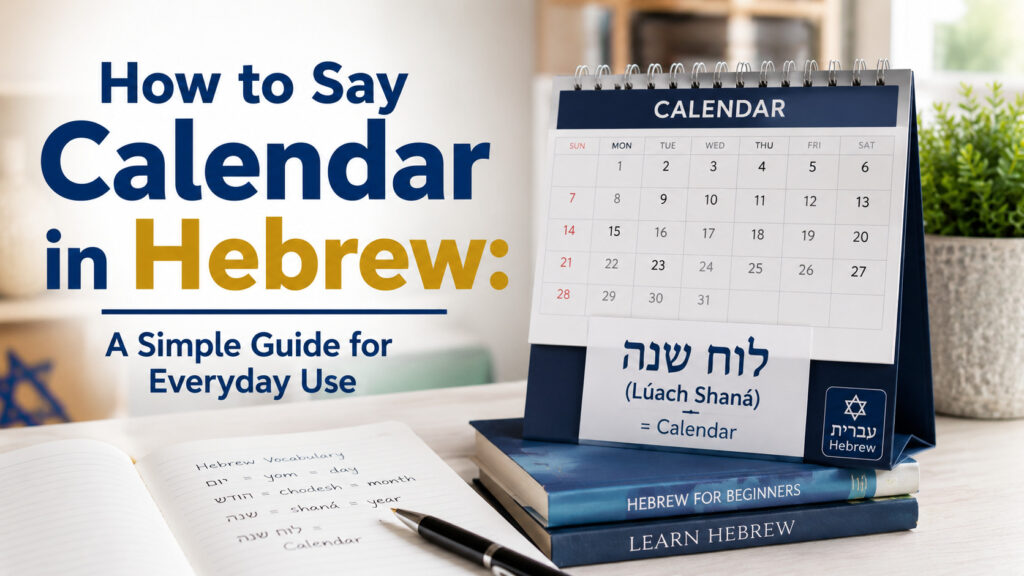
The Hebrew word for calendar is “לוח שנה” (luach shana), which literally translates to “table of the year” or “year board.” The word “לוח” (luach) means “board,” “table,” or “tablet,” while “שנה” (shana) means “year.” Together, they form the standard term used for any calendar, whether it is a wall calendar, a digital app, or a printed planner.
You may also encounter just “לוח” (luach) used on its own in casual speech, since context often makes it clear that a calendar is being discussed, similar to how English speakers might just say “the schedule” instead of “the calendar.”
Pronunciation of Luach Shana
Hebrew pronunciation can look unfamiliar at first, but breaking the word into parts makes it manageable.
Luach is pronounced “LOO-ahh,” with a soft, breathy “ch” sound similar to clearing your throat gently, much like the “ch” in the name “Bach.”
Shana is pronounced “shah-NAH,” with the stress falling on the second syllable.
Put together, luach shana sounds like “LOO-ahh shah-NAH.” The guttural “ch” sound is one of the more distinct features of Hebrew pronunciation, and practicing it separately before combining it into full words will help you sound more natural.
Common Ways to Say Calendar in Hebrew
While luach shana is the standard term, Hebrew has a few related expressions depending on the type of calendar being discussed:
- Luach shana – calendar, or year board (general term)
- Luach – calendar or schedule (shortened, casual use)
- Luach ivri – Hebrew calendar (the traditional Jewish lunar calendar)
- Luach azrachi – civil calendar (the standard Gregorian calendar)
- Luach chagim – holiday calendar (a calendar listing Jewish holidays)
These variations allow speakers to specify exactly which type of calendar they mean, which is especially useful in Israel where both the Hebrew and Gregorian systems are used side by side.
Formal and Informal Usage
Hebrew does not have a strong formal versus informal distinction for the word calendar itself, since it is a neutral, everyday noun. However, the way it is used can shift slightly depending on context.
In formal or written settings, such as official documents, school schedules, or religious contexts, luach shana or the more specific luach ivri and luach azrachi are commonly used to avoid ambiguity.
In casual conversation, Hebrew speakers often shorten it to simply luach. For example, someone might ask “מה יש לך בלוח היום?” meaning “What do you have on your calendar today?” without needing to say the full phrase.
Related Phrases for Everyday Conversations
Here are a few useful phrases that pair naturally with the word for calendar:
- לוח שנה עברי (luach shana ivri) – Hebrew year calendar
- לוח שנה לועזי (luach shana loazi) – secular or Gregorian calendar
- תאריך (ta’arich) – date
- חג (chag) – holiday
- ראש השנה (Rosh Hashanah) – the Jewish New Year, literally “head of the year”
Knowing these related words makes it easier to talk about scheduling, holidays, and dates in a natural, connected way.
Real-Life Examples with English Translations
Seeing these words used in full sentences helps make them stick.
“איפה הלוח שנה שלי?” – “Where is my calendar?”
“אני צריך לבדוק את הלוח שנה העברי.” – “I need to check the Hebrew calendar.”
“החג מופיע בלוח שנה בספטמבר.” – “The holiday appears on the calendar in September.”
“הלוח שנה האזרחי מתחיל בינואר.” – “The civil calendar starts in January.”
“תוסיף את הפגישה ללוח שנה שלי.” – “Add the meeting to my calendar.”
Common Mistakes When Saying Calendar in Hebrew
Even a straightforward word like calendar can lead to small mix-ups for new learners.
Confusing luach with a physical board: Since luach also means “board” or “tablet,” using it without context can occasionally sound like you mean a whiteboard or writing surface rather than a calendar.
Mixing up the two calendar systems: Learners sometimes forget that Israel operates on both the Hebrew lunar calendar and the Gregorian calendar, which can lead to confusion about dates for holidays versus everyday scheduling.
Mispronouncing the guttural “ch”: Softening or dropping the throat sound in luach can make the word harder for native speakers to recognize immediately.
Forgetting gender agreement in longer phrases: Hebrew nouns have gender, and when building longer descriptive phrases around luach shana, adjectives need to match its grammatical gender, which can trip up beginners.
Final Thoughts
Learning how to say calendar in Hebrew, luach shana, gives you a useful entry point into understanding how Hebrew speakers track time, holidays, and daily schedules. With the added knowledge of related terms like luach ivri and luach azrachi, you can navigate conversations about both the traditional Jewish calendar and the standard civil calendar with confidence. A little practice with pronunciation and context will make this simple but meaningful phrase feel natural in everyday use.


