
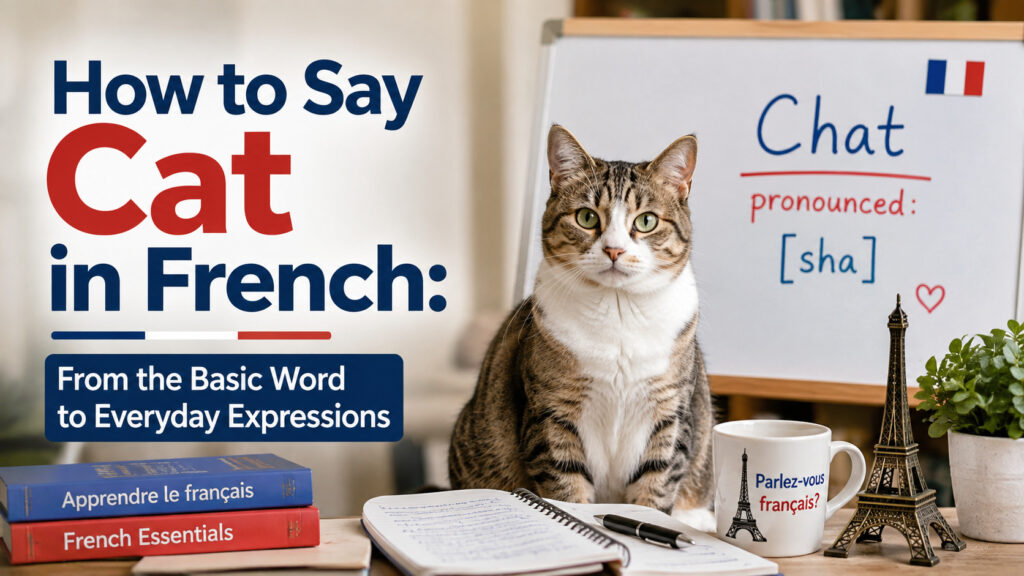
Have you ever wondered why some animal names feel instantly familiar in another language, while others sound completely different? French is one of those languages where a common word like cat can open the door to grammar rules, everyday expressions, and even a bit of French culture. If you are learning how to say cat in French, this guide will walk you through the meaning, pronunciation, common variations, and real conversational examples so you can use the word naturally and confidently.
Meaning and Translation
The word for cat in French is chat when referring to a male cat, and chatte when referring to a female cat. Like many French nouns, the word for cat carries gender, which affects the articles used with it. A male cat is referred to as un chat, while a female cat is referred to as une chatte. When speaking generally about cats as a species, French speakers typically use le chat or les chats, similar to how English speakers might say “the cat” or “cats” in general.
Pronunciation
Chat is pronounced “shah,” with a soft “sh” sound at the beginning, similar to the English word “shop.” The final “t” is silent, which is a common feature in French pronunciation. Chatte is pronounced “shaht,” where the final “t” becomes audible because of the added “e” at the end of the word. This is an important distinction, since mispronouncing the ending can accidentally change the gender of the word you are using. Practicing the silent versus pronounced “t” is one of the best ways to sound more natural when speaking French.
Common Ways to Say It
While chat and chatte are the standard words, French has a few related terms depending on context:
Chaton means “kitten,” used specifically for baby cats.
Matou is an informal, affectionate term for a male cat, often used the way English speakers might say “tomcat.”
Minou is a cute, casual nickname for a cat, similar to saying “kitty” in English.
Félin means “feline” and is used in more formal or scientific contexts to describe cats as a species.
These variations allow speakers to sound more expressive and natural depending on the setting, whether they are talking casually or describing cats in a more general or scientific way.
Formal and Informal Usage
In formal settings, such as academic writing, veterinary contexts, or scientific discussions, the correct and neutral term is chat or félin. These words are considered standard and appropriate in any professional or written context.
In informal, everyday conversation, French speakers often use warmer or more playful terms like minou or matou, especially when talking to children or expressing affection toward a pet. For example, a pet owner might say viens ici, minou, meaning “come here, kitty,” in a casual and endearing tone. Choosing between chat and these informal nicknames depends on the relationship between the speaker and the listener, as well as the overall tone of the conversation.
Related Phrases
Once you know the basic word, it helps to learn a few related expressions that often come up in everyday French:
Le chat dort meaning “the cat is sleeping.”
J’ai un chat meaning “I have a cat.”
Le chat miaule meaning “the cat is meowing.”
Mon chat est mignon meaning “my cat is cute.”
These simple phrases are useful for beginners who want to talk about pets, describe animals, or engage in basic conversations involving cats in French.
Real-Life Examples with English Translations
Seeing the word used in real sentences makes it easier to remember and apply. Here are a few examples:
A: Tu as un animal de compagnie? (Do you have a pet?) B: Oui, j’ai un chat. (Yes, I have a cat.)
A: Comment s’appelle ton chat? (What is your cat’s name?) B: Il s’appelle Leo. (His name is Leo.)
A: Où est le chat? (Where is the cat?) B: Le chat dort sur le canapé. (The cat is sleeping on the couch.)
A: Ton chaton est adorable. (Your kitten is adorable.) B: Merci, il est encore très jeune. (Thank you, he is still very young.)
Common Mistakes
Learners often make a few predictable mistakes when using this word. One common error is forgetting to match the article with the gender of the word, saying le chatte instead of la chatte, which is grammatically incorrect. Another mistake is mispronouncing the silent “t” in chat, which can make the word sound unnatural to native speakers. Some learners also confuse chat with the English word “chat,” meaning to talk casually, since the spelling looks identical but the pronunciation and meaning are completely different in French. Being aware of this false friend can help avoid confusion in both written and spoken French.
Final Thoughts
Learning how to say cat in French involves more than memorizing a single word. It requires understanding gender agreement, pronunciation details, and the variety of expressions used in everyday conversation. By practicing the phrases and examples covered in this guide, you will be able to talk about cats naturally and accurately, whether you are describing a pet, reading a children’s book, or having a casual conversation in French.