Ever raised a glass in France and heard everyone around the table say the same word before taking a sip? That word is santé, and it’s one of the most useful pieces of French vocabulary you can learn, whether you’re visiting Paris or just sharing a bottle of wine with French-speaking friends. This guide covers exactly how to say cheers in French, how to pronounce it correctly, and how locals actually use it at the table.
Meaning and Translation
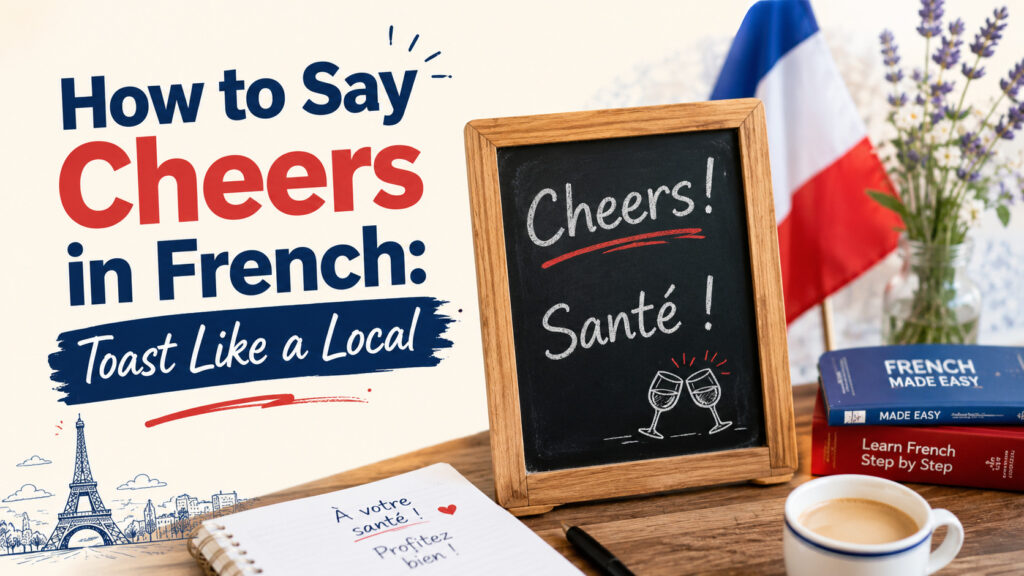
The standard way to say cheers in French is santé. The word literally means “health,” so when the French raise a glass and say santé, they’re essentially wishing good health to everyone at the table, similar to how English speakers sometimes say “to your health.” It’s a short, simple word, but it carries real cultural weight, since toasting is treated as a small but meaningful ritual in French social life.
Pronunciation
French pronunciation can look intimidating on paper, but santé is one of the easier words to pick up. Here’s how to say cheers in French, broken down:
- Santé is pronounced “sahn-TAY,” with a soft nasal “n” sound and the stress falling on the second syllable
The “an” combination produces a nasal vowel sound that doesn’t exist in English, so the “n” isn’t pronounced sharply the way it is in words like “can.” Instead, air flows partly through the nose, giving it a soft, rounded quality. Listening to a native speaker say it a few times is the fastest way to get the nasal sound right.
Common Ways to Say It
While santé is the most common and widely understood toast, French speakers use a few variations depending on the setting:
- Santé – the standard, universally understood toast
- À votre santé – a slightly more formal version, meaning “to your health”
- À la tienne – an informal version used with close friends, meaning “to yours”
- Tchin-tchin – a playful, informal expression often used while clinking glasses
Knowing these alternatives helps you match the tone of the group you’re drinking with, rather than relying on a single word in every situation.
Formal and Informal Usage
Santé on its own works comfortably in almost any setting, from a casual dinner with friends to a slightly more formal gathering, which makes it a safe default for most learners. It’s short, easy to say, and universally recognized across French-speaking regions.
À votre santé is the more formal option, appropriate for toasts at weddings, business dinners, or when addressing someone with the formal “vous.” À la tienne, on the other hand, uses the informal “tu” form and is reserved for friends, family, or peers you’re already on casual terms with. Tchin-tchin is playful and lighthearted, often used among younger people or in relaxed social settings, and it’s generally not used in formal contexts.
Related Phrases
A few useful phrases build naturally on the core toast:
- Santé à tous – cheers to everyone
- À nos succès – to our successes, often used at celebratory dinners
- À notre amitié – to our friendship
- Buvons à sa santé – let’s drink to his/her health
- Levons nos verres – let’s raise our glasses
Learning these phrases allows you to personalize a toast rather than repeating the same single word every time.
Real-Life Examples with English Translations
Here are a few natural sentences using these expressions in context:
- Santé, et bon appétit ! – “Cheers, and enjoy your meal!”
- À votre santé, merci d’être venus ce soir. – “To your health, thank you for coming tonight.”
- À la tienne, mon ami ! – “Cheers, my friend!”
- Levons nos verres à cette belle soirée. – “Let’s raise our glasses to this wonderful evening.”
Practicing full toasting sentences like these makes the phrase feel far more natural than memorizing santé in isolation.
Common Mistakes
A few pitfalls tend to trip up learners of this phrase:
- Skipping eye contact while toasting, which is considered somewhat impolite in French culture, unlike in some other countries where it’s optional.
- Mispronouncing the nasal “an” sound in santé as a hard “n,” which makes the word sound noticeably non-native.
- Using tchin-tchin in formal settings, where it can come across as too casual or even a little juvenile.
- Assuming santé is only used for alcoholic drinks, when in fact it can be used with any beverage during a toast, including non-alcoholic ones.
Paying attention to tone and setting, not just vocabulary, will help this small phrase land the way native speakers intend.
Final Thoughts
Learning how to say cheers in French adds a genuine, culturally aware touch to any shared meal or celebration with French speakers. With santé as your reliable go-to, and à votre santé, à la tienne, and tchin-tchin as useful variations, you’ll be ready to toast confidently in almost any setting. As with most conversational phrases, saying it often and paying attention to how locals use it will make it feel completely natural over time.