
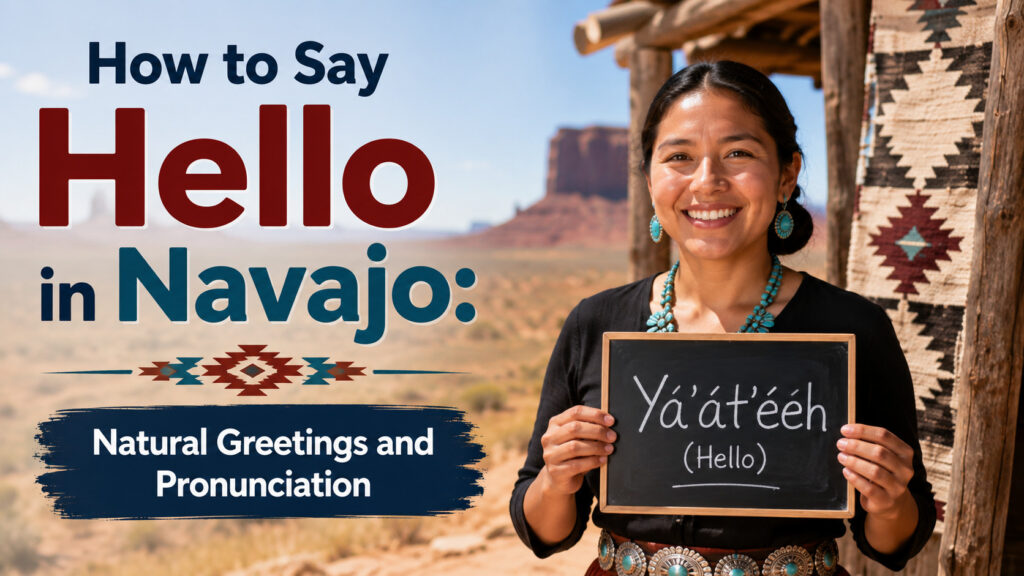
Have you ever wondered what it would feel like to greet someone not just with a word, but with a wish for harmony and well-being? That is exactly what happens when you say hello in the Navajo language. Navajo, also known as Diné bizaad, is one of the most linguistically rich Native American languages still actively spoken today, and its greetings carry meaning far deeper than a simple “hi.” If you have been searching for how to say hello in Navajo, this guide will walk you through the meaning, pronunciation, and natural usage so you can greet someone with genuine respect.
Meaning and Translation
The most common way to say hello in Navajo is Yá’át’ééh. While it is used the way English speakers use “hello,” it does not translate directly to that word. Instead, Yá’át’ééh literally means “it is good,” reflecting the Navajo cultural value of hózhó, a concept of harmony, balance, and beauty in life. When you greet someone with Yá’át’ééh, you are essentially affirming that things are good between you, the person you are speaking to, and the world around you. This makes the greeting feel more like a small blessing than a routine word exchange.
Pronunciation
Navajo pronunciation can be challenging for English speakers at first, since the language includes glottal stops and tonal shifts that do not exist in English. Yá’át’ééh is commonly pronounced yah-AH-teh, with a brief glottal stop, a quick catch in the throat, appearing where the apostrophes are placed in the spelling. The accented vowels indicate a rising and falling tone that native speakers use naturally, though beginners can still be understood clearly by focusing on a smooth, even pace. Listening to native speaker recordings and practicing slowly is the most effective way to get comfortable with the sound.
Common Ways to Say It
While Yá’át’ééh is the standard greeting, there are a few natural variations used depending on the time of day and situation.
Yá’át’ééh on its own works as a general hello, suitable for almost any greeting throughout the day.
Yá’át’ééh abíní means “good morning,” combining the greeting with abíní, meaning “morning,” and is commonly used early in the day.
When responding to a greeting, it is common to simply repeat Yá’át’ééh back, or to say Aoo’, meaning “yes,” as a warm acknowledgment.
These variations show that Navajo greetings, much like English ones, adjust naturally depending on context while keeping the core word at the center.
Formal and Informal Usage
Navajo culture places a strong emphasis on respect in every interaction, and Yá’át’ééh works well in both casual and formal settings since it is inherently a respectful greeting. Whether you are speaking to a close friend, a family member, an elder, or someone you are meeting for the first time, Yá’át’ééh is appropriate. What changes is often the accompanying behavior rather than the word itself. Making steady eye contact, offering a gentle handshake or light touch of the fingertips rather than a firm grip, and speaking with a calm, unhurried tone are all considered signs of respect that naturally pair with the greeting, especially when addressing elders or community leaders.
Related Phrases
Learning a few related expressions rounds out your ability to greet and interact politely in Navajo.
Hágoónee’ means “goodbye,” the natural counterpart to Yá’át’ééh when parting ways.
Ahéhee’ means “thank you,” an essential phrase to know alongside any greeting.
Aoo’ means “yes,” while doo means “no,” both useful for simple exchanges.
Háálá ádiníshní translates roughly to “how are you,” a natural follow-up question after saying hello.
Shí éí … yinishyé means “my name is …,” useful when introducing yourself after greeting someone.
Real-Life Examples with English Translations
Seeing these phrases used in context helps make them easier to remember and use naturally.
“Yá’át’ééh, háálá ádiníshní?” translates to “Hello, how are you?”
“Yá’át’ééh abíní, shizhé’é.” translates to “Good morning, my father,” a respectful greeting to an elder or parent.
“Yá’át’ééh! Ahéhee’ nínááhoosjéhí.” translates to “Hello! Thank you for meeting with me.”
“Shí éí … yinishyé, Yá’át’ééh.” translates to “My name is …, hello,” commonly used when introducing yourself.
“Hágoónee’, ahéhee’.” translates to “Goodbye, thank you,” a warm and polite way to end a conversation.
Common Mistakes
One common mistake English speakers make is treating Yá’át’ééh as a direct one-to-one translation of “hello” without understanding its deeper meaning of “it is good,” which can lead to using it in contexts where a simple greeting does not quite fit the intended tone. Another mistake is skipping the glottal stops entirely, which changes the rhythm of the word and can make it harder for native speakers to recognize. Learners also sometimes flatten the tonal variation in the vowels, pronouncing the word with a uniform pitch rather than the natural rise and fall that gives Navajo its distinct sound. Finally, it is worth remembering that Navajo is a living language tied closely to Diné culture and history, so approaching greetings with genuine respect and curiosity, rather than treating them as a novelty, matters a great deal to native speakers.
Final Thoughts
Learning how to say hello in Navajo offers a meaningful window into a language and culture built around harmony, respect, and connection. Yá’át’ééh remains the most natural and versatile greeting, carrying a depth of meaning that goes well beyond a simple hello. With attentive practice on pronunciation and an understanding of the cultural respect behind the word, greeting someone in Navajo can become a genuine and thoughtful gesture rather than just another phrase to memorize.


