
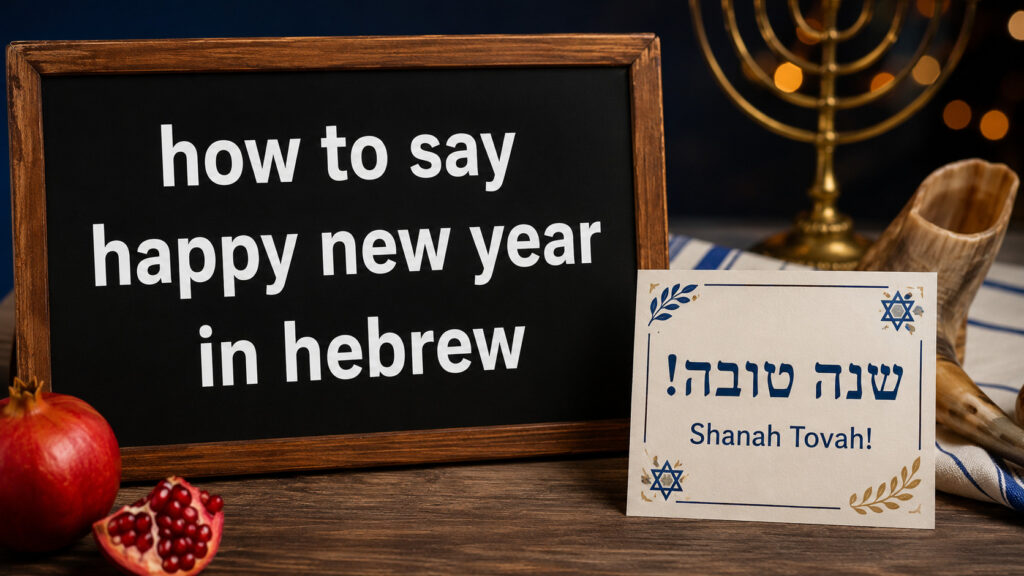
Did you know that Hebrew has more than one way to say happy new year, depending on whether you mean the Jewish New Year or the secular calendar new year? If you have a Jewish friend, colleague, or neighbor, knowing how to say happy new year in Hebrew can turn a simple greeting into a meaningful gesture of respect and connection.
This guide walks you through the meaning, pronunciation, and correct usage of Hebrew new year greetings so you can use them confidently and appropriately.
Meaning and Translation
The most common way to say happy new year in Hebrew is שנה טובה (Shana Tova). This phrase is used specifically for Rosh Hashanah, the Jewish New Year. שנה (shana) means “year,” and טובה (tova) means “good.” Together, the phrase literally means “a good year,” which carries the meaning of “happy new year” or “have a good year.”
For the secular new year, celebrated on January first, Hebrew speakers use שנה אזרחית טובה (Shana Ezrachit Tova), which means “a good civil year.” This distinction matters because Rosh Hashanah follows the Hebrew calendar and usually falls in September or October, while the civil new year follows the standard Gregorian calendar.
Pronunciation
Shana Tova is pronounced “shah-NAH toh-VAH.” The stress falls on the second syllable of each word. The “sh” sound is soft, similar to English, and the “ah” sounds are open and clear.
Shana Ezrachit Tova is pronounced “shah-NAH ez-rah-KHEET toh-VAH.” The “kh” sound in ezrachit is a guttural sound made at the back of the throat, similar to the “ch” in the Scottish word “loch.” This sound does not exist in English, so it may take some practice to get right, but native speakers will still understand you even if it comes out softer than expected.
Common Ways to Say It
שנה טובה (Shana Tova) is the standard, widely used greeting during the Jewish High Holidays and works in almost any casual or semi-formal setting.
שנה טובה ומתוקה (Shana Tova U’Metuka) means “a good and sweet year.” This extended version is especially popular because it connects to the tradition of eating apples dipped in honey during Rosh Hashanah to symbolize a sweet year ahead.
כתיבה וחתימה טובה (Ktiva VaChatima Tova) means “a good inscription and sealing,” referring to the belief that during the High Holidays, one’s fate is written and sealed for the coming year. This phrase is more traditional and often used in religious or family settings.
Formal and Informal Usage
For friends, coworkers, and casual acquaintances, שנה טובה (Shana Tova) is simple, warm, and appropriate in nearly every situation. It works well in text messages, cards, and quick verbal greetings.
In more traditional or religious settings, such as at a synagogue or with older relatives, adding כתיבה וחתימה טובה (Ktiva VaChatima Tova) shows a deeper understanding of the holiday’s spiritual meaning. This phrase is often exchanged between people who observe the religious customs of Rosh Hashanah closely.
For the secular new year, שנה אזרחית טובה (Shana Ezrachit Tova) is the appropriate and respectful choice, since using שנה טובה alone in that context could cause confusion with the Jewish holiday.
Related Phrases
ראש השנה (Rosh Hashanah) refers to the Jewish New Year itself, literally meaning “head of the year.”
תפוח בדבש (tapuach bidvash) means “apple in honey,” describing the traditional food eaten to symbolize a sweet new year.
חג שמח (Chag Sameach) means “happy holiday” and can be used as a general greeting during Rosh Hashanah alongside Shana Tova.
שופר (shofar) refers to the ram’s horn blown during Rosh Hashanah services as part of the holiday tradition.
גמר חתימה טובה (Gmar Chatima Tova) means “a good final sealing” and is typically said closer to Yom Kippur, which follows shortly after Rosh Hashanah.
Real-Life Examples with English Translations
שנה טובה לך ולכל המשפחה. (Shana Tova lecha ul’chol hamishpacha.) Happy new year to you and your whole family.
אני מאחל לך שנה טובה ומתוקה. (Ani me’achel lecha shana tova u’metuka.) I wish you a good and sweet year.
לקראת השנה החדשה, כתיבה וחתימה טובה. (Likrat hashana hachadasha, ktiva vachatima tova.) As we approach the new year, may you be inscribed and sealed for good.
שנה אזרחית טובה, שתהיה שנה מוצלחת. (Shana ezrachit tova, shet’hiyeh shana mutzlachat.) Happy civil new year, may it be a successful year.
Common Mistakes
One common mistake is using שנה טובה (Shana Tova) for the January first new year. This phrase is specifically tied to Rosh Hashanah, so using it outside that context can confuse Hebrew speakers or seem out of place.
Another mistake is mispronouncing the “kh” sound in words like ezrachit, often replacing it with a simple “k” sound. While this is a minor error and still understandable, practicing the guttural sound will make your pronunciation more accurate.
Some learners also forget that Rosh Hashanah does not fall on a fixed date each year, since it follows the Hebrew lunar calendar. Wishing someone Shana Tova based on the Gregorian calendar date alone can lead to greeting them too early or too late.
Lastly, avoid assuming all Hebrew speakers celebrate the new year the same way. Levels of religious observance vary widely, so reading the context of your relationship with the person will help you choose the most appropriate greeting.
Final Thoughts
Learning how to say happy new year in Hebrew is a thoughtful way to celebrate alongside Jewish friends, colleagues, or family members. Whether you use שנה טובה (Shana Tova) for Rosh Hashanah or שנה אזרחית טובה (Shana Ezrachit Tova) for the secular new year, understanding the meaning and context behind each phrase shows genuine respect for the tradition. With these greetings in hand, you will be ready to share warm wishes at the right moment, in the right way.


