
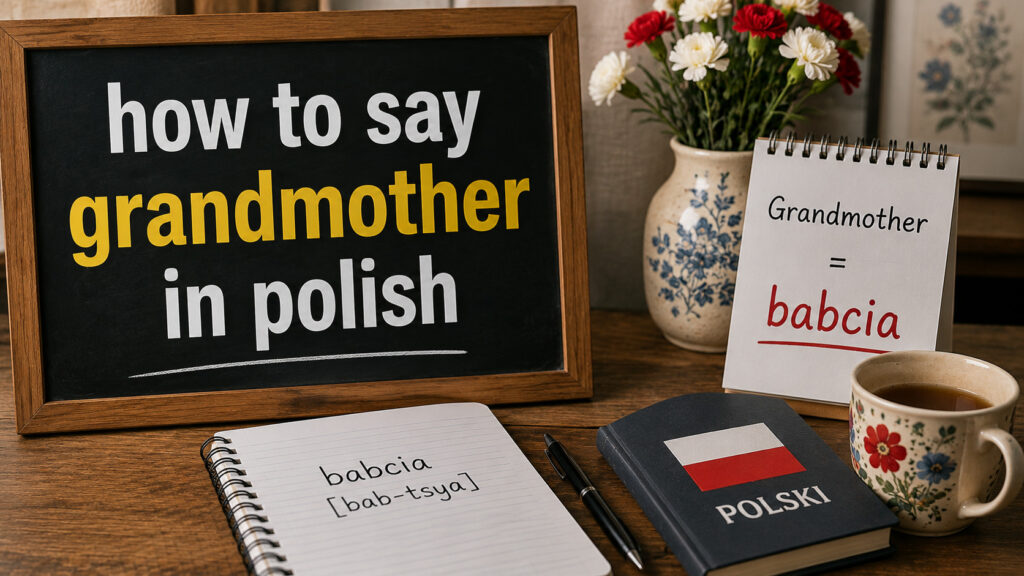
Ever noticed how the word for grandmother often sounds warm and affectionate no matter the language? In Polish culture, family bonds run deep, and the word used for grandmother carries a special sense of closeness and respect. If you are learning how to say grandmother in Polish, this guide will walk you through the meaning, pronunciation, and everyday usage so you can speak about family with confidence and warmth.
Meaning and Translation
The standard Polish word for grandmother is “babcia” (BAHB-chah). This is the most commonly used and widely understood term across Poland, comparable to how English speakers use “grandma” or “granny.” A more formal or literary term, “babka,” also exists but is far less common in everyday speech, since “babcia” is the term most Polish families actually use at home. Understanding this distinction is helpful if you come across “babka” in older texts or literature.
Pronunciation
Pronouncing “babcia” correctly will help you sound natural when speaking with Polish speakers. The word breaks down into two syllables: BAHB-chah, with the stress placed on the first syllable, which is typical in Polish since stress usually falls on the second-to-last syllable of a word. The “ci” combination in Polish produces a soft “ch” sound, similar to the “ch” in “cheese,” so “cia” at the end sounds like “chah.” Practicing this soft consonant sound will help you pronounce many other Polish words that follow the same pattern.
Common Ways to Say It
While “babcia” is the standard term, Polish speakers often use affectionate variations depending on the relationship and context. “Babunia” is a sweeter, more endearing version often used by young children or in tender family moments. “Baba” is an older or more informal term, though it can sound outdated or even slightly disrespectful in modern usage, so it is best avoided unless you hear it used naturally by native speakers first. “Babciu” is the vocative form, used when directly addressing your grandmother, such as calling out to her across a room.
Formal and Informal Usage
“Babcia” itself is considered a warm, informal term appropriate for everyday family life, and there is no strict formal equivalent since grandmothers are almost always addressed affectionately rather than formally in Polish culture. However, when referring to someone else’s grandmother in a more respectful or formal context, such as introducing her to others, Polish speakers might say “babcia pana” or “babcia pani,” meaning “his grandmother” or “her grandmother,” using respectful possessive forms. This shows that formality in this case relates more to how you refer to someone else’s family member rather than changing the core word itself.
Related Phrases
A few related family terms pair naturally with “babcia” in everyday conversation. “Dziadek” means “grandfather,” often used alongside “babcia” when referring to grandparents as a pair. “Dziadkowie” is the plural form meaning “grandparents.” “Kocham cię, babciu” translates to “I love you, grandma,” a heartfelt phrase often used by grandchildren. “Odwiedzić babcię” means “to visit grandma,” a common phrase used when talking about family visits or holiday plans.
Real-Life Examples with English Translations
Seeing the word used in context can help it stick in your memory. Here are a few natural examples:
“Moja babcia piecze pyszne ciasto.” translates to “My grandmother bakes delicious cake,” a common sentence used when talking about family traditions.
“Idziemy do babci na obiad.” means “We are going to grandma’s for dinner,” a typical phrase used when discussing weekend plans.
“Babciu, jak się masz?” translates to “Grandma, how are you?” a warm and direct way to greet her.
Common Mistakes
One common mistake learners make is confusing “babcia” with “baba,” not realizing that “baba” can sound outdated or carry a different connotation depending on context. Another frequent error is mispronouncing the soft “ci” sound, saying it more like a hard “k” or “s” sound instead of the correct soft “ch.” Learners also sometimes forget to use the vocative form “babciu” when directly speaking to their grandmother, which can sound slightly unnatural to native speakers. Paying attention to these small details will help your Polish sound more authentic and respectful.
Final Thoughts
Learning how to say grandmother in Polish is more than just memorizing a word. It is a small window into the warmth and closeness that define Polish family life. Whether you use the everyday “babcia,” the affectionate “babunia,” or the direct “babciu” when speaking to her personally, understanding these variations will help you connect more genuinely with Polish speakers and their family traditions.


