
Have you ever wondered why the word aloha seems to show up everywhere in Hawaiian language, even in greetings that are supposed to be specific to a certain time of day? Hawaiian greetings are built around this single powerful word, and learning how they connect to different times of day reveals a lot about the culture behind the language. If you are learning how to say good morning in Hawaiian, this guide will walk you through the meaning, pronunciation, common variations, and real conversational examples so you can greet people naturally and respectfully.
Meaning and Translation
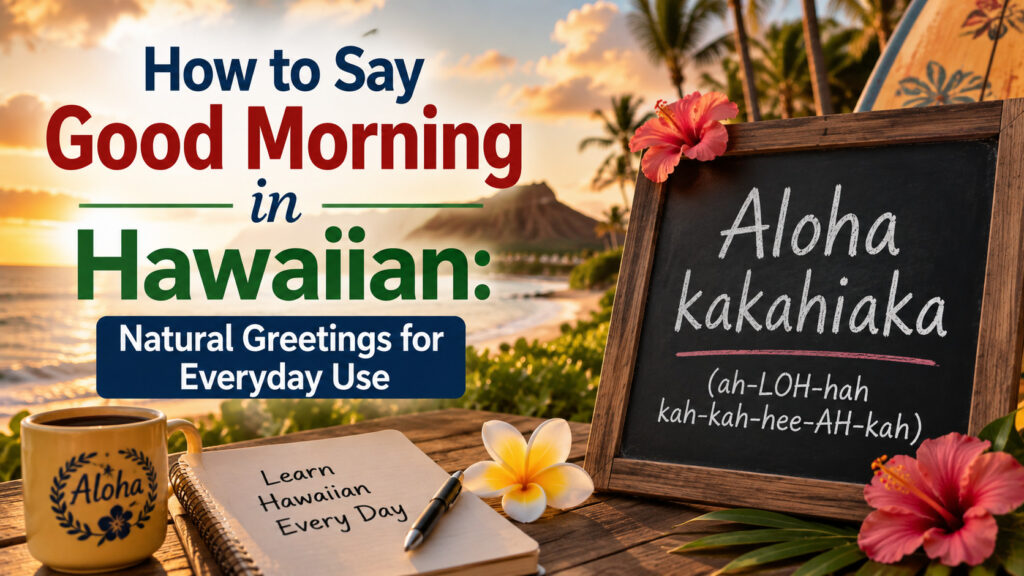
The most accurate way to say good morning in Hawaiian is aloha kakahiaka. Aloha is a versatile word that carries meanings of love, affection, and greeting, while kakahiaka means “morning.” Together, the phrase translates closely to “morning greeting” or “good morning,” specifying that the greeting applies to the early part of the day. While aloha alone can be used at any time as a general hello, adding kakahiaka makes the greeting more specific and time appropriate, similar to how English distinguishes between a general “hello” and a more particular “good morning.”
Pronunciation
Aloha kakahiaka is pronounced “ah-LOH-hah kah-kah-hee-AH-kah.” Hawaiian pronunciation follows consistent vowel sounds, where each vowel is pronounced clearly and does not blend together the way some English vowels do. The stress in aloha falls on the second syllable, “LOH,” while in kakahiaka, the stress falls on the fourth syllable, “AH.” Hawaiian also uses a glottal stop, called an okina, in some words, though kakahiaka does not include one. Practicing each syllable slowly and clearly will help you sound accurate, since Hawaiian relies heavily on precise vowel pronunciation.
Common Ways to Say It
While aloha kakahiaka is the standard and most complete way to say good morning, there are a few related expressions used depending on the setting:
Aloha alone is often used as a general greeting throughout the day, including in the morning, especially in casual or tourist-facing contexts.
Kakahiaka hou can be heard in some contexts to mean “a new morning,” though this is less commonly used as a direct greeting compared to aloha kakahiaka.
E ala mai is an expression sometimes used to mean “wake up” or “rise,” more closely related to encouraging someone to start their day rather than a direct greeting.
These variations show how Hawaiian greetings can shift slightly depending on whether the focus is on greeting someone or acknowledging the start of the day itself.
Formal and Informal Usage
Hawaiian does not have a strict formal versus informal grammatical structure the way some other languages do, but context still shapes how greetings are used. In more formal or ceremonial settings, such as cultural events, official gatherings, or educational environments focused on preserving the Hawaiian language, aloha kakahiaka is used fully and intentionally to show respect for tradition and proper language use.
In informal, everyday situations, especially in casual conversation or in areas where Hawaiian is blended with English, many speakers simply say aloha without adding kakahiaka, relying on context and time of day to convey the meaning. This flexibility reflects how aloha functions as both a formal and casual greeting depending on the setting and the speaker’s familiarity with full Hawaiian phrasing.
Related Phrases
Learning a few related expressions helps you use Hawaiian greetings more naturally throughout the day:
Aloha auinalā meaning “good afternoon.”
Aloha ahiahi meaning “good evening.”
Pehea ‘oe meaning “how are you.”
Mahalo meaning “thank you,” often used alongside greetings in polite conversation.
A hui hou meaning “until we meet again,” commonly used as a farewell.
These phrases help build a fuller understanding of Hawaiian greetings beyond just the morning, allowing for more natural conversation throughout the day.
Real-Life Examples with English Translations
Seeing these phrases used in context makes them easier to remember and apply naturally. Here are a few examples:
A: Aloha kakahiaka! Pehea ‘oe? (Good morning! How are you?) B: Maika’i, mahalo. A ‘oe? (I am good, thank you. And you?)
A: Aloha kakahiaka, e komo mai. (Good morning, come in.) B: Mahalo nui loa. (Thank you very much.)
A: Aloha! Pehea ka lā? (Hello! How is the day going?) B: Maika’i loa, mahalo. (Very good, thank you.)
Common Mistakes
Learners often make a few predictable mistakes when using this phrase. One common error is assuming aloha alone always means good morning, when in reality it functions as a general greeting rather than a time-specific one. Another mistake is mispronouncing the vowels in kakahiaka by rushing through them, when each vowel should be pronounced distinctly and clearly. Some learners also forget the okina, a glottal stop found in many Hawaiian words, though it is worth noting that kakahiaka itself does not require one, so overcorrecting by adding unnecessary breaks can also sound unnatural. Taking time to learn correct vowel pronunciation is the most important step in avoiding mistakes with this phrase.
Final Thoughts
Learning how to say good morning in Hawaiian involves more than memorizing a single phrase. It requires understanding pronunciation, the flexible role of aloha, and how greetings shift naturally throughout the day. By practicing the phrases and examples covered in this guide, you will be able to greet people respectfully and naturally, whether you are visiting Hawaii, studying the language, or simply wanting to start a conversation the right way.


