
Have you ever been invited to a Chinese friend’s birthday party and had no idea what to say when everyone raised their glasses? Or maybe you are learning Mandarin and want a simple, natural way to greet someone on their special day. Knowing how to say happy birthday in Mandarin is one of the easiest and most rewarding phrases a beginner can learn, and it instantly makes your greeting feel warm and genuine.
This guide breaks down everything you need to know, from the meaning of the phrase to pronunciation, common variations, and real examples you can use right away.
Meaning and Translation
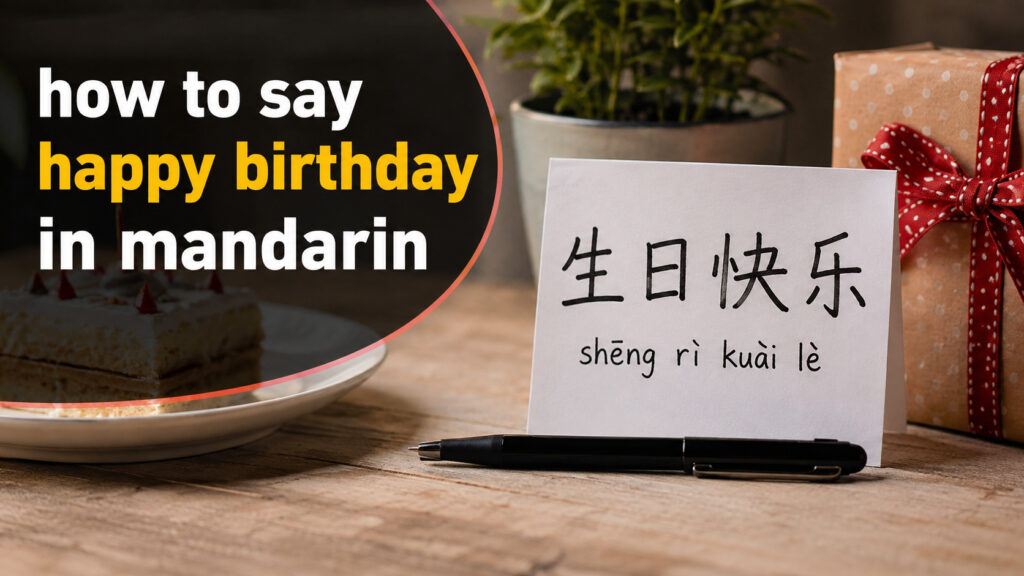
The standard way to say happy birthday in Mandarin is 生日快乐 (Shēngrì kuàilè). This phrase is made up of two parts. 生日 (shēngrì) means “birthday,” combining 生 (shēng, meaning “birth” or “life”) and 日 (rì, meaning “day”). 快乐 (kuàilè) means “happy” or “joyful.” Put together, the phrase literally translates to “birthday happy,” which in natural English becomes “happy birthday.”
This is the most widely used and universally understood birthday greeting across mainland China, Taiwan, Hong Kong, and Chinese-speaking communities around the world.
Pronunciation
Getting the pronunciation right will help your greeting sound natural rather than robotic. Here is a simple breakdown using pinyin, the standard system for writing Mandarin sounds with the Latin alphabet.
Shēngrì is pronounced “shuhng-rr,” with a rising then falling tone on the first syllable and a soft “r” sound on the second, similar to the “r” in the English word “burr” but softer.
Kuàilè is pronounced “kwai-luh.” The first syllable sounds like the English word “why” with a “k” in front, and the second syllable rhymes with “duh.”
When said together, it flows as “shuhng-rr kwai-luh.” Mandarin is a tonal language, so the pitch of your voice changes the meaning of a word. If you are just starting out, do not worry too much about perfecting every tone. Native speakers will still understand you, especially in a warm, celebratory context like a birthday wish.
Common Ways to Say It
While 生日快乐 (Shēngrì kuàilè) is the go to phrase, there are a few variations depending on the situation.
生日快乐 (Shēngrì kuàilè) is the standard and most common greeting, suitable for almost anyone.
祝你生日快乐 (Zhù nǐ shēngrì kuàilè) adds 祝 (zhù, meaning “to wish”) and 你 (nǐ, meaning “you”), making it “I wish you a happy birthday.” This version sounds slightly more heartfelt and is often used in cards or speeches.
生日快乐,万事如意 (Shēngrì kuàilè, wànshì rúyì) means “happy birthday, may everything go as you wish.” This is a common addition when people want to express extra good fortune along with the birthday wish.
Formal and Informal Usage
Mandarin greetings can shift slightly depending on how well you know the person. For close friends, classmates, or family members, a simple 生日快乐 (Shēngrì kuàilè) works perfectly and feels casual and friendly.
For someone older, a boss, or a person you respect, using 祝你生日快乐 (Zhù nǐ shēngrì kuàilè) adds a touch of politeness. If you want to be even more formal, you can say 祝您生日快乐 (Zhù nín shēngrì kuàilè), replacing 你 (nǐ) with 您 (nín), the respectful form of “you” often used with elders or in professional settings.
Unlike some languages, Mandarin does not require a completely different phrase for formal occasions, which makes it easier for beginners to sound appropriate in almost any setting.
Related Phrases
Learning a few related phrases can round out your birthday vocabulary and help you join in the celebration naturally.
生日蛋糕 (shēngrì dàngāo) means “birthday cake.”
许愿 (xǔyuàn) means “to make a wish,” often said before blowing out candles.
礼物 (lǐwù) means “gift” or “present.”
长命百岁 (chángmìng bǎisuì) is a traditional blessing meaning “may you live a long life of a hundred years,” often used for older relatives during birthday celebrations.
生日快乐歌 (shēngrì kuàilè gē) refers to the “Happy Birthday” song, which in China is often sung to the same melody as the English version, just with Mandarin lyrics.
Real-Life Examples with English Translations
明天是我妹妹的生日,我要跟她说生日快乐。 (Míngtiān shì wǒ mèimei de shēngrì, wǒ yào gēn tā shuō shēngrì kuàilè.) Tomorrow is my younger sister’s birthday, I want to tell her happy birthday.
祝你生日快乐,希望你今年过得开心。 (Zhù nǐ shēngrì kuàilè, xīwàng nǐ jīnnián guò de kāixīn.) Wishing you a happy birthday, I hope you have a joyful year.
爷爷,祝您生日快乐,长命百岁。 (Yéye, zhù nín shēngrì kuàilè, chángmìng bǎisuì.) Grandpa, happy birthday, may you live a long and healthy life.
这是给你的生日礼物,生日快乐! (Zhè shì gěi nǐ de shēngrì lǐwù, shēngrì kuàilè!) This is your birthday gift, happy birthday!
Common Mistakes
One common mistake beginners make is mispronouncing 快乐 (kuàilè) as “kwai-lee” instead of “kwai-luh.” Paying attention to the correct ending sound makes a noticeable difference.
Another mistake is forgetting the tones entirely, which can occasionally cause confusion, though context usually makes the meaning clear in a birthday setting.
Some learners also mix up 你 (nǐ) and 您 (nín) when trying to be formal. Remember that 您 (nín) is reserved for elders, teachers, or people you want to show extra respect toward, while 你 (nǐ) works fine for friends and peers.
Finally, avoid translating English birthday idioms word for word, such as “many happy returns,” since these do not carry the same meaning in Mandarin and can sound confusing to native speakers. Stick to the phrases covered above for a natural and accurate greeting.
Final Thoughts
Learning how to say happy birthday in Mandarin is a small step that can create a meaningful connection with Chinese speaking friends, family, or colleagues. With 生日快乐 (Shēngrì kuàilè) as your foundation, plus a few related phrases and an understanding of formal versus informal usage, you will be ready to celebrate any birthday with confidence. The next time someone close to you has a birthday, try using these phrases and watch how much a simple greeting in their language can mean.


