
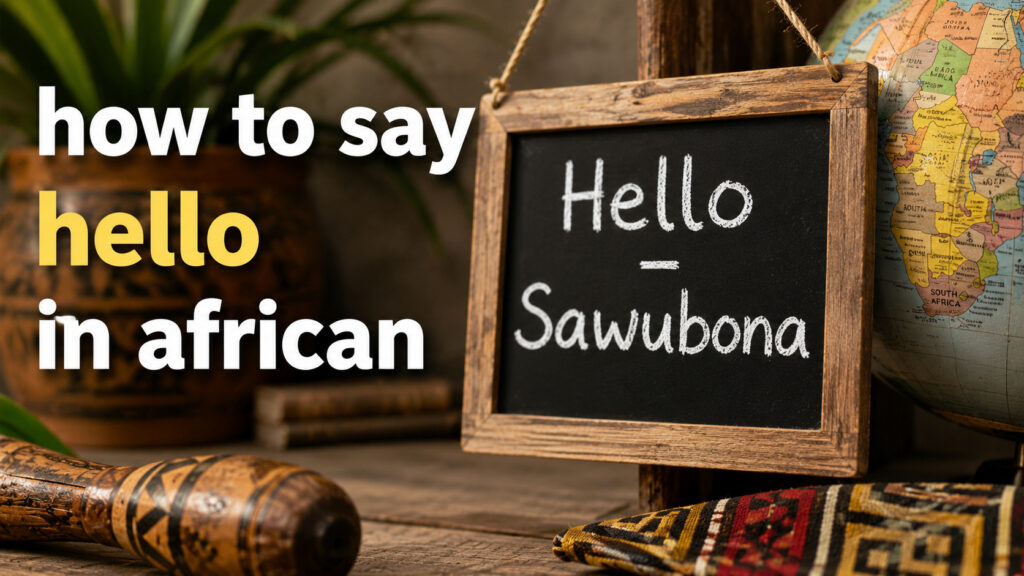
Ever wondered how many different ways there are to say hello across the African continent? With over 2,000 languages spoken in Africa, there is no single “African language,” but several widely spoken languages offer beautiful and meaningful greetings worth learning. If you are curious about how to say hello in African languages, this guide introduces some of the most common and widely understood greetings, along with their meaning, pronunciation, and everyday use.
Meaning and Translation
Since Africa is home to thousands of languages, greetings vary widely by region and culture. Some of the most widely spoken languages include Swahili, Zulu, Yoruba, and Amharic, each with its own unique way of saying hello. In Swahili, spoken across East Africa, “hello” is “Jambo” or the more traditional “Habari.” In Zulu, spoken in South Africa, hello is “Sawubona,” which literally translates to “I see you.” In Yoruba, spoken in Nigeria, hello is “Bawo ni.” In Amharic, spoken in Ethiopia, hello is “Selam.” Each greeting reflects the culture and values of its people.
Pronunciation
Pronunciation varies significantly across these languages, but here are some helpful breakdowns. “Jambo” is pronounced JAHM-boh, with equal emphasis on both syllables. “Sawubona” is pronounced sah-woo-BOH-nah, with the stress falling on the third syllable. “Bawo ni” is pronounced BAH-woh nee, with a gentle rise in tone typical of Yoruba, which is a tonal language where pitch can change meaning. “Selam” is pronounced SEH-lahm, with a soft emphasis on the first syllable. Since many African languages are tonal, listening to native speakers is especially helpful for mastering the correct pitch and rhythm.
Common Ways to Say It
Beyond the basic hello, many African languages offer several variations depending on the time of day or social context. In Swahili, “Habari za asubuhi” means “good morning,” while “Habari za jioni” means “good evening.” In Zulu, “Sawubona” is used for one person, while “Sanibonani” is used to greet a group. In Yoruba, “Bawo ni” is casual, while “Ẹ nlẹ” is a more formal or plural greeting. In Amharic, “Selam” works for most situations, though “Endemin walu” adds a more conversational touch, roughly meaning “how are you doing.”
Formal and Informal Usage
Formality plays an important role in many African greeting customs. In Zulu culture, “Sawubona” is respectful and appropriate in almost any setting, though addressing elders often comes with additional respectful phrases. In Yoruba culture, greetings often depend on age and status, with younger speakers expected to greet elders first and use more formal language, such as “Ẹ nlẹ” instead of the casual “Bawo ni.” In Swahili-speaking regions, “Habari” is generally polite and works well in both formal and informal settings, making it a safe choice for beginners. Learning these cultural nuances shows respect and helps you make a positive impression.
Related Phrases
Learning a few related phrases can help you continue a conversation after the initial greeting. In Swahili, “Asante” means “thank you,” and “Karibu” means “welcome.” In Zulu, “Ngiyabonga” means “thank you.” In Yoruba, “E se” means “thank you.” In Amharic, “Ameseginalehu” means “thank you.” Pairing a greeting with a simple thank you phrase can go a long way in showing appreciation and cultural awareness during your travels or conversations.
Real-Life Examples with English Translations
Seeing these greetings in context can help you understand how they are used naturally. Here are a few examples:
“Jambo, habari yako?” in Swahili translates to “Hello, how are you?” a common way to start a friendly conversation.
“Sawubona, unjani?” in Zulu means “Hello, how are you?” often used when meeting someone new.
“Bawo ni, se daadaa ni?” in Yoruba translates to “Hello, are you well?” a warm and respectful greeting.
Common Mistakes
One common mistake is assuming there is a single “African” language, when in reality the continent has thousands of distinct languages, each with its own greetings and cultural context. Another mistake is ignoring tone in tonal languages like Yoruba, where a slight change in pitch can alter the meaning of a word entirely. Learners also sometimes overlook the importance of formality and age-based respect in greetings, which can be an important part of the interaction in many African cultures. Taking time to learn the specific language relevant to the region you are engaging with will lead to more meaningful and respectful communication.
Final Thoughts
Learning how to say hello in African languages opens the door to a rich and diverse continent full of distinct cultures and traditions. Whether you choose to learn Swahili’s welcoming “Jambo,” Zulu’s meaningful “Sawubona,” Yoruba’s respectful “Bawo ni,” or Amharic’s simple “Selam,” taking the time to learn a specific language shows genuine respect and curiosity. With a little practice, these greetings can help you build real connections wherever your travels or conversations take you.


