
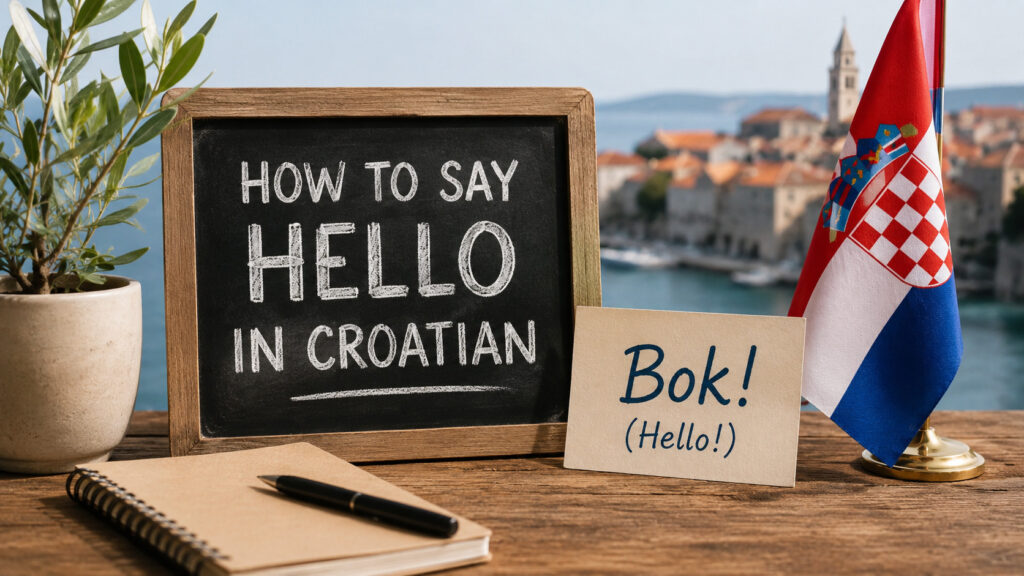
Ever wondered how a single word can open the door to a new culture? In Croatia, greetings are more than just a formality. They reflect warmth, respect, and regional pride along the Adriatic coast and beyond. If you are planning a trip to Croatia or simply want to learn how to say hello in Croatian, this guide covers everything from pronunciation to real-life examples so you can greet locals naturally and confidently.
Meaning and Translation
The most common way to say hello in Croatian is “Bok” (pronounced bohk). It is a short, friendly greeting used in almost every casual setting, similar to how English speakers use “hi.” Another widely used greeting is “Zdravo” (ZDRAH-voh), which also means hello and works well in both casual and semi-formal situations. Croatian, like many Slavic languages, offers multiple greetings depending on the time of day and the level of formality required.
Pronunciation
Croatian pronunciation is fairly consistent once you learn the basic sounds, since most letters are pronounced the way they are written. “Bok” is pronounced exactly as it looks, with a short, crisp “o” sound. “Zdravo” breaks down into three syllables: ZDRAH-voh, with the stress on the first syllable. For a more formal greeting, “Dobar dan” (DOH-bar dahn), meaning good day, has a clear rhythm with equal emphasis on each word. Practicing these greetings out loud will help you sound more natural when speaking with native speakers.
Common Ways to Say It
Beyond “Bok” and “Zdravo,” Croatians use time-specific greetings throughout the day. “Dobro jutro” (DOH-broh YOO-troh) means good morning and is used until around late morning. “Dobar dan” is the standard greeting for daytime hours and is one of the most versatile phrases you can learn. In the evening, Croatians often say “Dobra večer” (DOH-brah VEH-cher), meaning good evening. These variations show that Croatian greetings are closely tied to context and time, much like in English.
Formal and Informal Usage
Knowing when to use a formal or informal greeting is important in Croatian culture. “Bok” is strictly informal and best reserved for friends, peers, and people close to your own age. “Zdravo” sits in a more neutral zone and can be used with acquaintances or in casual business settings. For formal situations, such as meeting someone older, addressing a stranger, or speaking in a professional environment, “Dobar dan” is the safest and most respectful choice. Using an overly casual greeting in a formal setting can come across as impolite, so context matters.
Related Phrases
Once you have mastered the basic hello, a few related phrases can round out your greeting skills. “Kako si?” (KAH-koh see) means “How are you?” in an informal tone, while “Kako ste?” (KAH-koh steh) is the formal version. To say goodbye, Croatians commonly use “Doviđenja” (doh-vee-JEH-nyah) in formal settings or simply “Bok” again in casual ones, since it doubles as both hello and goodbye. Learning these phrases together with your greeting will make conversations flow more naturally.
Real-Life Examples with English Translations
Seeing these phrases used in context can make them easier to remember. Here are a few natural examples:
“Bok, kako si?” translates to “Hi, how are you?” and is perfect for greeting a friend on the street.
“Dobar dan, ja sam iz Amerike.” means “Good day, I am from America,” a polite way to introduce yourself to someone you have just met.
“Dobro jutro, lijep dan za šetnju.” translates to “Good morning, nice day for a walk,” a friendly way to start a conversation with a neighbor or shopkeeper in the morning.
Common Mistakes
Learners often mix up the formality levels, using “Bok” with someone who expects a more respectful greeting like “Dobar dan.” Another common mistake is forgetting that Croatian greetings change with the time of day, so using “Dobro jutro” in the afternoon can sound slightly off. Some learners also mispronounce “Zdravo” by rushing the first syllable, when it should be given equal emphasis with the rest of the word. Paying attention to these small details will help your Croatian sound more natural and polished.
Final Thoughts
Learning how to say hello in Croatian is a simple but powerful way to connect with locals and show genuine interest in the culture. Whether you choose the casual “Bok,” the neutral “Zdravo,” or the respectful “Dobar dan,” matching your greeting to the situation will help you communicate with confidence. With a little practice, these small phrases can make a lasting impression and open the door to warmer, more authentic conversations during your time in Croatia.


