
Ever noticed how the very first word you learn in a new language can shape your whole first impression? Armenian, one of the oldest languages in the world with its own unique alphabet, offers a few simple and warm ways to say hi. If you are learning how to say hi in Armenian, this guide covers the meaning, pronunciation, and everyday usage so you can greet people naturally and confidently.
Meaning and Translation
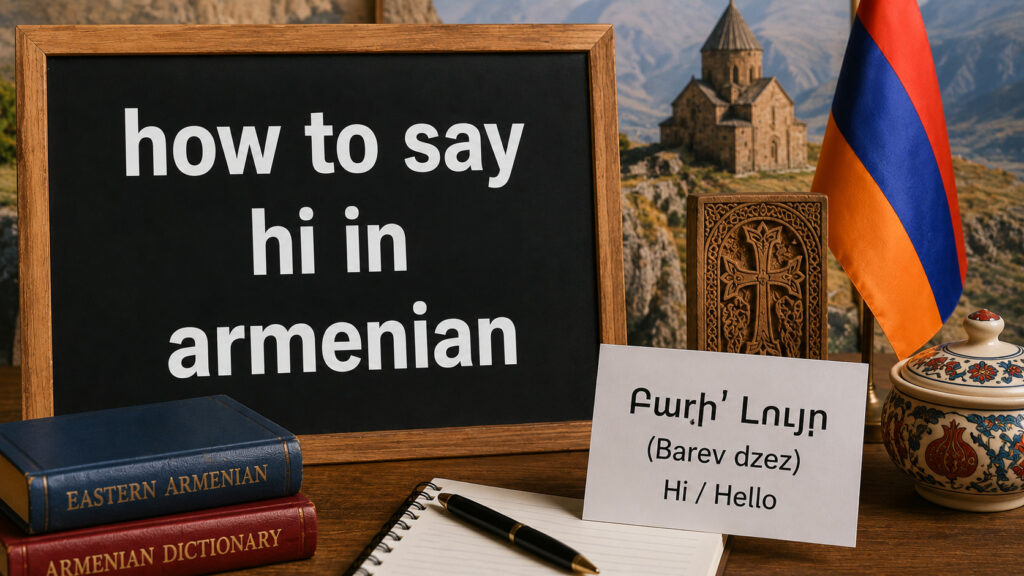
The most common informal way to say hi in Armenian is “Barev” (bah-REV). This is a friendly, everyday greeting used widely across Armenia and among Armenian communities worldwide. A slightly more formal version, “Barev Dzez” (bah-REV dzez), adds the formal “you” and is used when addressing someone with more respect. Both phrases stem from the root word “barev,” which conveys a general sense of greeting and goodwill.
Pronunciation
Pronouncing “Barev” correctly is straightforward once broken down. The word has two syllables: bah-REV, with the stress falling on the second syllable. The “r” is lightly rolled, similar to Spanish, but does not require the same emphasis as a fully trilled r. For “Barev Dzez,” the added word “Dzez” is pronounced dzez, with the “dz” sound blended together smoothly, similar to the “ds” in “kids.” Practicing slowly at first will help you get comfortable with the rhythm of Armenian pronunciation.
Common Ways to Say It
Beyond “Barev,” Armenian speakers use a few other common greetings depending on the setting. “Vonts es?” means “How are you?” and is often used right after saying hi to continue the conversation. “Barov” is a regional variation heard in some dialects, though “Barev” remains the most standard and widely recognized greeting. In Western Armenian, spoken by many diaspora communities, you may also hear “Parev,” which is essentially the same greeting with a slightly different regional pronunciation.
Formal and Informal Usage
Armenian, like many languages, distinguishes between formal and informal speech, and greetings are no exception. “Barev” alone is casual and appropriate for friends, peers, or people your own age. “Barev Dzez” is the respectful version, best used when speaking to elders, professionals, or anyone you are meeting for the first time in a formal setting. Using “Barev Dzez” shows cultural awareness and respect, which is highly valued in Armenian social interactions, especially with older generations.
Related Phrases
A few related phrases can help you build on your greeting and keep a conversation going. “Inch bes es?” is another way to ask “How are you?” in a casual tone. “Shnorhakalutyun” means “thank you,” a useful phrase to pair with any greeting. “Hajoghutyun” means “goodbye,” rounding out a simple exchange. Learning these phrases alongside “Barev” gives you the basic tools for a short, friendly interaction in Armenian.
Real-Life Examples with English Translations
Seeing these phrases in context can help you understand how they are used naturally. Here are a few examples:
“Barev, vonts es?” translates to “Hi, how are you?” a common way to greet a friend or acquaintance.
“Barev Dzez, shat urakh em Dzez tesnelov.” means “Hello, I am very happy to see you,” a respectful greeting often used in formal introductions.
“Barev, inch bes es? Amen inch lav a?” translates to “Hi, how are you? Is everything good?” a warm, casual way to check in with someone.
Common Mistakes
One common mistake learners make is using “Barev” in formal situations where “Barev Dzez” would be more appropriate, which can come across as overly casual. Another frequent error is mispronouncing the stress pattern, placing emphasis on the first syllable instead of the second, which can make the word sound less natural to native speakers. Learners also sometimes confuse Eastern and Western Armenian pronunciations, such as “Barev” versus “Parev,” so it helps to know which dialect community you are speaking with, since Armenian is spoken with regional variations both in Armenia and among diaspora communities worldwide.
Final Thoughts
Learning how to say hi in Armenian is a simple but meaningful way to connect with Armenian speakers and show appreciation for one of the world’s oldest living languages. Whether you use the casual “Barev” with friends or the respectful “Barev Dzez” in formal settings, understanding the context behind each greeting will help you communicate naturally. With a little practice, this small phrase can open the door to warmer conversations and a deeper connection to Armenian culture.


