
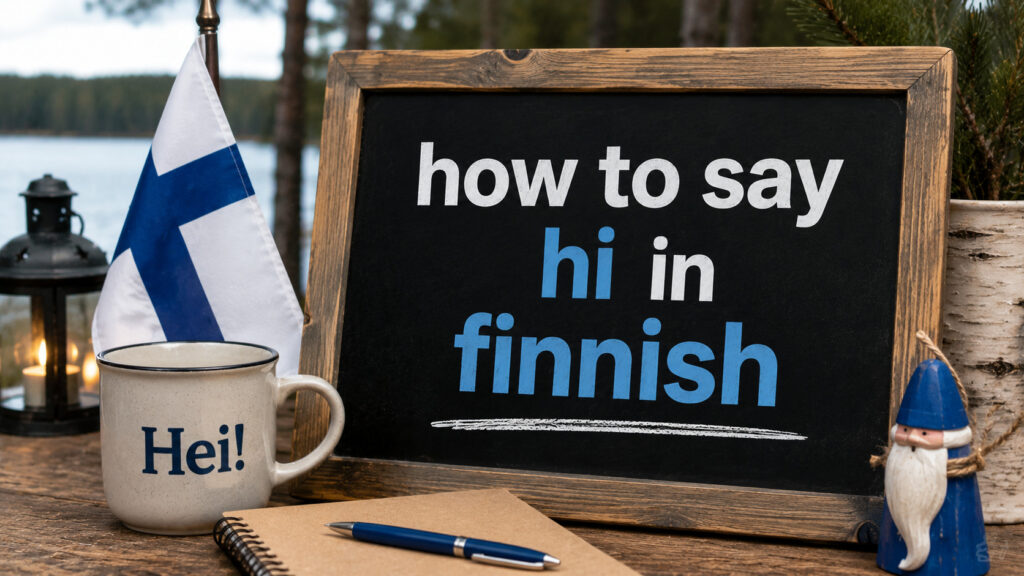
Ever wondered why Finnish, a language known for being one of the trickiest for English speakers to learn, actually has some of the easiest greetings to master? Finnish greetings are refreshingly short and straightforward compared to the rest of the language’s complex grammar. If you are learning how to say hi in Finnish, this guide covers the meaning, pronunciation, and everyday usage so you can greet people naturally and with confidence.
Meaning and Translation
The most common informal way to say hi in Finnish is “Moi” (moy). This short, friendly greeting is widely used across Finland in casual settings. Another popular casual greeting is “Hei” (hay), which functions almost identically to “Moi” and can be used interchangeably in most everyday situations. For a more traditional or formal greeting, Finns use “Hyvää päivää” (HYU-vaa PYE-vaa), which translates to “good day.”
Pronunciation
Finnish pronunciation is refreshingly consistent, since words are pronounced exactly as they are spelled, with no silent letters or unpredictable sounds. “Moi” is pronounced moy, rhyming with the English word “boy.” “Hei” is pronounced hay, rhyming with the English word “hay.” “Hyvää päivää” is broken into two words: HYU-vaa (with a slightly rounded “u” sound) and PYE-vaa, with double vowels held slightly longer than single ones, a distinctive feature of Finnish pronunciation.
Common Ways to Say It
Beyond the basic “Moi” and “Hei,” Finnish speakers have a few fun variations worth knowing. “Moi moi” doubles the casual greeting and is often used both as a hello and, confusingly to beginners, sometimes as a lighthearted goodbye among friends. “Terve” (TEHR-veh) is another common informal greeting, especially popular in central and eastern Finland. “Hyvää huomenta” means “good morning,” while “Hyvää iltaa” means “good evening,” both used to greet people at specific times of day.
Formal and Informal Usage
Finnish culture tends to be more relaxed about formality compared to many other European languages, and this shows in its greetings. “Moi,” “Hei,” and “Terve” are all considered informal but are widely accepted in most everyday situations, including with new acquaintances or in casual professional settings. “Hyvää päivää” is reserved for more formal contexts, such as greeting an elder, addressing a customer in a shop, or beginning a formal meeting. Finns generally appreciate directness and simplicity, so overusing formal language can sometimes feel unnecessary in daily interactions.
Related Phrases
A few related phrases can help you continue a conversation after your initial greeting. “Mitä kuuluu?” means “How are you?” and is a natural follow-up after saying hi. “Kiitos” means “thank you,” a simple and essential word in any interaction. “Näkemiin” means “goodbye” in a more formal sense, while “Moi moi” or simply “Hei hei” works as a casual farewell. These phrases round out a basic but functional Finnish greeting exchange.
Real-Life Examples with English Translations
Seeing these phrases in context can help you understand how they are used naturally. Here are a few examples:
“Moi, mitä kuuluu?” translates to “Hi, how are you?” a common way to greet a friend casually.
“Hyvää päivää, kiitos avusta.” means “Good day, thank you for your help,” a polite phrase suitable for a formal or customer service setting.
“Hei hei, nähdään huomenna!” translates to “Bye bye, see you tomorrow!” a friendly and casual way to end a conversation.
Common Mistakes
One common mistake learners make is assuming “Moi moi” always means hello, when in casual speech it is frequently used as a goodbye instead, which can create confusion. Another frequent error is not holding double vowels long enough, since Finnish vowel length can change the meaning of a word entirely, even though this distinction is less critical in simple greetings. Learners also sometimes overuse formal phrases like “Hyvää päivää” in casual settings, which can sound unnecessarily stiff to native speakers who tend to favor short, relaxed greetings in daily life.
Final Thoughts
Learning how to say hi in Finnish is a simple and rewarding first step into a language known for its complexity elsewhere. Whether you use the casual “Moi” or “Hei” with friends, or the more formal “Hyvää päivää” in professional settings, understanding the context behind each greeting will help you sound natural. With just a little practice, these short and friendly words can open the door to warmer conversations with Finnish speakers.


