
Have you ever searched for a romantic phrase in Celtic, only to discover that Celtic is not actually one single language at all? Many people are surprised to learn that Celtic refers to a family of related languages, including Irish, Scottish Gaelic, Welsh, and a few others, each with its own way of expressing love. If you are learning how to say I love you in Celtic, this guide will walk you through the meaning, pronunciation, common variations, and real conversational examples across the most widely spoken Celtic languages so you can express love accurately and meaningfully.
Meaning and Translation
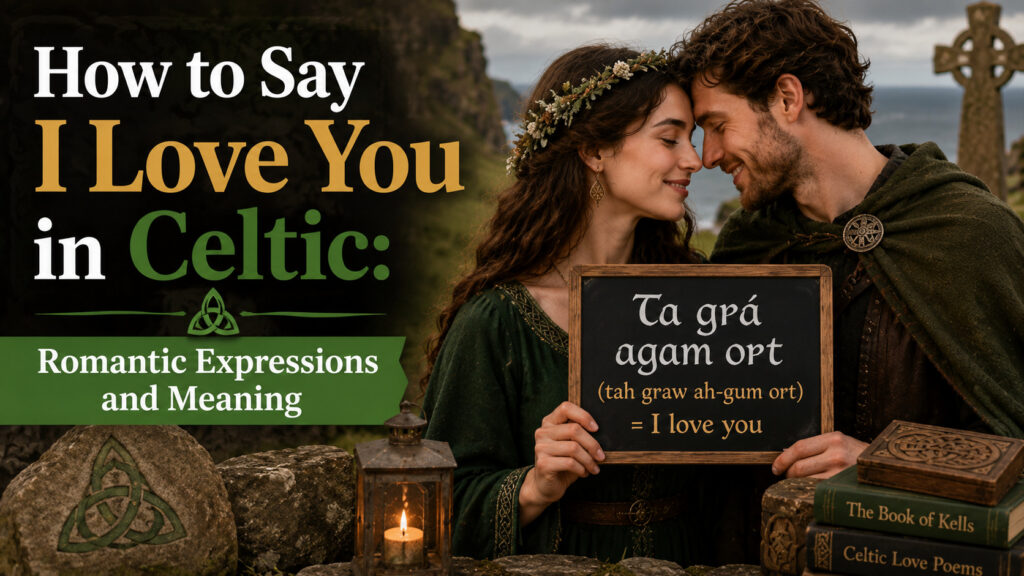
Since Celtic is a language family rather than a single language, the most commonly referenced expressions come from Irish and Scottish Gaelic, two of the most widely learned Celtic languages today. In Irish, I love you is expressed as tá grá agam duit, which translates literally to “love is at me for you,” reflecting how Irish uses possession-based grammar rather than a direct verb like English does. In Scottish Gaelic, the equivalent phrase is tha gaol agam ort, following a similar grammatical structure and meaning. In Welsh, another Celtic language, the phrase rwy’n dy garu di is used, which translates more directly to “I love you,” since Welsh grammar aligns more closely with English sentence structure in this case.
Pronunciation
Tá grá agam duit is pronounced “taw graw AH-gum ditch,” with a soft emphasis on grá, meaning love, and a gentle rolling flow through the rest of the phrase. Tha gaol agam ort is pronounced “ha guhl AH-gum orsht,” with the gaol sounding close to “guhl” rather than how it might appear in English spelling. Rwy’n dy garu di is pronounced “ROO-in duh GAH-ree dee,” with clear, even emphasis across each word. Since these languages use spelling systems quite different from English, listening to native speakers or audio resources is especially helpful for mastering accurate pronunciation.
Common Ways to Say It
Beyond the standard phrases, each Celtic language offers a few related expressions to express love and affection:
In Irish, mo ghrá means “my love,” often used as an affectionate term for a partner.
In Scottish Gaelic, mo ghaol also means “my love,” used in a similar affectionate way.
In Welsh, cariad means “love” or “darling,” commonly used both as a term of endearment and as a general word for love.
In Irish, is breá liom thú is a softer, less intense way to express fondness, closer to “I am fond of you” than the stronger tá grá agam duit.
These variations allow speakers to express different levels of affection, from casual fondness to deep romantic love, depending on the relationship and context.
Formal and Informal Usage
Celtic languages generally do not have strict formal versus informal grammatical structures for romantic expressions, since phrases like I love you are inherently personal and typically reserved for close relationships regardless of setting. However, softer expressions like mo ghrá in Irish or cariad in Welsh are often used more casually, functioning almost like a nickname between partners, close friends, or even family members.
The stronger, complete phrases such as tá grá agam duit or tha gaol agam ort are typically reserved for genuine romantic declarations rather than casual conversation, since they carry more weight and sincerity. Understanding this distinction helps ensure the phrase matches the emotional intent behind it, especially since these languages do not rely on formality levels the way some other language families do.
Related Phrases
Learning a few related expressions helps build a fuller vocabulary around love and affection in Celtic languages:
In Irish, mo chroí means “my heart,” often used as a term of endearment.
In Scottish Gaelic, mo chridhe also means “my heart,” used in a similarly affectionate way.
In Welsh, rwy’n dy garu di o hyd means “I still love you,” adding emphasis to an ongoing relationship.
In Irish, grá mo chroí means “love of my heart,” a poetic and deeply affectionate phrase.
These expressions are often used in poetry, music, and everyday romantic conversation across Celtic-speaking regions.
Real-Life Examples with English Translations
Seeing these phrases used in context helps make them easier to remember and apply meaningfully. Here are a few examples:
A: Tá grá agam duit, a stór. (I love you, my darling.) B: Tá grá agam duit freisin. (I love you too.)
A: Tha gaol agam ort, mo chridhe. (I love you, my heart.) B: Agus tha gaol agam ortsa cuideachd. (And I love you too.)
A: Rwy’n dy garu di, cariad. (I love you, darling.) B: Rwy’n dy garu di hefyd. (I love you too.)
Common Mistakes
Learners often make a few predictable mistakes when exploring these expressions. One common error is assuming there is a single Celtic language, when in fact Irish, Scottish Gaelic, Welsh, and other Celtic languages each have distinct grammar, spelling, and pronunciation. Another mistake is directly translating the English sentence structure, forgetting that Irish and Scottish Gaelic use possession-based phrasing rather than a direct verb like English does. Some learners also mispronounce key sounds by relying on English spelling patterns, which do not match the pronunciation rules of Celtic languages. Taking time to learn which specific Celtic language is being referenced is the most important step in using these expressions accurately.
Final Thoughts
Learning how to say I love you in Celtic involves understanding that Celtic represents a family of distinct languages rather than one single language. By exploring the meaning, pronunciation, and expressions from Irish, Scottish Gaelic, and Welsh, you gain a richer and more accurate way to express love. Practicing the phrases and examples covered in this guide will help you speak with genuine meaning, whether you are honoring Celtic heritage, learning the language for personal connection, or expressing love to someone special.


