
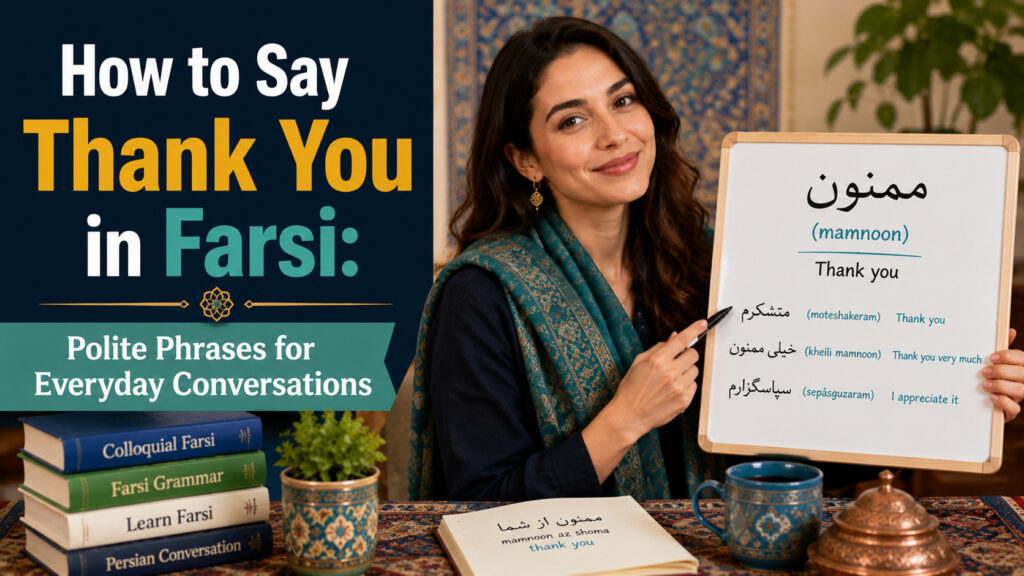
Have you ever noticed how a simple “thank you” can carry completely different weight depending on the language and culture behind it? In Farsi, also known as Persian, gratitude is woven deeply into daily conversation, and there is more than one way to express thanks depending on the situation and the level of politeness required. If you have been searching for how to say thank you in Farsi, this guide will walk you through the meaning, pronunciation, and natural usage so you can express gratitude the right way in any setting.
Meaning and Translation
The most common word for thank you in Farsi is merci, borrowed directly from French and widely used in everyday Persian conversation, especially among younger speakers and in casual settings. A more traditional Persian phrase is kheili mamnoon, meaning “thank you very much” or “much obliged.” For a more formal expression, tashakkor mikonam is used, which translates closely to “I thank you” and carries a more polished, respectful tone. Understanding these three options gives you a solid foundation, since Farsi speakers naturally shift between them depending on who they are speaking to.
Pronunciation
Getting the pronunciation right will help these phrases sound natural rather than forced. Merci is pronounced mer-SEE, closely following its French origin, with a light stress on the second syllable. Kheili mamnoon is pronounced khay-LEE mam-NOON, with the kh sound produced from the back of the throat, similar to the ch in the Scottish word “loch.” Tashakkor mikonam is pronounced tah-shah-KOR mee-koh-NAM, with a clear rhythm across each syllable. Practicing the throat-based kh sound is often the trickiest part for English speakers, so taking time to repeat it slowly will make a noticeable difference.
Common Ways to Say It
Farsi offers several everyday expressions for saying thank you, each suited to a different level of warmth or formality.
Merci is the simplest and most commonly used option, appropriate in nearly any casual conversation, from thanking a friend to acknowledging a small favor.
Kheili mamnoon means “thank you very much” and is used when you want to express a bit more appreciation than a simple merci.
Tashakkor mikonam is the more formal option, often used in professional settings, formal writing, or when speaking with someone you deeply respect.
Mamnoonam is a shorter, commonly used variation meaning “I am grateful,” striking a balance between casual and polite.
Dast-e shoma dard nakoneh is a warm, idiomatic phrase literally meaning “may your hand not hurt,” traditionally used to thank someone for their effort, such as after a home-cooked meal.
Formal and Informal Usage
Farsi places noticeable importance on politeness levels, and choosing the right phrase for the setting matters. In casual conversations with friends or family, merci or mamnoonam work perfectly and feel natural. In more formal settings, such as speaking with an elder, a business contact, or someone in a position of authority, kheili mamnoon or tashakkor mikonam are more appropriate, since they convey a higher degree of respect. Persian culture also has a social custom known as taarof, a form of polite exchange where compliments and gratitude are sometimes offered even more elaborately than necessary, so hearing longer, more decorative expressions of thanks in formal settings is common and expected.
Related Phrases
Beyond the core expressions for thank you, several related phrases often come up in polite Farsi conversation.
Khahesh mikonam means “you’re welcome,” the natural response to any expression of thanks.
Lotf kardid means “you were kind” or “that was kind of you,” often said alongside thanks for a favor.
Ghorboonet beram is an affectionate, informal expression showing deep appreciation, though it is reserved for close friends or family due to its intimate tone.
Bebakhshid means “excuse me” or “I am sorry,” a useful phrase often paired with gratitude when asking for help.
Khoda negahdar means “goodbye,” commonly used to close a conversation after expressing thanks.
Real-Life Examples with English Translations
Seeing these phrases used in context helps make them easier to remember and apply naturally.
“Merci, kheili lotf kardid.” translates to “Thank you, that was very kind of you.”
“Kheili mamnoon baraye komaketoon.” translates to “Thank you very much for your help.”
“Tashakkor mikonam az waqti ke gozashtid.” translates to “I thank you for the time you gave.”
“Mamnoonam, in hadiyeh kheili ziba bood.” translates to “Thank you, this gift was very beautiful.”
“Dast-e shoma dard nakoneh, ghazaa khoshmazeh bood.” translates to “Thank you for your effort, the food was delicious.”
Common Mistakes
One common mistake English speakers make is relying only on merci in every situation, since while it is widely used and understood, sticking exclusively to it can miss the more respectful tone that kheili mamnoon or tashakkor mikonam convey in formal settings. Another mistake is mispronouncing the kh sound as a simple h or k, which changes the word noticeably and can make it harder for native speakers to understand clearly. Learners also sometimes forget the cultural layer of taarof, not realizing that a Farsi speaker’s elaborate offer or refusal after being thanked is often a polite social custom rather than a literal statement. Finally, using overly intimate phrases like ghorboonet beram with someone you have just met can come across as too familiar, so matching the phrase to the relationship is important.
Final Thoughts
Learning how to say thank you in Farsi opens the door to warmer, more culturally aware conversations, whether you are traveling, building relationships, or simply showing appreciation to a Farsi-speaking friend. From the simple merci to the more heartfelt kheili mamnoon and tashakkor mikonam, choosing the right phrase for the moment reflects both language skill and cultural respect. With a little practice on pronunciation and context, expressing gratitude in Farsi will soon feel natural and genuine.


