
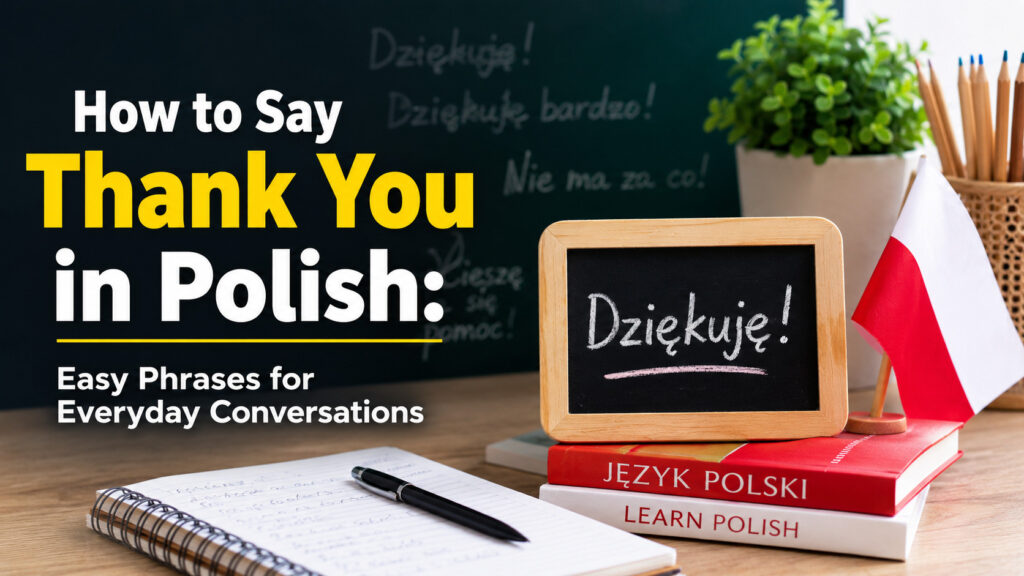
Ever wondered how a single word can open doors in a foreign country? In Poland, that word is often “dziękuję,” and learning to say it correctly can turn a simple interaction into a warm connection. Whether you are planning a trip to Kraków, working with Polish colleagues, or simply curious about Slavic languages, knowing how to say thank you in Polish is one of the most useful phrases you can add to your vocabulary. This guide breaks it down step by step so you can start using it with confidence today.
Meaning and Translation of Thank You in Polish
The standard way to say thank you in Polish is “dziękuję” (pronounced roughly as “jen-KOO-yeh”). It comes from the verb “dziękować,” which means “to thank.” Literally, dziękuję translates to “I thank,” similar to how “gracias” works in Spanish or “merci” in French. It is a single word that carries the full weight of gratitude, making it easy to remember once you get comfortable with the pronunciation.
Polish, like other Slavic languages, relies on verb conjugation rather than separate words for different subjects. This means dziękuję already implies “I” as the subject, so you do not need to add anything else to make a complete thought.
Pronunciation of Dziękuję
Polish pronunciation can look intimidating at first because of the diacritical marks, but it becomes manageable once broken into syllables. Here is a simple breakdown:
- dzię: sounds like “jen” with a nasal touch on the “ę”
- ku: sounds like “koo”
- ję: sounds like “yeh,” again with a slight nasal quality
Put together, it sounds close to “jen-koo-yeh.” The nasal vowels (ę and ą) are unique to Polish and take practice, but native speakers will still understand you even if your accent is not perfect. Listening to native speakers through language apps or short videos is one of the fastest ways to train your ear for these sounds.
Common Ways to Say Thank You in Polish
While dziękuję is the most common and versatile option, Polish offers several variations depending on context and emphasis:
- Dziękuję – Thank you (standard, all-purpose)
- Dziękuję bardzo – Thank you very much
- Dzięki – Thanks (casual, shortened version)
- Wielkie dzięki – Big thanks (informal, enthusiastic)
- Serdecznie dziękuję – I thank you sincerely (heartfelt, more formal)
These variations let you match your tone to the situation, whether you are chatting with a friend or thanking someone in a professional setting.
Formal and Informal Usage
Like many European languages, Polish distinguishes between formal and informal speech, and this affects how you express thanks.
In formal situations, such as speaking with elders, professionals, or strangers, dziękuję or dziękuję bardzo are always safe choices. You might also hear dziękuję panu (thank you, sir) or dziękuję pani (thank you, ma’am) when addressing someone respectfully by title.
In informal situations, such as with friends or family, dzięki is the go-to phrase. It is the Polish equivalent of a quick “thanks” in English and is used constantly in daily conversation. Using dzięki with someone you have just met, however, might come across as too casual, so it is best reserved for people you already know well.
Related Phrases for Everyday Conversations
Beyond a basic thank you, having a few related expressions ready will make your conversations flow more naturally:
- Proszę – You’re welcome, or please
- Nie ma za co – No problem, or it was nothing
- Dziękuję za pomoc – Thank you for the help
- Dziękuję za wszystko – Thank you for everything
- Bardzo miło z twojej strony – That’s very kind of you
Learning these alongside dziękuję gives you a small toolkit for polite exchanges, whether you are receiving directions, a gift, or a favor.
Real-Life Examples with English Translations
Seeing these phrases in context makes them easier to remember. Here are a few everyday examples:
- “Dziękuję za pomoc z bagażem.” – “Thank you for the help with the luggage.”
- “Dzięki, że przyszedłeś.” – “Thanks for coming.”
- “Serdecznie dziękuję za zaproszenie.” – “I sincerely thank you for the invitation.”
- “Dziękuję bardzo, to bardzo miłe.” – “Thank you very much, that’s very kind.”
- “Nie, dziękuję.” – “No, thank you.”
Notice how the phrase changes slightly depending on who is speaking and what is being thanked. Practicing these short sentences out loud can help the pronunciation and rhythm feel more natural over time.
Common Mistakes When Saying Thank You in Polish
Even simple phrases can trip up new learners. Here are a few mistakes to watch for:
Mispronouncing the nasal vowels: Skipping the nasal sound in “ę” can make dziękuję harder to understand. Take time to practice this sound separately.
Using dzięki in formal settings: This casual version can seem disrespectful with someone you do not know well, such as a business contact or an older person.
Forgetting proszę as a response: Many learners say dziękuję correctly but forget how to respond when someone thanks them. Proszę covers both “please” and “you’re welcome,” depending on context.
Overusing bardzo unnecessarily: While dziękuję bardzo is common, adding bardzo to every phrase can sound repetitive. Save it for moments that call for extra emphasis.
Final Thoughts
Learning how to say thank you in Polish is a small step that makes a big difference when connecting with Polish speakers. Starting with dziękuję and building up to variations like dzięki, dziękuję bardzo, and serdecznie dziękuję gives you the flexibility to express gratitude in almost any situation. With a little practice on pronunciation and an understanding of formal versus informal use, you will be able to use this phrase naturally and confidently in everyday conversations.


