
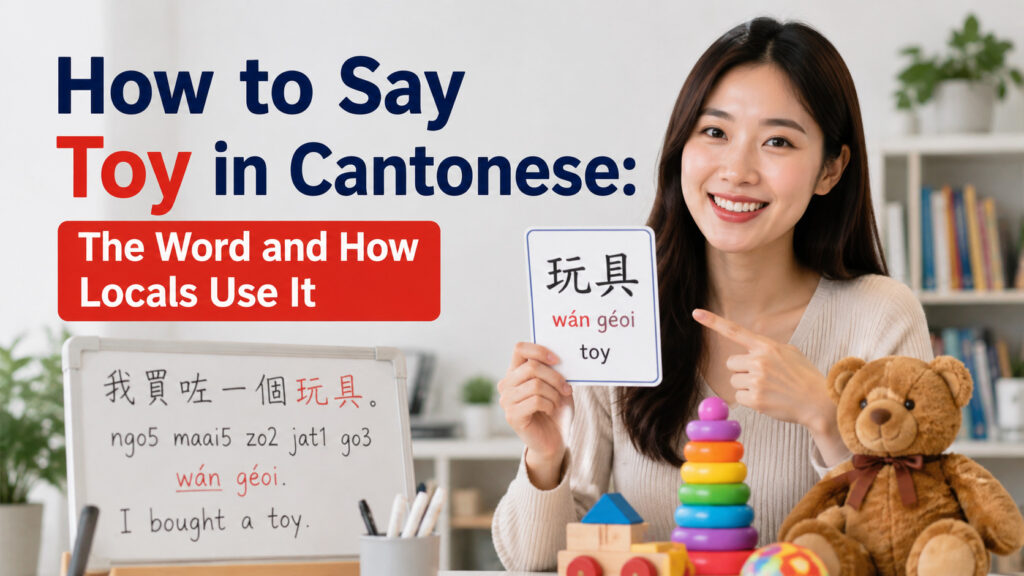
Ever tried to shop for a birthday present in Hong Kong and realized you had no idea how to ask a shopkeeper where the toy section was? Cantonese is full of small, everyday words that rarely make it into textbooks, and “toy” is one of them. If you’re learning Cantonese for travel, for family, or simply out of curiosity, knowing how to say toy in Cantonese is a useful, practical building block. This guide breaks down the word, its pronunciation, and how it actually gets used in daily conversation.
Meaning and Translation
The standard word for “toy” in Cantonese is 玩具 (wun6 geoi6). It’s a two-character compound word shared with Mandarin, though the pronunciation is completely different in Cantonese. The first character, 玩 (waan2/wun6), relates to “play” or “fun,” and the second, 具 (geoi6), means “tool” or “implement.” Put together, they literally translate to something like “plaything” or “instrument for play,” which is exactly what a toy is. This word covers toys in the general sense, from a child’s stuffed animal to a plastic action figure or a board game piece.
Pronunciation
Getting the pronunciation right matters more in Cantonese than in many other languages, since it’s a tonal language with six distinct tones. Here’s how to say toy in Cantonese, broken down:
- 玩 is pronounced “wun” with a low, falling-rising tone (tone 6)
- 具 is pronounced “geoi” also with tone 6, roughly like “guy” said with rounded lips
Together, it sounds close to “wun-geui,” with both syllables spoken in a low, level tone. If you’re using Jyutping, the standard romanization system for Cantonese, it’s written as wun6 geoi6. Listening to native speakers or audio clips is genuinely the fastest way to nail this, since tone differences can be subtle to an untrained ear.
Common Ways to Say It
Beyond the general word 玩具, there are related and more casual expressions worth knowing:
- 玩具 (wun6 geoi6) — the standard, all-purpose word for toy
- 玩意 (waan2 ji3) — a more colloquial term that can mean “gadget,” “plaything,” or “thing to fiddle with,” often used more loosely than 玩具
- 公仔 (gung1 zai2) — specifically refers to a doll or figurine, a very common word parents use with young kids
Knowing these variations helps you sound more natural, since locals don’t always default to the textbook term.
Formal and Informal Usage
玩具 works in nearly every context, from a formal store sign to a casual chat with a toddler, which makes it a safe default. You’ll see it printed on packaging, store directories, and children’s product labels without sounding stiff or overly technical.
In more casual, affectionate speech, especially between parents and young children, 玩意 or specific words like 公仔 (doll) tend to come up more naturally. For instance, a parent might point at a stuffed bear and say 公仔 rather than the broader 玩具. This is similar to how English speakers might say “stuffed animal” instead of the general word “toy” when the context is clear.
Related Phrases
A few useful phrases build directly on 玩具:
- 玩具店 (wun6 geoi6 dim3) — toy store
- 玩具反斗城 (wun6 geoi6 faan2 dau2 sing4) — the Cantonese name commonly used for Toys “R” Us
- 玩具車 (wun6 geoi6 ce1) — toy car
- 電子玩具 (din6 zi2 wun6 geoi6) — electronic toy
Learning these compound phrases is a great next step once the base word feels comfortable, since Cantonese frequently builds vocabulary by combining familiar characters.
Real-Life Examples with English Translations
Here are a few natural sentences using the word in context:
- 呢個玩具幾好玩。 (ni1 go3 wun6 geoi6 gei2 hou2 waan2.) — “This toy is quite fun to play with.”
- 佢鍾意玩具車。 (keoi5 zung1 ji3 wun6 geoi6 ce1.) — “He/she likes toy cars.”
- 附近有冇玩具店? (fu6 gan6 jau5 mou5 wun6 geoi6 dim3?) — “Is there a toy store nearby?”
- 呢個係佢最鍾意嘅玩具。 (ni1 go3 hai6 keoi5 zeoi3 zung1 ji3 ge3 wun6 geoi6.) — “This is his/her favorite toy.”
Practicing full sentences like these helps the word stick far better than memorizing it in isolation.
Common Mistakes
- Mixing up tones between 玩具 (wun6 geoi6) and similar-sounding syllables changes the meaning entirely, since Cantonese tones are meaning-bearing, not optional inflection.
- Assuming Mandarin pinyin pronunciation applies here. Even though the characters 玩具 are identical to Mandarin, the sounds are unrelated, so relying on Mandarin pronunciation will lead to confusion.
- Overusing 玩具 when a more specific word like 公仔 (doll) or 玩具車 (toy car) would sound more natural in context.
- Forgetting that 具 is pronounced with rounded lips, closer to “geui” than a flat “gay” sound, which is a common beginner slip.
Slowing down and practicing with audio resources helps iron out these small but important errors.
Final Thoughts
Learning how to say toy in Cantonese is a small step, but it opens the door to shopping, chatting with kids, and understanding everyday signage across Hong Kong and other Cantonese-speaking regions. With 玩具 as your core word, and 玩意 and 公仔 as useful companions, you’re well equipped to talk about toys naturally and confidently. As with most Cantonese vocabulary, consistent listening and speaking practice will do more for your pronunciation than any written guide alone.


